Getting Google AdSense approval can be frustrating when a website has useful articles but the application still gets rejected. Many new publishers assume that approval depends on a certain number of posts, a specific word count, website age, or a particular amount of traffic.

In reality, there is no single shortcut that guarantees approval.
Google evaluates whether a website is suitable for its advertising program, including the quality and originality of its content, the overall website experience, navigation, and compliance with applicable AdSense and publisher policies. That means preparing the entire website properly is more important than trying to meet an arbitrary checklist.
If you are planning to apply for Google AdSense in 2027, the following practices can help you prepare a stronger website before submitting your application.
What Does Google AdSense Approval Actually Mean?
Google AdSense allows website owners and publishers to display advertisements and potentially earn revenue when users interact with those ads according to Google’s rules.
Before advertisements can be served, Google may review the website associated with an AdSense account. The review is not simply a test of how many articles have been published. Your website should provide genuine value to visitors and should not contain content or practices that violate Google’s policies.
A website that looks unfinished, contains copied material, has confusing navigation, or provides little original value can create problems during the review process.
The goal, therefore, should not be to make a website that merely looks ready for AdSense. The goal should be to build a website that is genuinely useful to its audience.
My Personal AdSense Experience
I also experienced how difficult AdSense approval can be. My website was rejected three times, and one of the major reasons given was “Low Value Content.” But I did not give up. Instead of abandoning the website, I continued improving the content, adding more useful information, and working on the overall quality of the website.
Eventually, my efforts paid off, and my AdSense application was approved. Today, I am an AdSense publisher, and my experience taught me an important lesson: rejection does not always mean you should stop—it can show you what needs to be improved.
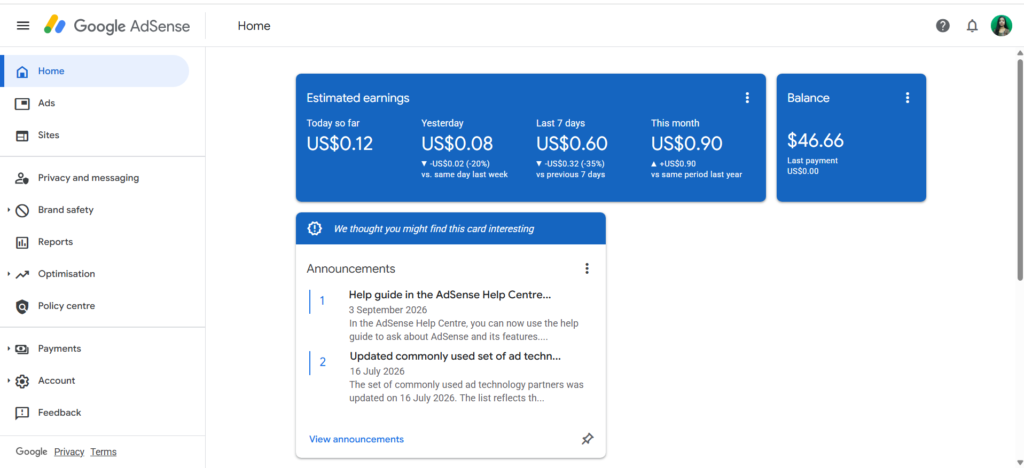
I have kept a screenshot of my AdSense approval/publisher status as proof of this journey. You can see it below.
10 Proven Ways to Improve Your Chances of AdSense Approval in 2027
1. Publish Original and Helpful Content
Content is one of the most important parts of a website prepared for AdSense.
Publishing a large number of pages does not automatically make a website valuable. Each page should have a clear purpose and should provide information that is useful to the person who searched for it.
Strong content should:
- Answer the main question clearly
- Provide useful details instead of generic statements
- Add original explanations, examples, comparisons, or experience where appropriate
- Be written for people rather than only for search engines
- Avoid unnecessary repetition
- Be factually responsible and regularly reviewed when information can change
If you are writing about a product, service, platform, law, technology, or online earning method, explain the subject in enough detail to help the reader make an informed decision.
For example, an article about AdSense approval should not simply repeat common claims such as “publish 20 articles” or “wait six months.” It should explain what actually matters, distinguish official requirements from commonly repeated advice, and help readers understand how to prepare their websites.
Originality also means adding something meaningful to the topic. Simply rewriting information that already exists on dozens of websites may not create a strong resource.
2. Don’t Chase a Fixed Word Count
One of the most common AdSense myths is that every website needs articles containing a particular number of words.
There is no universal rule that every article must contain 800, 1,000, or 2,000 words before a website can qualify for AdSense.
The better approach is to give the topic the amount of coverage it genuinely requires.
A simple question may need a short answer. A complicated topic may require several thousand words because readers need explanations, examples, steps, limitations, and frequently asked questions.
Instead of asking:
“How many words do I need for AdSense?”
ask:
“Does this page completely satisfy the user’s reason for visiting it?”
Read Also:- Google AdSense Low Value Content Error: Why You Got Rejected & How to Fix It
That shift can improve both content quality and the overall usefulness of the website.
Avoid adding paragraphs simply to increase word count. Search engines and readers can both benefit more from concise, meaningful information than from repetitive text.
3. Build a Clear Website Structure and Navigation
A website should be easy for visitors to understand from the moment they arrive.
Users should be able to identify what the website is about, find important sections, move between related pages, and return to the main areas without confusion.
A clean structure can include:
- A logical main menu
- Clearly defined categories
- Descriptive page titles
- Relevant internal links
- A visible homepage
- Easy access to important information
- A working search function where appropriate
- A footer containing useful site links
Internal linking is particularly useful when it helps readers discover related information.
For example, an article about Google Ads can naturally link to another detailed guide about creating a Google Ads campaign. The link should exist because it helps the reader, not simply because the website needs more internal links.
Also check your website for broken navigation, missing pages, redirect problems, and links that lead to irrelevant destinations.
4. Create Important Trust and Information Pages
Before applying for AdSense, make sure visitors can understand who operates the website and how they can contact you.
Depending on the type of website, useful pages may include:
About Us
Explain what the website is about, who operates it, and what kind of information or services it provides.
Contact Us
Give visitors a practical way to contact the website owner or organization.
Privacy Policy
Explain how the website handles information and data collected from visitors.
Terms and Conditions
This can help clearly establish the rules governing the use of your website, particularly for business, service, or commercial websites.
Disclaimer
A disclaimer can be useful where the website publishes opinions, educational information, financial information, reviews, or other content where appropriate.
These pages should not be created merely as empty placeholders. They should contain information relevant to the actual website and its operations.
5. Make Your Website Mobile-Friendly and Easy to Use
A visitor should be able to read your content comfortably regardless of whether they access the website from a phone, tablet, or desktop computer.
Before submitting an AdSense application, test your website on different screen sizes.
Look for problems such as:
- Text that is difficult to read
- Buttons that are too small
- Content extending beyond the screen
- Overlapping elements
- Menus that do not work properly
- Images that load incorrectly
- Excessive pop-ups
- Slow or frustrating page experiences
Good design does not mean adding complicated animations or visual effects.
Read Also:- How to Protect Your Google AdSense Account from Invalid Traffic (Complete Guide)
In many cases, a simple layout with readable typography, clear spacing, logical navigation, and well-organized content provides a better experience.
The website should make it easy for visitors to consume the information they came to find.
6. Use Original or Properly Licensed Images
Images can make an article easier to understand, but using an image from Google Images does not automatically give you permission to publish it.
Before using an image, make sure you have the appropriate rights to use it.
Safer options can include:
- Images created by your team
- Your own photographs
- Properly licensed stock images
- Images available under licenses that permit your intended use
Always check the specific license rather than assuming that an image is free because it appears on a website offering free images.
For important articles, original screenshots, diagrams, illustrations, or photographs can also make the content more useful when they genuinely support the subject.
Do not add unrelated stock images simply to make an article appear longer.
7. Follow Google AdSense and Publisher Policies
Policy compliance is essential.
Before applying, review the current Google AdSense and publisher policies that apply to your website and its content.
Pay particular attention to areas such as:
- Prohibited or restricted content
- Copyright violations
- Misleading information
- Invalid advertising activity
- Manipulative traffic practices
- Content that violates Google’s publisher requirements
Do not assume that a page is acceptable simply because another website publishes similar material.
Policies can change, and the rules that apply to a website can depend on the type of content and advertising activity involved. Checking Google’s current documentation before applying is therefore safer than relying on old blog posts or forum comments.
8. Avoid Thin, Duplicate, and Low-Value Pages
A website can have many indexed URLs and still provide little useful information.
Thin pages may contain very little meaningful information, while duplicate pages may repeat substantially the same material without providing a clear reason for existing separately.
Common problems include:
- Copying articles from other websites
- Publishing lightly rewritten versions of existing content
- Creating multiple pages targeting almost the same query without adding value
- Automatically producing large numbers of low-value pages
- Creating pages mainly to attract search traffic without helping visitors
If your website contains several pages covering nearly identical topics, review whether each page has a distinct purpose.
A smaller collection of genuinely useful pages can be stronger than a large collection of repetitive pages.
9. Make Sure the Website Is Ready Before Applying
Submitting an application before the website is properly prepared can create unnecessary problems.
Before applying, open the website as if you were a first-time visitor.
Read Also:- Why Google AdSense Gets Disabled: 10 Common Reasons and How to Protect Your Account
Check whether:
- The homepage clearly explains the website
- Important pages are accessible
- Articles open correctly
- Navigation works
- Internal links lead to relevant pages
- Images display correctly
- The website works on mobile devices
- There are no obvious unfinished sections
- Content is readable
- Policies and important information are easy to find
Also check whether your website contains pages that are incomplete, placeholder text, empty categories, test pages, or unnecessary URLs.
Your website should look like an established resource rather than a project that is still being assembled.
10. Perform a Complete Website Check Before Submitting
A final audit can help you discover problems that are easy to miss while publishing individual articles.
Go through the website page by page and check four major areas.
Content
Ask:
- Is the information useful?
- Is it original?
- Does each page have a clear purpose?
- Are outdated claims still accurate?
- Is unnecessary repetition removed?
User Experience
Ask:
- Can visitors easily navigate the website?
- Is the content readable?
- Does the site work properly on mobile?
- Are important pages easy to locate?
Technical Quality
Check:
- HTTPS
- Working URLs
- Broken links
- Mobile usability
- Page loading problems
- Incorrect redirects
- Missing or broken images
Policy Compliance
Review your content and website practices against the latest Google policies before submitting your application.
This final check is often more useful than simply counting articles or calculating the total number of words on your website.
AdSense Approval: Common Claims vs What You Should Actually Know
A lot of AdSense advice on the internet is presented as if Google has published a fixed checklist. Many of these claims are actually recommendations shared by bloggers rather than universal Google requirements.
| Common Claim | What You Should Know |
|---|---|
| You need exactly 20–25 posts | Google does not publish a universal minimum post count for every website |
| Every article needs 800–1000 words | There is no universal AdSense word-count requirement |
| Your domain must be 3–6 months old | Do not treat a specific domain age as a universal approval requirement |
| You need a large amount of traffic | Do not assume a specific traffic number guarantees approval |
| More articles always mean a better chance | Quality and usefulness matter more than publishing pages simply to increase the count |
| Every website needs the same pages | Required or useful pages can depend on the website and its activities |
| Following SEO tricks guarantees approval | SEO and AdSense approval are related to website quality in different ways; rankings do not guarantee AdSense approval |
The safest approach is to separate official Google requirements and policies from advice based on individual experiences.
Read Also:- The Real Formula for Google AdSense Approval (Tested & Honest Guide)
Build the Website for Users, Not Just for AdSense
One of the biggest mistakes new publishers make is creating a website primarily around the approval process.
They publish a few articles, add several pages, install technical elements, and immediately apply without asking whether the website is actually useful.
A better strategy is to reverse that process.
Build a website that:
Solves problems → provides original information → creates a good user experience → follows Google’s policies → and is then submitted for AdSense review.
That approach is more sustainable because the website is being built as a real information resource rather than as a temporary project created only to display advertisements.
How Many Blog Posts Do You Need for AdSense Approval in 2027?
There is no universal number of blog posts that guarantees Google AdSense approval.
You may see recommendations online suggesting that a website needs 10, 20, 25, 30, or even 50 articles before applying. These numbers should not be treated as official AdSense requirements unless Google specifically states them.
What matters more is whether your website has enough useful content for visitors and whether the site is properly developed around its intended topic.
For example, a website with 15 detailed and genuinely useful articles may provide more value than a website containing 50 short pages created only to increase the page count.
Before applying, review your website as a complete resource rather than focusing on an arbitrary article target.
Ask yourself:
- Does the website have enough useful information for its target audience?
- Are the main topics properly covered?
- Does every article provide something valuable?
- Are there unnecessary or repetitive pages?
- Can visitors easily find related information?
If the answer is yes, the overall website may be much better prepared than one that simply meets a self-imposed article count.
Does Domain Age Matter for AdSense Approval?
A common claim is that a website must be several months old before it can receive AdSense approval.
However, you should not treat a specific domain-age period such as three or six months as a universal AdSense requirement.
A website’s age alone does not make its content useful, original, or policy-compliant.
Instead of waiting for an arbitrary number of months, focus on building the website properly.
A newer website can still work on:
- Publishing useful content
- Creating a clear structure
- Providing accurate information
- Building important website pages
- Improving navigation
- Maintaining a good user experience
- Following Google’s policies
Domain history can be relevant in certain situations, but it should not be presented as a guaranteed formula for AdSense approval.
How Much Traffic Do You Need for AdSense Approval?
Another common question is whether a website needs thousands of visitors before applying.
There is no universal traffic number that guarantees AdSense approval.
Traffic and AdSense approval are two different things.
A website can have substantial traffic and still have problems with content quality or policy compliance. Likewise, a relatively new website may not have large traffic numbers while it is still building its audience.
The more important question is whether the website provides legitimate value and follows the applicable requirements.
Do not try to manufacture traffic simply to make your AdSense application look stronger.
Avoid practices that can generate invalid or artificial advertising activity. Traffic should come from legitimate sources and should represent genuine users.
Also remember that AdSense approval does not automatically mean high earnings.
Approval gives you the opportunity to monetize eligible content through AdSense. Your eventual revenue can depend on factors such as traffic volume, audience location, content topic, advertiser demand, ad placement, and user behavior.
Why Does Google AdSense Reject Websites?
Read Also:- AdSense Policy Violation Errors Explained: How to Avoid Getting Banned
An AdSense rejection does not necessarily mean that your entire website is worthless.
It means that something about the website or its current setup may not satisfy the requirements or expectations applicable to the AdSense program.
Some common areas that can cause problems include content quality, policy compliance, website structure, navigation, and the overall readiness of the site.
Insufficient or Low-Value Content
If pages provide very little useful information, visitors may have little reason to stay on the website.
A page should have a clear purpose and should provide meaningful information instead of filling space with generic statements.
Duplicate or Reused Content
Copying material from another website or publishing content that adds little original value can weaken the quality of your site.
If you use information from external sources, add your own useful explanation, analysis, examples, or experience where appropriate and ensure that the resulting content complies with copyright and other applicable policies.
Policy Violations
AdSense publishers must follow Google’s applicable policies.
Content or website practices that violate those policies can create serious problems, regardless of how many articles the website contains.
Always check the latest official policy documentation instead of relying on old approval tips published elsewhere.
Poor Website Navigation
Visitors should be able to move through your website without getting lost.
If menus, links, categories, or important pages are difficult to use, improve the structure before applying.
An Unfinished Website
A website containing placeholder text, empty sections, incomplete pages, broken links, or obvious development elements can look unfinished.
Complete the important parts of the website before requesting a review.
Invalid or Manipulative Traffic Practices
Trying to increase traffic or advertising activity through artificial methods can create serious problems.
Do not click your own advertisements, encourage others to click ads, or use traffic methods designed to generate invalid ad interactions.
What Should You Do After an AdSense Rejection?
Receiving a rejection does not mean you should immediately submit another application without changing anything.
First, read the reason provided by Google and identify the specific issue.
Then conduct a complete website review.
Step 1: Understand the Rejection Reason
Do not focus only on the word “rejected.” Read the explanation and identify what Google is asking you to address.
Step 2: Audit Your Content
Review your important pages for:
- Originality
- Usefulness
- Accuracy
- Repetition
- Thin content
- Copyright issues
- Outdated information
Step 3: Check the Website Experience
Test your website on both desktop and mobile devices.
Make sure navigation, menus, links, images, and important pages work correctly.
Step 4: Review Your Policies
Check your website and content against the current AdSense and publisher policies.
Do not rely on a checklist copied from an old article because Google’s policies and documentation can change.
Step 5: Fix the Actual Problems
Make meaningful improvements instead of making cosmetic changes only.
For example, changing the website color or adding a few words to an article will not solve a deeper content-quality problem.
Step 6: Apply Again When the Website Is Ready
Once the identified issues have been addressed, you can consider submitting the website for another review.
AdSense Approval Checklist for 2027
Use this checklist before submitting your website for review.
Content Checklist
- Content provides genuine value
- Articles are original and useful
- Pages have a clear purpose
- Important information is accurate
- Repetitive content has been removed
- Thin or unnecessary pages have been reviewed
- Copyright concerns have been addressed
Website Checklist
- Website is fully accessible
- Homepage is clear
- Navigation works properly
- Important pages are easy to find
- Internal links work
- Broken links have been checked
- Website works properly on mobile
- Images display correctly
- HTTPS is working correctly
Trust and Information Pages
- About Us
- Contact Us
- Privacy Policy
- Terms and Conditions where appropriate
- Disclaimer where appropriate
Policy Checklist
- Current AdSense policies reviewed
- Prohibited content checked
- Copyright issues checked
- Traffic sources reviewed
- No invalid advertising activity
- No misleading practices
Our AdSense Approval Experience
Real experience can make an AdSense guide more useful than a collection of generic tips.
If you have previously applied for AdSense, document what actually happened instead of presenting assumptions as universal rules.
For example, you can explain:
- When you first applied
- Whether the application was rejected
- What changes you made
- What problems you identified
- What happened after making those changes
- When you eventually received approval
The important point is to clearly distinguish your personal experience from Google’s official requirements.
A strategy that worked for one website should not automatically be described as a rule that Google requires from every publisher.
Frequently Asked Questions
How long does Google AdSense approval take?
The review time can vary. There is no need to promise a fixed approval period because the review process and individual circumstances can differ.
If your application is being reviewed, follow the instructions shown in your AdSense account and check Google’s current documentation for the latest information.
Is there a minimum traffic requirement for AdSense?
Do not assume that you need a particular number of visitors before applying. There is no universal traffic figure that guarantees approval.
Focus on legitimate traffic, useful content, website quality, and policy compliance.
How many articles do I need before applying for AdSense?
Google does not publish a universal minimum article count that applies to every website.
Instead of chasing a number, make sure your website contains enough useful content to serve its intended audience properly.
Does a new website qualify for AdSense?
Website age by itself should not be treated as a guaranteed approval factor.
A new website should focus on having useful content, a functional structure, a good user experience, and compliance with applicable policies.
Can I apply for AdSense after being rejected?
A rejection does not necessarily mean that you can never apply again.
Review the reason for the rejection, make meaningful improvements, and follow the instructions provided by Google before submitting another application.
Can AI-assisted content be used on a website applying for AdSense?
Using AI as a tool does not make content automatically valuable or automatically unacceptable.
The important consideration is the quality and usefulness of the final content, along with compliance with Google’s applicable policies.
Do not publish large amounts of automatically generated, repetitive, inaccurate, or low-value material simply to increase the number of pages on your website.
Human review, fact-checking, editing, and genuine value are important when using AI-assisted workflows.
Can I get AdSense approval with low traffic?
A rejection does not necessarily mean that you can never apply again.
Review the reason for the rejection, make meaningful improvements, and follow the instructions provided by Google before submitting another application.
Final Verdict
Getting Google AdSense approval is not about finding one secret number of articles, reaching a particular word count, or waiting for a fixed number of months.
A stronger approach is to build a complete website that deserves to be monetized.
Focus on:
Useful content + originality + clear navigation + good user experience + important website information + legitimate traffic practices + policy compliance.
Before applying, look at your website from a visitor’s perspective.
Would a real person find the content useful?
Can they easily navigate the site?
Can they understand who operates it?
Are the important pages accessible?
Is the information original, accurate, and properly presented?
If your website can answer these questions positively, you are preparing it on a much stronger foundation than simply following an arbitrary “20 posts” or “1,000 words” formula.
Google AdSense policies and requirements can change, so always check Google’s current official documentation before submitting an application. This is especially important when preparing a website for AdSense in 2027.