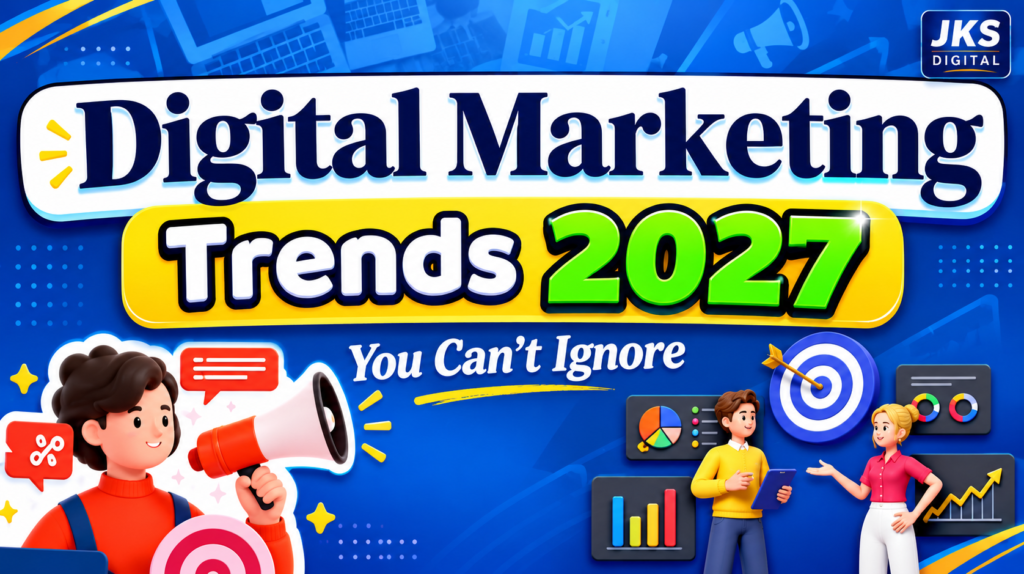
Digital Marketing Trends 2027:- Digital marketing is entering a phase where simply being visible online is no longer enough. Search engines are changing, artificial intelligence is becoming part of everyday marketing work, social platforms are turning into search destinations, and customers are moving between websites, videos, social media, messaging apps, and other digital touchpoints before making a decision.
For businesses, this means the old approach of creating content, running an advertisement and waiting for results is becoming less reliable. In 2027, marketing will increasingly depend on how well a business understands its audience, creates useful experiences and connects different channels together.
The interesting part is that not every new technology needs to become a priority. Some trends will have a direct impact on everyday marketing, while others may be useful only for certain industries.
This guide looks at the digital marketing trends expected to shape 2027 and, more importantly, explains what they can mean for businesses, marketers and website owners.
1. Artificial Intelligence Will Become Part of Everyday Marketing
Artificial intelligence is moving beyond experiments and becoming part of regular marketing workflows.
Marketers can already use AI to brainstorm ideas, organize research, analyze customer data, generate content drafts, create variations of advertisements and identify patterns that may take much longer to find manually.
But the bigger change in 2027 will not simply be about generating more content.
The real advantage will come from using AI to make better marketing decisions.
For example, a marketer could use AI to:
- Analyze which pages attract visitors but fail to generate leads
- Identify common questions customers ask before purchasing
- Create different versions of an advertisement for testing
- Find gaps in an existing content strategy
- Summarize large amounts of campaign data
- Help customer-support teams respond to routine questions
- Repurpose one piece of content into different formats
This does not remove the need for human marketers. Someone still needs to decide whether the information is accurate, whether the message fits the brand and whether the final content actually helps the audience.
In 2027, the distinction may increasingly be between using AI as a shortcut and using AI as a useful marketing assistant.
2. Search Will Become More Conversational and More Complex
The way people find information online is changing.
Instead of always typing short keywords into a traditional search box, users can ask longer questions, describe a problem in natural language and expect a direct answer.
AI-powered search experiences are adding another layer to this change.
For businesses, this creates an important challenge: being visible may no longer depend only on ranking for a single keyword.
A website may need to demonstrate that it genuinely understands a topic through useful explanations, supporting information, relevant examples and clear answers to related questions.
This does not mean traditional SEO disappears in 2027.
Instead, SEO becomes broader.
Businesses will need to think about how their content can be discovered, understood and referenced across different types of search experiences.
3. SEO Will Move Beyond Keywords
Keywords will continue to matter, but treating SEO as a process of placing exact phrases into articles is becoming increasingly limited.
Search engines have become better at understanding context and relationships between topics.
Imagine someone searches:
“How much does it cost to build an ecommerce website?”
They may also want to know:
- What affects the price?
- Which platform should they use?
- Do they need hosting?
- What features are essential?
- How long does development take?
- What maintenance costs should they expect?
A useful page can address the complete decision-making process instead of repeating the same keyword dozens of times.
For 2027, businesses should focus on topic depth, relevance, clarity and usefulness rather than writing content purely for keyword density.
4. Search Intent Will Matter More Than Search Volume
A keyword receiving thousands of searches is not automatically valuable to every business.
Consider two searches:
“What is SEO?”
and
“SEO agency price for small business”
The first suggests someone may simply be learning.
The second suggests a person could be closer to making a purchasing decision.
Both searches can be useful, but they serve different purposes.
That is why businesses should look beyond search volume and ask:
What is this person actually trying to accomplish?
Content can then be created according to different stages of the customer journey:
- Learning
- Comparing options
- Solving a specific problem
- Evaluating a product or service
- Preparing to purchase
This approach can make a content strategy much more practical because every article has a clearer purpose.
5. Original Experience Will Become More Important in Content
As AI makes content production easier, the internet can become crowded with pages saying similar things.
That creates an opportunity for businesses that can provide something they actually know from experience.
A digital marketing agency, for example, could publish a generic article about SEO. But an article explaining what happened after testing a particular SEO strategy on a real website can provide a different level of usefulness.
Read Also:- Do You Want to Build a Career in Digital Marketing? Click Now!
Original content can include:
- Real examples
- Screenshots
- Case studies
- Campaign observations
- Testing results
- Mistakes and lessons
- Expert explanations
- Before-and-after comparisons
- Data collected by the business
The goal is not simply to sound different.
The goal is to give readers information that would be difficult to obtain from a generic rewrite of existing pages.
6. Short-Form Video Will Continue to Influence Discovery
Short videos have become an important way for people to discover products, businesses, creators and ideas.
In 2027, businesses should not think of short-form video only as an entertainment format.
A 30-second video can answer a customer question, demonstrate a product, explain a service or introduce a brand before the person ever visits the website.
For example, a digital marketing business could create short videos such as:
- “Why your website gets impressions but no clicks”
- “One mistake hurting your Google Ads campaign”
- “What is local SEO?”
- “3 things to check before running Meta Ads”
- “Why your Google Business Profile matters”
These videos can then become entry points into the wider marketing system.
A viewer may discover the video on social media, search for the business later, visit its website and eventually contact the company.
That means video should increasingly be considered part of the customer journey, rather than an isolated social-media activity.
7. Video SEO Will Matter Across More Platforms
Creating a video is only one part of video marketing.
The other challenge is helping the right audience discover it.
Titles, descriptions, spoken information, captions, thumbnails and the overall topic of a video can influence how useful it is for viewers and how easily it can be understood by platforms.
Businesses should therefore avoid uploading videos without thinking about their purpose.
A stronger approach is to ask:
What question does this video answer, and who would search for that answer?
That question can influence everything from the title to the opening seconds of the video.
Read Also:- Digital Marketing Agency in Jharoda – JKS Digital for SEO, Google Ads & Online Growth
It also makes it easier to turn one topic into multiple pieces of content.
For example, one detailed video can become:
- A short video
- A blog article
- A social post
- An email
- A carousel
- A FAQ section
This brings us to another important development in digital marketing: people are no longer discovering businesses through only one channel.
8. Social Media Will Play a Bigger Role in Search and Discovery
Social platforms are increasingly being used to discover information, products, services, restaurants, creators and businesses.
Someone looking for a service may search directly on a social platform instead of starting with a traditional search engine.
This changes how businesses should think about social media.
Posting regularly is not enough.
Profiles should clearly communicate:
- What the business does
- Who it serves
- Where it operates, when relevant
- What products or services are available
- How people can contact it
- Why someone should trust it
Content should also answer real questions rather than being created only to fill a posting calendar.
For local businesses especially, social content, customer reviews, location information and search visibility can work together to influence discovery.
9. Customers Will Expect a Connected Digital Experience
A customer may first encounter a business through a Google search, watch its video on social media, visit the website later and then contact the company through WhatsApp.
The business may see these as separate channels.
The customer usually does not.
From the customer’s perspective, it is simply one journey.
That makes consistency increasingly important.
The basic information about a business should remain accurate across platforms, while the message and visual identity should feel connected.
This does not mean publishing exactly the same post everywhere.
Instead, each platform can serve a different purpose while contributing to the same customer experience.
10. The Real Digital Marketing Shift: From More Content to More Useful Content
One of the biggest lessons businesses can take into 2027 is that producing more marketing material is not automatically the same as improving marketing.
A company can publish five articles every week and still fail to attract qualified customers.
Another company may publish fewer pieces but make each one more useful, specific and relevant to the problems its customers actually face.
The important questions are therefore changing.
Instead of asking:
“How much content should we publish?”
businesses should also ask:
“What problem are we solving?”
“Who is this for?”
“What should the person do after consuming it?”
“Can we provide something genuinely useful that similar businesses are not providing?”
These questions will become increasingly important as AI-generated material makes content creation faster and competition for attention becomes stronger.
What These Trends Mean for Businesses in 2027
The digital marketing landscape in 2027 will not be defined by one platform or one technology.
AI, search, SEO, video and social media will increasingly overlap. A customer might discover a business through a search result, understand it through a video, check its social presence, read reviews and finally contact it through a messaging platform.
Businesses that understand these connections can build marketing systems instead of treating every channel as a separate activity.
And that leads to the next major question: how should businesses use customer data, personalization and privacy while building these connected experiences?
11. Personalization Will Become More Relevant to the Customer’s Situation
Personalization in digital marketing is moving beyond simply adding a person’s name to an email.
Customers can receive different messages depending on what they searched for, which page they visited, what they previously purchased, or where they are in the buying process.
For example, an online clothing store does not need to show the same message to someone who has never visited the website and someone who has already viewed a particular product several times.
In 2027, businesses can use customer signals to make experiences more relevant, such as:
- Showing related products based on browsing behavior
- Recommending content according to previous interests
- Sending different email campaigns to different customer groups
- Displaying location-specific information
- Creating different landing-page experiences for different audiences
- Following up with customers based on their previous interactions
However, personalization should have a clear purpose. Using too much personal data or making the experience feel intrusive can have the opposite effect.
The goal should be relevance without making customers uncomfortable.
12. First-Party Data Will Become an Important Marketing Resource
Businesses are increasingly interested in information they collect directly from their own customers and visitors.
This is known as first-party data.
It can include information such as:
- Email addresses collected with permission
- Purchase history
- Website interactions
- Customer preferences
- Form submissions
- Product interests
- Responses to surveys
- Customer-service interactions
This information can help a business understand its existing audience without depending entirely on external audience databases.
For example, an ecommerce business can learn which products customers repeatedly view, while a service company can identify the questions people commonly ask before contacting the team.
The important part is responsible collection and use.
A business should clearly communicate what information it collects, why it collects it and how customers can manage their choices.
13. Privacy Will Become Part of the Customer Experience
Privacy is no longer only a technical or legal issue.
It can influence whether people feel comfortable interacting with a brand.
Customers may ask:
- Why is this website asking for my information?
- Why am I receiving these messages?
- How did this company get my email address?
- What happens to the information I submit?
- Can I stop receiving marketing communication?
In 2027, businesses should make privacy easier to understand instead of hiding important information inside complicated explanations.
Clear consent, sensible data collection and straightforward communication can help create a more trustworthy experience.
For marketers, this also means avoiding the temptation to collect information simply because technology makes it possible.
Useful data is more valuable than unnecessary data.
14. AI Will Reshape Paid Advertising
Artificial intelligence is also changing how online advertising is created, tested and optimized.
Advertising platforms increasingly use automation to help businesses identify audiences, distribute budgets and deliver different creative variations.
This means advertisers may spend less time manually controlling every individual setting and more time working on:
- Offer strategy
- Creative concepts
- Audience understanding
- Landing pages
- Conversion quality
- Testing
- Measurement
For example, instead of producing one advertisement and running it for several weeks, a business can develop multiple creative concepts and compare how different messages perform.
The important shift is that automation does not eliminate strategy.
It makes the quality of the inputs more important.
If the offer is unclear or the landing page is poor, better automation cannot automatically solve the entire customer journey.
Read Also:- Top Digital Marketing Secrets for 2026 That Actually Work
15. Creative Testing Will Become a Major Competitive Skill
Advertising competition is not only about targeting the right audience.
Two businesses can target similar people and receive very different results because their advertisements communicate different ideas.
Creative testing involves experimenting with elements such as:
- Headlines
- Images
- Videos
- Hooks
- Offers
- Calls to action
- Customer problems
- Benefits
- Different storytelling approaches
A local training institute, for example, could test whether students respond more strongly to a career-focused message, a course-focused message or a practical learning demonstration.
Rather than guessing which message will work, marketers can use actual campaign data to learn.
In 2027, the ability to test, learn and improve creative quickly can become an important part of performance marketing.
16. Landing Pages Will Matter as Much as the Advertisement
Getting someone to click an advertisement is only one step.
What happens after the click can determine whether that visitor becomes a lead or leaves the website.
A landing page should make the next step obvious.
Depending on the business, this could include:
- A clear explanation of the offer
- Relevant pricing information
- Benefits
- Proof or testimonials
- Frequently asked questions
- Important terms
- A simple contact form
- A phone or WhatsApp option
- A clear call to action
The message should also match the advertisement.
If an advertisement promises a particular service but the landing page immediately talks about something else, visitors can become confused.
In 2027, businesses should look at the advertisement and landing page as one experience, not two unrelated marketing assets.
17. Local SEO Will Remain Important for Location-Based Businesses
For businesses that depend on customers from specific areas, local search visibility will continue to have practical value.
A person looking for a nearby service may search using terms such as:
- Digital marketing institute near me
- Dentist in [area]
- Best salon near me
- Website developer in [city]
- Cafe near [location]
Local SEO can help businesses become easier to discover when people are already looking for something nearby.
Important elements include:
- Accurate business information
- A properly maintained Google Business Profile
- Relevant local content
- Genuine customer reviews
- Consistent contact details
- Location-specific website pages where appropriate
- Useful photos and business information
But local SEO should not be reduced to adding a city name repeatedly.
The business itself needs to provide a genuine local experience.
18. Creator Marketing Will Focus More on Relevance
Influencer marketing is changing as audiences become more familiar with sponsored promotions.
Large follower numbers do not automatically mean that a creator is the right fit for a brand.
A smaller creator with a highly relevant audience may be useful for a particular campaign because their content is closely connected to the product or industry.
Businesses should therefore consider factors such as:
- Audience relevance
- Engagement quality
- Content style
- Previous brand collaborations
- Audience trust
- Geographic relevance
- The creator’s relationship with the subject
For example, a local fitness business may find greater relevance in working with creators who actually have an audience in its service area rather than simply choosing someone with a large national following.
The focus is increasingly shifting from reach alone to relevance and credibility.
Read Also:- The Biggest Problem New Digital Marketers Face: How to Get Clients?
19. User-Generated Content Can Strengthen Social Proof
People often want to see how a product or service looks in real situations before making a decision.
That is one reason user-generated content can be valuable.
It may include:
- Customer photos
- Product demonstrations
- Reviews
- Testimonials
- Unboxing videos
- Before-and-after experiences
- Customer stories
For businesses, this content can provide a perspective that polished brand advertising sometimes cannot.
However, businesses should not present fabricated testimonials or misleading experiences as genuine customer content.
Authenticity matters because the purpose of social proof is to help potential customers understand what real users experienced.
20. Community Marketing Can Build Longer-Term Relationships
Not every customer interaction needs to lead directly to a sale.
Some businesses are building communities around shared interests, learning, professional development or customer support.
This could happen through:
- WhatsApp communities
- Social media groups
- Email communities
- Private forums
- Events
- Webinars
- Educational sessions
A community can give customers a reason to continue interacting with a business even when they are not currently buying anything.
For example, an education company could create a community where members receive useful career information, practical resources and updates.
Over time, that relationship can become part of the brand experience.
21. Conversational Marketing Will Become More Useful
Customers increasingly expect quick answers.
They may not want to complete a long form just to ask a simple question.
Conversational marketing can use channels such as:
- Website chat
- Social-media messages
- AI-assisted customer support
- Email conversations
The objective is not to automate every conversation.
Instead, automation can handle simple and repetitive questions while more complex situations are passed to a human.
For example, a customer could ask about course timings, available services or basic pricing information and receive an immediate response.
If the customer has a complicated requirement, the conversation can then move to a member of the team.
This creates a balance between speed and human support.
22. Omnichannel Marketing Will Become More Practical
Customers rarely follow a perfectly straight path from advertisement to purchase.
Someone might:
- See a short video.
- Search for the brand.
- Visit the website.
- Read reviews.
- Follow the social account.
- Send a WhatsApp message.
- Purchase several days later.
If every platform is managed separately, important parts of this journey can be lost.
Omnichannel marketing attempts to connect these touchpoints so that the customer receives a more consistent experience.
This does not mean every business needs to be active on every platform.
A better approach is to identify where the target audience actually spends time and build a connected journey around those channels.
23. Marketing Measurement Will Shift Toward Business Results
Traffic, impressions, likes and followers can be useful indicators, but they do not always tell a business whether marketing is producing meaningful results.
A website can receive thousands of visitors without generating enough enquiries.
Likewise, a social post can receive many likes without producing customers.
Businesses therefore need to connect marketing activity with outcomes such as:
- Qualified leads
- Sales
- Revenue
- Cost per lead
- Customer acquisition cost
- Conversion rate
- Repeat purchases
- Customer lifetime value
This does not mean every campaign should be judged by immediate sales.
Brand awareness and audience building can take time.
The important point is to understand what each marketing activity is supposed to achieve and how that result will be measured.
24. The Marketer’s Role Will Change Along With the Technology
As more routine tasks become automated, marketers may spend less time performing repetitive work manually.
That creates more space for skills such as:
- Strategic thinking
- Customer research
- Creative development
- Data interpretation
- Brand communication
- Experimentation
- Decision-making
Read Also:- The Digital Marketing Master Guide for 2026: What’s In, What’s Out, and Why It Matters
Knowing how to use a tool will still matter, but understanding why and when to use it can become even more valuable.
A marketer who can generate 100 pieces of content is not necessarily more effective than someone who can identify the five pieces of content a specific audience genuinely needs.
Technology can increase speed.
Human judgment determines direction.
25. Interactive Content Can Increase Engagement
People do not always want to read a long explanation before deciding what to do next. Sometimes they prefer to interact with information and get an answer that feels relevant to their situation.
That is where interactive content can be useful.
Businesses can experiment with:
- Calculators
- Quizzes
- Assessments
- Product selectors
- Polls
- Surveys
- Interactive FAQs
- Cost estimators
- Recommendation tools
For example, a digital marketing agency could create a simple website SEO health checker that helps visitors identify common problems before contacting the agency.
The value of interactive content is not simply that it keeps someone on a page longer. It can also help the business understand what the visitor needs.
26. Email Marketing Will Remain an Owned Communication Channel
Social-media algorithms can change, advertising costs can increase and search visibility can fluctuate.
Email gives businesses a direct communication channel with people who have voluntarily subscribed or interacted with the brand.
That makes email useful for more than promotional offers.
Businesses can use it for:
- Educational newsletters
- Product updates
- New content
- Special offers
- Customer onboarding
- Event reminders
- Follow-up messages
- Re-engagement campaigns
The quality of the email list matters more than simply having a large number of subscribers.
A smaller audience that actually wants to receive the communication can be more useful than a large list filled with inactive or irrelevant contacts.
27. Mobile Experience Will Remain a Core Marketing Requirement
A large part of digital activity happens on mobile devices, so businesses cannot treat mobile optimization as a secondary task.
A visitor may discover a business through a social post or search result and immediately open its website on a phone.
If the page loads slowly, text is difficult to read, buttons are hard to tap or the enquiry process is confusing, the business can lose that potential customer.
A mobile-friendly experience should include:
- Easy-to-read text
- Fast-loading pages
- Simple navigation
- Clearly visible buttons
- Short and practical forms
- Mobile-friendly images and videos
- Easy access to contact options
Before launching a campaign in 2027, businesses should experience their own website the way a customer would—on a phone, not just on a desktop computer.
28. Content Repurposing Will Help Businesses Work More Efficiently
Creating every piece of content from scratch can consume a significant amount of time.
A more efficient approach is to build multiple useful assets around one strong topic.
For example, one detailed article about local SEO could become:
- A YouTube video
- Three short-form videos
- An Instagram carousel
- A LinkedIn post
- An email newsletter
- A set of FAQs
- A customer-facing checklist
The goal is not to copy and paste the same paragraph everywhere.
Each version should be adapted to the platform and the audience.
This allows businesses to get more value from original research while keeping the content experience natural on each channel.
29. Brand Trust Will Become an Important Marketing Asset
Digital consumers have more choices than ever.
They can compare prices, read reviews, watch demonstrations and look for alternatives within minutes.
As a result, trust can influence whether someone decides to contact or purchase from a business.
Trust can be built through:
- Clear information
- Honest pricing
- Genuine reviews
- Useful educational content
- Transparent policies
- Consistent communication
- Real examples of work
- Accurate claims
Businesses should also avoid making promises that their service cannot realistically deliver.
A marketing campaign can attract attention quickly, but misleading claims can damage the relationship after the customer arrives.
30. Reviews Will Become Part of the Digital Customer Journey
Customer reviews are no longer something people check only after reaching a business’s website.
They can appear during local searches, social discovery, product research and other stages of the decision-making process.
For businesses, this means reputation management should be treated as an ongoing activity.
A useful review strategy includes:
- Encouraging genuine customers to share feedback
- Responding professionally to reviews
- Learning from recurring complaints
- Correcting inaccurate business information
- Avoiding fake reviews or purchased ratings
Negative feedback does not automatically mean a business has failed.
How a company responds can also tell potential customers something about its approach to customer service.
31. Customer Retention Will Deserve More Attention
Getting a new customer can require advertising, content, sales conversations and follow-up.
Once someone has already purchased, the business has an opportunity to build on an existing relationship.
Retention strategies can include:
- Helpful onboarding
- Follow-up communication
- Loyalty programs
- Personalized recommendations
- Customer education
- Support after purchase
- Exclusive offers
- Regular but relevant communication
For subscription businesses and ecommerce brands, retention can be particularly important because repeat customers contribute to longer-term revenue.
Marketing should therefore not end when the sale is completed.
The post-purchase experience is also part of marketing.
32. Businesses Should Not Chase Every New Trend
Every year brings new platforms, tools and marketing techniques.
That does not mean every business needs to adopt all of them.
A local service provider may gain more from improving its website, local visibility and customer reviews than from spending months trying to build an audience on a new platform.
Before adopting a trend, businesses should ask:
- Does our audience actually use this?
- Does it solve a real business problem?
- Can we maintain it consistently?
- Can we measure its impact?
- Do we have the resources to do it properly?
This helps prevent marketing teams from becoming busy without becoming effective.
33. Common Digital Marketing Mistakes to Avoid in 2027
As marketing becomes more technology-driven, some basic mistakes can still create major problems.
Creating Content Without a Clear Audience
A topic may appear popular, but if it has no connection to the people a business wants to reach, it may generate little business value.
Depending Entirely on AI-Generated Content
AI can speed up research and drafting, but publishing unverified or generic material can weaken the quality of a website.
Ignoring Existing Customers
Constantly searching for new customers while neglecting people who already purchased can create an unnecessary gap in the customer journey.
Measuring Only Vanity Metrics
Followers, impressions and likes can provide useful context, but they should not be the only measures of success.
Sending the Same Message Everywhere
A blog reader, Instagram viewer and existing customer may have very different needs. Content should be adapted rather than duplicated without thought.
Forgetting the Website
Social platforms can generate attention, but a business should not completely neglect the place where customers can learn more, compare options and take action.
34. A Practical Digital Marketing Strategy for 2027
Businesses do not need to implement every trend at once.
A practical approach can start with a few fundamental steps.
Step 1: Understand the Customer
Identify what customers need, what problems they face, what questions they ask and what prevents them from purchasing.
Step 2: Improve the Website
Make sure the website is useful, mobile-friendly, easy to navigate and clear about what the business offers.
Step 3: Build Search Visibility
Create content around genuine customer questions and strengthen both traditional SEO and local search where relevant.
Step 4: Use AI Carefully
Use AI to assist with research, analysis, brainstorming and repetitive work, while keeping human review in the process.
Step 5: Choose the Right Social Platforms
Do not try to maintain every platform simply because it exists. Focus on channels that match the audience and business objectives.
Step 6: Create a Content System
Turn useful research into multiple formats instead of repeatedly starting from an empty page.
Step 7: Build Trust
Collect genuine reviews, demonstrate expertise and communicate clearly.
Step 8: Measure Meaningful Results
Track leads, sales, conversions, customer acquisition costs and retention alongside traffic and engagement.
35. What Could Digital Marketing Look Like in 2027 and Beyond?
The direction of digital marketing suggests that the boundaries between SEO, social media, content, advertising, customer service and AI will continue to become less distinct.
A customer may not think about these activities as separate marketing channels.
They simply want an answer, a useful product, a trustworthy business or a convenient way to solve a problem.
That means businesses will need to connect the different pieces.
AI can help with speed and analysis. Search can help people discover information. Video can demonstrate ideas quickly. Social platforms can create conversations. Email and messaging can support relationships. Websites can bring the complete experience together.
The businesses that understand these connections can build a more consistent customer journey instead of treating every marketing activity as an isolated campaign.
Frequently Asked Questions About Digital Marketing Trends 2027
What are the biggest digital marketing trends for 2027?
Important areas include AI-assisted marketing, AI-powered search, evolving SEO, search intent, short-form video, social search, personalization, first-party data, privacy, AI advertising, local SEO, creator marketing, conversational marketing and customer retention.
Is SEO still important in 2027?
Yes, SEO remains relevant, but the way businesses approach it is changing. Instead of focusing only on individual keywords, businesses need useful, relevant and trustworthy content that addresses real search needs across changing search experiences.
Will AI replace digital marketers in 2027?
AI can automate and assist with many marketing tasks, but strategy, creativity, customer understanding, brand decisions and human judgment remain important. The role of marketers is likely to change as more repetitive work becomes automated.
How is AI changing SEO?
AI is affecting both how marketers create and analyze content and how people search for information. This makes topic understanding, useful content, original information and clear answers increasingly important.
Is video marketing still important in 2027?
Video remains useful for discovery, education, demonstrations and brand communication. Businesses can use both short-form and longer videos depending on the audience and purpose.
What is first-party data?
First-party data is information a business collects directly through its own interactions with customers or visitors, such as permitted email subscriptions, purchases, website interactions and customer preferences.
What should a small business focus on first?
A small business can start with the fundamentals: a useful website, accurate local information, genuine reviews, relevant content, a manageable social presence and clear measurement of leads and sales.
How can businesses prepare for digital marketing changes?
Businesses can prepare by learning how their customers discover information, experimenting with useful technologies, strengthening their owned digital assets, protecting customer trust and regularly reviewing which marketing activities actually contribute to business goals.
Conclusion
Digital marketing in 2027 will not be about finding one magical platform or one new tool that guarantees success.
The bigger change is the way different parts of marketing are becoming connected.
AI is changing how marketers work. Search is becoming more conversational. SEO is moving toward deeper understanding and usefulness. Social platforms are becoming discovery channels. Video is influencing customer decisions. First-party data and privacy are becoming more important. At the same time, reviews, communities, messaging and customer retention are becoming part of the wider marketing experience.
For businesses, the practical lesson is simple: do not chase every trend—understand which changes actually matter to your customers and build around them.
The strongest digital marketing strategy for 2027 will not necessarily be the one that uses the most tools. It will be the one that combines technology with useful content, clear communication, customer understanding and genuine trust.
As digital channels continue to evolve, businesses that keep learning, testing and adapting will be better prepared for whatever comes next.