Job vs Freelancing vs Agency:- The career landscape in 2026 is evolving faster than ever before. Compared to just a few years ago, the way people work, earn, and grow professionally has undergone a massive transformation. Artificial Intelligence, automation, remote work culture, and the rise of the global gig economy have reshaped traditional career paths and created new opportunities that didn’t exist before.
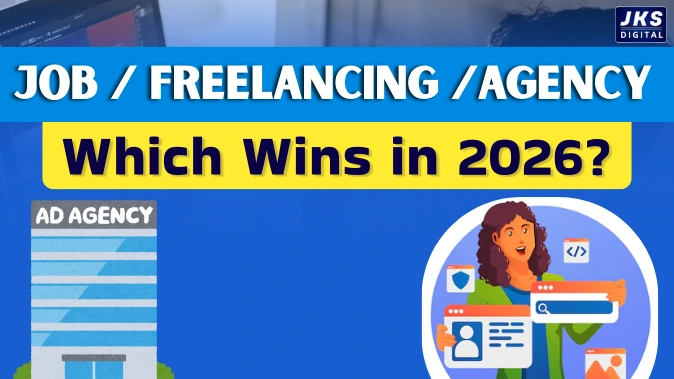
As a result, students, fresh graduates, working professionals, and even experienced experts are facing a common and important question:
Should I choose a stable job, work as a freelancer, or build my own agency?
The truth is, there is no universal answer. What works perfectly for one person may not be suitable for another. Each career path comes with its own benefits, challenges, income potential, and long-term impact on your lifestyle and personal growth. The right choice depends on your skills, risk-taking ability, financial situation, and future vision.
This article explores the real-world reality of all three career options—job, freelancing, and agency ownership—through a 2026 lens. Instead of promises or hype, it focuses on practical insights to help you understand what each path truly offers. By the end, you will be better equipped to choose a career direction that is not only relevant today but also future-proof for the years ahead.
The Career Reality of 2026
In 2026, career stability is no longer defined solely by a fixed monthly salary. The professional landscape has shifted dramatically:
- Job security is unpredictable: Even well-paid employees in reputed companies face layoffs due to automation, restructuring, or economic shifts.
- Global earning potential for freelancers: Skilled freelancers are tapping into international markets, earning more than many traditional jobs.
- Agencies are scaling faster than ever: By leveraging automation tools and remote teams, small agencies can now serve global clients efficiently.
Key Changes Shaping Careers in 2026
- AI is transforming work, not eliminating creativity
- AI handles repetitive, time-consuming tasks such as data entry, basic analysis, and customer support automation.
- Human creativity, strategic thinking, and problem-solving remain in high demand.
- Remote work is the new normal
- Working from home or anywhere in the world is no longer a perk; it’s an expectation.
- Companies hire talent based on skills and output rather than location or office presence.
- Skills matter more than degrees
- Employers and clients prioritize practical ability over formal qualifications.
- Continuous learning and adapting to new tools or technologies is key to staying relevant.
- Multiple income streams are essential
- Relying on a single salary is increasingly risky.
- Professionals now combine jobs with freelancing, consulting, side projects, or digital businesses to secure financial stability.
With these realities in mind, it’s clear that each career path—job, freelancing, or agency—comes with unique advantages and challenges. Understanding these deeply will help you make a smart, future-proof decision for 2026 and beyond.
What Does a Job Mean in 2026?
A job remains the most common career path in 2026, especially for those seeking stability and structure. It provides a fixed salary, defined working hours, and a clearly outlined work environment. While the nature of jobs is evolving due to AI and remote work, many people still prefer the predictability and security a traditional role offers.
However, a job comes with both advantages and limitations. Understanding these can help you decide if this path suits your goals in 2026.

Pros of a Job
- Monthly income stability: Guaranteed salary provides financial predictability.
- Clear roles and responsibilities: You know what is expected of you, reducing ambiguity.
- Learning from experienced teams: Exposure to senior professionals and mentors helps build skills.
- Lower financial risk initially: You don’t need to invest in tools, clients, or marketing.
- Social security benefits (in some roles): Health insurance, provident fund, and other perks are often included.
Cons of a Job
- Limited income growth: Raises and promotions are typically incremental and may not match inflation or market trends.
- Dependence on a single employer: Your career progress is tied to company decisions.
- Less control over time: Fixed schedules and office hours can limit flexibility.
- Risk of layoffs and automation: Jobs can become redundant due to AI or business restructuring.
- Slower skill diversification: You may specialize narrowly, reducing exposure to diverse skills.
In 2026, jobs still provide stability, but they may not offer maximum financial or creative freedom. For those willing to take calculated risks, freelancing or agency work could provide faster growth and flexibility.
Job Reality in 2026
Jobs are no longer “permanent.” Many companies prefer contract-based hiring, performance-based pay, and lean teams. Promotions are slower, and loyalty does not always guarantee security.
Best suited for:
Freshers who need structure, people who value stability, and those who prefer predictable routines.
Freelancing in 2026: Freedom with Responsibility
Freelancing means offering your skills directly to clients without being tied to a single employer. By 2026, freelancing has evolved from a side hustle to a full-fledged career path, offering freedom, flexibility, and global opportunities.

Pros of Freelancing
- Flexible working hours: You can set your own schedule and work from anywhere.
- Global client opportunities: Access clients and projects from around the world.
- Income based on skill, not time: High-demand skills can command premium rates.
- Freedom to choose projects: Work on what interests you, aligning with your strengths.
- Fast learning curve: Exposure to diverse projects accelerates skill development.
Cons of Freelancing
- Income inconsistency: Earnings can fluctuate month to month.
- No paid leaves or job security: You are responsible for your own financial safety net.
- Client dependency: Losing a major client can significantly affect income.
- Self-marketing pressure: You need to continuously promote yourself to get work.
- Mental stress during dry months: Periods of low client demand can be challenging.
Freelancing Reality in 2026
AI and automation tools have made freelancers more productive, but competition has also intensified. Clients now expect faster delivery, higher quality, and specialization. Building a personal brand and honing niche expertise has become more important than ever.
Read Also:- Top 5 Skills to Build a Career After 12th – Best for 2026
Best suited for:
- Skilled professionals with marketable expertise
- Self-motivated learners who thrive independently
- Individuals who value freedom over comfort
- Those ready to manage uncertainty and income fluctuations
Agency Model: Building a Scalable Business
Running an agency is more than freelancing with a team—it’s a structured business. Agencies provide services at scale by implementing systems, processes, and leveraging people to handle larger projects and multiple clients.
Pros of Running an Agency
- High income potential: Scalable projects lead to higher revenue than freelancing.
- Business scalability: Adding clients, services, or teams multiplies growth.
- Brand value creation: Agencies build a long-term reputation that adds credibility.
- Team-based workload: Delegation reduces individual pressure and increases efficiency.
- Multiple clients reduce dependency: Less risk compared to relying on one or two clients.
Cons of Running an Agency
- High responsibility: You’re accountable for clients, team members, and operations.
- Cash flow management stress: Maintaining steady revenue and expenses requires planning.
- Team and client handling challenges: Leadership and communication skills are essential.
- Initial long working hours: Early growth stages can be demanding.
- Requires leadership skills: Success depends on guiding people effectively.
Agency Reality in 2026
Niche agencies are outperforming generalists. Focusing on a specific industry or service yields better results. AI tools, automation, and remote teams reduce costs and improve efficiency, allowing agencies to scale faster than ever.

Best suited for:
- Entrepreneurial minds seeking independence
- Experienced freelancers ready to grow
- Risk-takers aiming for long-term wealth creation
- Individuals willing to invest time and effort in building systems and teams
Read Also:- The Biggest Problem New Digital Marketers Face: How to Get Clients?
Income Comparison: The Honest Truth
When choosing a career path, income often plays a major role. However, it’s important to view earnings realistically, considering both potential and risk.
Job
- Income type: Fixed monthly salary
- Growth: Slow, incremental raises
- Security: Relatively stable, but limited upside
- Ideal for those who prioritize predictability over rapid financial growth
Freelancing
- Income type: Variable, based on skill and projects
- Growth: Potentially unlimited if you master high-demand skills
- Risk: Inconsistent income; depends on clients and market demand
- Freelancers can out-earn traditional employees if they specialize and market themselves well
Agency
- Income type: Business revenue, scalable
- Growth: Highest earning potential among the three paths
- Risk: Higher responsibility, cash flow management, and initial investment
- A well-run agency can surpass both jobs and freelancing, especially when leveraging teams, automation, and niche specialization
Key Insight for 2026
In the modern career landscape, skills matter more than job titles.
- A highly skilled freelancer can earn more than a mid-level manager in a traditional job.
- An agency with the right systems, team, and niche focus can generate significantly higher income than both.
The takeaway: your earning potential is directly tied to your skills, adaptability, and ability to leverage technology and systems, rather than simply the career path you choose.
Work-Life Balance: Myth vs Reality
Many people are drawn to freelancing or running an agency because they associate these paths with freedom. However, in 2026, freedom always comes with responsibility. No career is completely “stress-free,” and work-life balance depends more on discipline, planning, and mindset than simply the career choice.

- Job: Offers a structured schedule, which can make planning life outside work easier. However, the fixed hours and office expectations limit flexibility. Employees often find themselves juggling personal priorities around work schedules.
- Freelancing: Provides time flexibility and the ability to work from anywhere. But it also comes with constant client deadlines, the pressure to maintain steady income, and the need to handle self-marketing. Time freedom can quickly feel like responsibility overload without proper planning.
- Agency Life: Initially, running an agency can be the most hectic, with long hours spent managing clients, teams, and operations. Over time, systems, automation, and delegation allow agency owners to regain balance, but this requires strategic effort and leadership skills.
Key insight: True work-life balance in 2026 comes from self-discipline, smart time management, and systemized workflows, not from the career path itself.
Skill Growth & Learning Speed
The speed at which you learn and acquire new skills directly affects your career trajectory in 2026. AI, automation, and global competition mean that stagnation can quickly make a career obsolete.
- Job: Provides a structured learning environment with mentorship opportunities. However, skill growth is often slower because tasks are repetitive and promotions are incremental.
- Freelancing: Offers rapid, hands-on, real-world learning. Freelancers tackle diverse projects, face new challenges, and acquire market-relevant skills quickly. The downside is that learning is self-directed and can be inconsistent without a clear growth plan.
- Agency: Combines technical skills with business acumen and leadership experience. Running an agency forces you to learn client management, team building, operations, marketing, and finance—all at an accelerated pace.
Key insight: In 2026, continuous learning is non-negotiable. Careers that fail to adapt or stop learning are at high risk of being replaced by more skilled competitors or AI-enabled solutions.
Risk Factor in 2026
Every career path comes with risk; the type of risk differs depending on the route you choose.
- Job Risks: Layoffs, downsizing, AI automation replacing repetitive roles, limited control over income growth.
- Freelancing Risks: Income gaps, client dependency, high competition, and the need for constant self-marketing.
- Agency Risks: Financial losses, team conflicts, client dissatisfaction, and the pressure of scaling a business responsibly.
Key insight: The safest career in 2026 is not necessarily the one with the least risk, but the one where you control your learning, income streams, and growth. Those who proactively manage their skills, reputation, and financial planning are best positioned to thrive in any path.
Which Career Path Should You Choose?
Choosing the right career path in 2026 depends on your current stage, goals, and risk appetite. There is no one-size-fits-all answer, but here are some practical guidelines:
For Students & Freshers
- Focus on skill learning, internships, and real-world projects.
- A job provides exposure to structured work environments and mentorship.
- Freelancing or small projects can build confidence, portfolio, and practical experience early.
- Combining both approaches allows you to explore your interests while staying secure.
For Working Professionals
- Part-time freelancing is a safe way to test new skills or industries before quitting your job.
- Helps build a side income, expand your network, and explore flexibility.
- Evaluate your long-term goals before transitioning fully to freelancing or agency work.
For Experienced Freelancers
- Building an agency is a natural next step for scaling income, managing multiple clients, and gaining stability.
- It allows you to leverage teams, systems, and processes to grow beyond individual capacity.

For Entrepreneurs
- Starting an agency or product-based business offers long-term growth and wealth creation.
- Success requires leadership, strategic vision, and the ability to balance client work with business operations.
Job vs Freelancing vs Agency: Quick Comparison
Job vs Freelancing vs Agency: Quick Comparison
| Factor | Job | Freelancing | Agency |
|---|---|---|---|
| Stability | High | Moderate | Moderate |
| Income Potential | Moderate | High | Highest |
| Freedom | Low | High | Moderate |
| Risk | Low | Moderate | High |
| Growth Speed | Slow | Fast | Fastest |
Insight: Each path has its trade-offs. Your choice should align with your goals, skills, risk tolerance, and desired lifestyle.
2026 Career Trends You Cannot Ignore
The modern career landscape is shaped by technology, globalization, and new work cultures. To stay competitive, consider these trends:
- AI + human skills combination: Automation handles repetitive tasks, but human creativity, strategy, and empathy are irreplaceable.
- Personal branding over resumes: Clients and employers increasingly evaluate your portfolio, online presence, and reputation.
- Remote global work culture: Work from anywhere while collaborating with international teams and clients.
- Niche specialization: Agencies and freelancers succeed by focusing on specific industries or high-demand skills rather than general services.
- Multiple income streams: Relying on a single source of income is risky; diversify through freelancing, side projects, investments, or agency services.
Ignoring these trends can make even a stable job or successful freelance career vulnerable in 2026. Staying adaptable, skill-focused, and tech-savvy is no longer optional—it’s essential.
Final Verdict: What Is Best in 2026?
There is no universal “best” career path—what works for one person may not work for another. Each option comes with its unique advantages and trade-offs:
- Job: Offers stability and a predictable routine, but income growth and freedom are limited.
- Freelancing: Provides flexibility, independence, and higher earning potential, but requires discipline, self-marketing, and the ability to handle uncertainty.
- Agency: Offers the highest income potential and long-term growth through scale, but demands strong leadership, responsibility, and systemized workflows.
For most people in 2026, a progressive career path often works best:
Job → Freelancing → Agency
- Start with skills: Gain experience and exposure through structured roles or internships.
- Move with experience: Transition to freelancing to explore freedom, client work, and portfolio growth.
- Scale with systems: Build an agency or business to leverage teams, processes, and long-term growth opportunities.
Final Words
In 2026, success is not about finding the perfect career path—it’s about adaptability, continuous learning, and taking calculated risks. The comfort zone is shrinking, but the opportunities for growth are expanding faster than ever.
To thrive in the modern career landscape:
- Choose growth over fear. Don’t let risk paralyze you.
- Choose skills over shortcuts. Invest in learning, specialization, and real-world experience.
- Choose a future you control. Diversify your income, embrace technology, and plan strategically.
With the right mindset, tools, and skills, any path—job, freelancing, or agency—can lead to success in 2026 and beyond