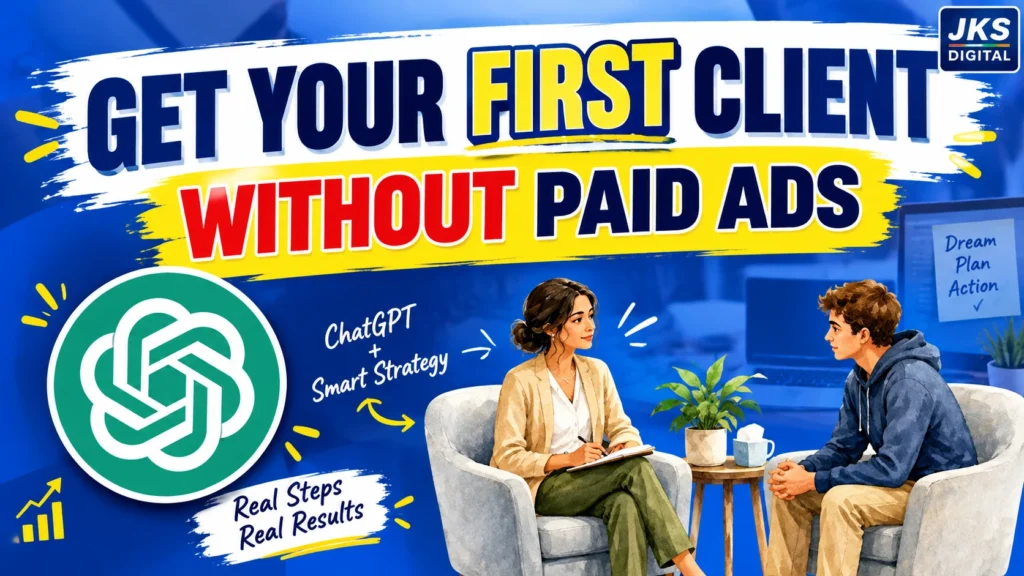
How to Get Your First Client Using ChatGPT in 2027:- Getting your first client online can be harder than learning a new skill. You might know how to use ChatGPT, create social media posts, write articles, or build websites, but finding someone willing to pay for your work is a different challenge. Without experience, testimonials, or a marketing budget, it can be difficult to know where to begin.
The good news is that you do not necessarily need paid advertising to start finding potential clients. You can use ChatGPT to research businesses, understand their problems, prepare personalized service offers, write professional outreach messages, and organize your client acquisition process.
However, ChatGPT cannot guarantee clients or replace the effort required to build relationships. Your results will depend on the service you offer, the quality of your work, the relevance of your outreach, and how consistently you follow up.
In this guide, you will learn how to use ChatGPT to identify potential clients, find businesses that may need your services, and approach them without spending money on advertisements. You will also discover practical prompts, outreach examples, and a step-by-step plan you can begin using as a beginner.
1. Why Is Getting Your First Client So Difficult?
Many beginners assume that learning a skill is enough to start earning money online. They complete a course, experiment with AI tools, and create a few sample projects. But when they try to find clients, they often face the same problems.
They do not know which businesses to contact, what to offer, how much to charge, or what to say in their first message.
Here are four common challenges and how ChatGPT can help you address them.
You Have a Skill but Do Not Know Who Will Pay for It
Suppose you have learned content writing. You can write blog posts using ChatGPT, but you do not know which businesses need blog content or how to find them.
Instead of contacting random people, you can narrow your target audience. For example, you could research small e-commerce stores that need product descriptions, local businesses that want informative website content, or service providers whose websites have outdated articles.
ChatGPT can help you compare these customer groups, identify possible content needs, and develop a relevant service offer. You should still verify each business’s actual needs before contacting it.
You Do Not Have Previous Clients or Testimonials
Without previous clients, it may be difficult to convince someone to trust your work. However, you can demonstrate your ability through sample projects.
For example, if you want to provide SEO services, you could prepare a sample website audit using publicly available information. If you want to offer social media services, create three sample posts for a fictional business or a clearly labelled portfolio example.
Do not present sample work as a paid client project or claim results you have not achieved. The purpose is to show potential customers what you can do.
You Cannot Afford Paid Advertising
Advertising can help businesses reach potential customers, but beginners do not necessarily need to start there.
You can explore free client discovery methods, including Google Maps, LinkedIn, relevant professional communities, referrals, and your existing network. These methods require time and effort, and they do not guarantee responses, but they can help you begin without an advertising budget.
You Do Not Know How to Approach Potential Clients
A generic message such as “Hello, I provide digital marketing services. Do you need my service?” gives the recipient little reason to respond.
A better approach is to identify something specific about the business, explain a relevant opportunity, and offer a useful next step.
ChatGPT can help you draft that message. You must provide accurate information about the business and review the final message before sending it.
2. Can You Really Get Clients Using ChatGPT Without Paid Ads?
Yes, ChatGPT can help you with several parts of the client acquisition process without requiring a paid ChatGPT plan or an advertising budget. However, access to particular features may depend on your account, and you may encounter usage limits.
The important distinction is that ChatGPT is an assistant, not an automatic client-generating system.
You can use it to:
- Research a target market and identify suitable types of businesses.
- Brainstorm services that match your existing skills.
- Draft personalized emails and professional messages.
- Create sample content and portfolio ideas.
- Prepare discovery-call questions and service proposals.
- Organize prospect research and follow-up tasks.
For example, imagine that you want to offer website content services to small businesses. You find a business website with outdated service descriptions. You can use ChatGPT to help you outline a clearer version of one publicly available section, then review the facts and create a short sample.
You could contact the business with a polite explanation of the opportunity and ask whether it would be interested in discussing an improvement.
The business may respond positively, decline, or never reply. That is normal. Your objective is to build a relevant, professional process rather than assume every message will produce a sale.
What ChatGPT cannot do for you automatically: It cannot guarantee that your offer is valuable, that a business has a budget, or that a prospect will become a paying customer. You remain responsible for research, quality control, communication, and delivery.
3. Choose One Service You Can Actually Sell
Before searching for clients, decide what you want to sell. This is one of the most important steps because a vague offer makes it difficult to identify the right customer.
Instead of saying, “I can do everything with AI,” choose one service, one target audience, and one clear problem to solve.
Here are five services beginners can explore, depending on their skills and willingness to learn.
Content Writing and Blog Optimization
Businesses with content-focused websites may need help writing articles, updating old posts, improving readability, or organizing content around relevant search queries.
You can use ChatGPT to brainstorm article outlines, improve drafts, generate topic ideas, and check whether content answers the reader’s questions.
However, useful content still requires fact-checking, original insights, appropriate research, and editing. Simply generating large quantities of generic AI text is not a strong service offer.
A possible offer: Help small businesses improve one existing blog post by making it more useful, easier to read, and better organized around the reader’s search intent.
Social Media Content Creation
Many businesses want to maintain an active social media presence but struggle to produce content consistently.
You could offer content calendars, post captions, creative concepts, carousel outlines, or short-video scripts for a specific type of business.
ChatGPT can help you develop ideas and draft captions. You will still need to understand the business’s audience, verify its information, and ensure the content matches its brand.
A possible offer: Prepare a seven-day social media content plan for a local service business, including post topics, captions, and creative suggestions.
Website SEO Audits
Some businesses have websites but may have issues with page titles, missing descriptions, unclear headings, outdated content, or confusing service pages.
If you understand basic SEO, you can review publicly accessible pages and identify improvements. ChatGPT can help you organize your observations into a readable report.
Do not claim that you have found a technical issue unless you have actually verified it. Some problems require access to analytics, search console data, or technical crawling tools.
A possible offer: Provide a short website review highlighting three verified opportunities to improve content clarity and on-page SEO.
Product Descriptions for Online Stores
Online stores may need clear, informative product descriptions that explain features, benefits, specifications, and suitable use cases.
ChatGPT can help you structure descriptions and adapt the tone to a target audience. You must check product details against reliable information supplied by the business.
A possible offer: Rewrite three product descriptions to make their features easier to understand while preserving accurate specifications.
Lead Research and Business Outreach Support
Some businesses need help identifying relevant prospects, organizing public business information, or preparing personalized outreach drafts.
You could offer a carefully researched prospect list that includes business names, official websites, publicly listed business contact channels, and a brief explanation of why each prospect may be relevant.
ChatGPT can help organize research and draft messages, but it should not invent business details, contact information, or evidence of customer needs. Respect privacy, platform terms, and applicable outreach rules.
A possible offer: Prepare a small, verified list of businesses matching a client’s target audience, with a short research note for each prospect.
Which Service Should You Choose?
Use this prompt in ChatGPT to help narrow your options.
Copy-and-use ChatGPT prompt:
“Act as a freelance business advisor. I want to start offering a service to small businesses without spending money on paid advertising. My current skills are [list your skills]. My available time is [hours per day], and my experience level is [beginner/intermediate]. Suggest three realistic services I could offer. For each service, explain the target customer, the problem it solves, the skills I need, the deliverables I could provide, how I could demonstrate my ability through sample work, and how I could find potential clients for free. Do not promise guaranteed earnings. Recommend the most suitable option based on my current abilities.”
Do not choose a service solely because ChatGPT suggests it. Select something you can learn, demonstrate, and deliver responsibly.
4. Use ChatGPT to Build a Service Offer in 15 Minutes
Once you have selected a service, turn it into a specific offer. A service offer explains who you help, what problem you address, what you will deliver, and what the customer can expect.
For example, “I provide SEO services” is too broad to communicate a clear starting point.
A more specific offer could be:
“I help small service businesses improve their website content by reviewing important pages, identifying unclear information, and suggesting practical on-page SEO improvements.”
This tells the potential customer what you do without promising a particular ranking or business result.
Step 1: Define Your Target Customer
Avoid trying to sell your service to every business. Choose a group you can research and understand.
Examples include local salons, independent consultants, small online stores, coaching businesses, or home-service providers.
Your target should match your skills. If you understand local SEO, for instance, local service businesses may be a reasonable starting point.
Step 2: Identify a Specific Problem
Ask yourself what the business might need help with. Look for observable signs rather than making assumptions.
For a content service, you might notice that an important service page has confusing descriptions. For social media support, you might observe that the business has not published recent updates.
These observations can help you start a conversation, but they do not prove that the business wants to purchase your service.
Step 3: Create a Small, Clearly Defined Package
A beginner-friendly package should have a clear scope and realistic deliverables.
For example, a basic website content review might include:
- Reviewing up to three publicly accessible pages.
- Identifying a small number of verified content improvements.
- Suggesting revised headings or descriptions.
- Delivering a concise written report.
Specify the scope, delivery timeline, price, and any exclusions before accepting paid work. Do not offer unlimited revisions or promise results outside your control.
Step 4: Use ChatGPT to Refine the Offer
Copy-and-use ChatGPT prompt:
“Help me create a clear freelance service offer. My service is [service], and my target customers are [customer type]. The problem I want to help solve is [specific problem]. My current experience level is [level]. Create three offer versions: a small starter service, a standard service, and a more comprehensive service. For each version, list the deliverables, scope, limitations, information I need from the customer, and a reasonable way to evaluate pricing for my market. Avoid exaggerated claims, guaranteed results, and unsupported promises.”
Review the output carefully. ChatGPT can suggest a structure, but you must validate the price, scope, and deliverables against your market and abilities.
Step 5: Prepare One Sample Before Contacting Businesses
You do not need a large portfolio to begin demonstrating your skills. One or two relevant examples can help potential clients understand your work.
Read Also:- Best Earning Apps in 2027 to Make Extra Money Online
For example:
- A before-and-after rewrite of a fictional service page.
- A sample seven-day social media calendar.
- A short SEO review of a sample website.
- Three product descriptions using verified sample specifications.
Clearly label demonstration projects as samples. If you use information from an existing business, make sure your presentation is fair, factual, and professional.
The goal is not to give away a complete project for free. It is to provide enough evidence of your ability that a potential client can evaluate whether your service is relevant.
5. Where to Find Potential Clients for Free in 2027
After defining your service and preparing a sample, start looking for businesses that match your target audience.
You do not need to contact hundreds of random prospects. Begin with a smaller, relevant list and prioritize research quality over message volume.
Google Maps: Find Local Businesses
Google Maps can help you discover businesses in a particular area or category. Depending on your service, you might research salons, restaurants, consultants, repair services, or other local providers.
A practical workflow:
- Search for a relevant business category and location.
- Open individual business listings.
- Review the available business information and official website.
- Identify a specific, observable opportunity related to your service.
- Record the business name, official website, public contact channel, and research notes.
- Contact only those businesses for which you have a relevant and appropriate reason to reach out.
For example, if you offer website content improvements, review the business’s actual service pages. Do not automatically assume that a low review count, an outdated-looking website, or an incomplete profile means the business needs your service.
LinkedIn: Connect With Relevant Decision-Makers
LinkedIn can help you identify business owners, marketing managers, founders, and other professionals who may be relevant to your offer.
Start by narrowing your search to a suitable industry, business size, or professional role. Read profiles and company information before sending a connection request.
A simple, personalized message is usually more appropriate than immediately sending a lengthy sales pitch. Follow LinkedIn’s rules and avoid repetitive or automated unsolicited messaging.
Facebook Groups: Participate in Relevant Communities
Some professional and business communities allow members to ask for recommendations, discuss business challenges, or share service requests.
Look for relevant groups and read their rules before participating. Offer genuinely useful answers instead of repeatedly advertising your services.
If a member explicitly requests help with a problem you can solve, you can respond with relevant advice and offer to discuss the service if appropriate.
Freelance Platforms: Respond to Existing Demand
Freelance marketplaces can help you find customers who are already looking for services. Search for projects that match your abilities, read the requirements carefully, and prepare a tailored proposal.
Competition may be significant, and some platforms charge fees or impose limits on free applications. Check the current terms before relying on a platform as a completely free acquisition channel.
Your Existing Network: Start With People Who Know You
Your existing professional contacts, former classmates, acquaintances, and business connections may help you discover potential opportunities.
Tell them specifically what service you provide and what type of customer you want to help. Avoid pressuring friends or family to purchase something they do not need.
A useful introduction could be:
“I’m starting to offer website content and basic SEO improvement services for small businesses. If you know a business owner who needs help with these areas, I’d appreciate an introduction.”
The aim is to make your service understandable and easy to refer.
Build a Simple Prospect Tracker
Use a spreadsheet to keep your research organized. Record the business name, official website, service opportunity, source of information, public contact channel, date contacted, response, and follow-up date.
This helps you avoid contacting the same business repeatedly and makes it easier to learn which types of prospects respond to your offer.
Remember that free client discovery is not the same as guaranteed free customer acquisition. Your time, research, sample creation, and communication still require effort. A focused process can make that effort more productive.
6. How to Find Businesses That Actually Need Your Service
Finding a business online is easy. Finding a business that might genuinely benefit from your service requires research.
One of the biggest mistakes beginners make is contacting every business they can find and sending the same message. This approach often fails because the business owner does not understand why the message is relevant to them.
Instead, use ChatGPT to help you research a specific business, identify an observable opportunity, and prepare a personalized approach.
The objective is not to convince every business to purchase your service. It is to identify suitable prospects and start relevant conversations.
Step 1: Start With a Specific Type of Business
Choose one business category that matches your service.
For example, if you offer social media content creation, you could research local salons, fitness studios, restaurants, or independent consultants.
If you offer website SEO services, you could look for small businesses with established websites and service pages that could be clearer or more useful.
If you provide product descriptions, focus on online stores with products relevant to your experience.
Choosing a narrow audience makes research easier because you can identify similar problems across businesses without assuming that every business has the same needs.
Step 2: Review the Business’s Online Presence
Visit the business’s official website and relevant public profiles. Examine the parts that relate directly to your service.
For a website content service, check whether important service pages explain what the business offers, who it serves, and how customers can enquire.
For a social media service, review the available posts to understand the business’s content style, consistency, and audience.
For a basic SEO service, look at page titles, headings, content organization, and whether important information is easy to find. More advanced technical SEO issues may require dedicated tools or access to website data.
Record only what you can actually verify.
For example:
- Observation: The website’s service page does not clearly explain the differences between its available packages.
- Possible opportunity: A clearer comparison could help visitors understand the options.
- Potential offer: Review the page structure and suggest a more useful package comparison.
Notice the difference between an observation and an assumption. You can verify what a page says, but you cannot automatically conclude that the business is losing customers because of it.
Step 3: Use ChatGPT to Organize Your Research
Once you have collected accurate information, ChatGPT can help you turn your observations into useful recommendations.
Copy-and-use ChatGPT prompt:
“Act as a website content and customer experience reviewer. I want to research a potential business client.
Business type: [business type]
Official website: [website URL]
Verified observations from my review:
- [Observation 1]
- [Observation 2]
- [Observation 3]
My service: [your service]
Based only on the observations I have provided, identify which issues are directly supported by the evidence and which are only possibilities. Suggest up to three practical improvements related to my service. Explain how each improvement could make the website clearer or more useful to visitors. Do not invent website problems, traffic data, lost sales, rankings, or business results. Finish by suggesting one helpful, non-pushy way to introduce these observations to the business owner.”
Review the output before using it. If the prompt refers to a website, verify any additional claims by checking the relevant pages yourself.
Step 4: Prioritize Prospects Instead of Contacting Everyone
Not every business you find will be a suitable prospect. Use a simple scoring method to prioritize your research.
| Factor | What to look for |
|---|---|
| Service fit | Does your service match the business’s needs? |
| Observable opportunity | Can you identify a specific improvement? |
| Relevant contact channel | Is there an appropriate public way to reach the business? |
| Ability to deliver | Can you provide the promised service competently? |
| Business relevance | Does your offer make sense for this type of business? |
You can score each factor from 0 to 2, where 0 means there is no clear match, 1 means the match is uncertain, and 2 means there is a strong, evidence-based match.
This score is only a personal research aid, not a prediction of whether someone will become a customer.
Read Also:- Best Earning Apps in 2027 to Make Extra Money Online
Start with the prospects that best match your abilities and offer. A smaller, carefully researched list is more useful than a large list of businesses that have no clear reason to hear from you.
7. ChatGPT Prompts to Find and Approach Your First Client
ChatGPT becomes more useful when you give it a clear objective, relevant information, and specific instructions.
Instead of asking, “How can I get clients?”, break the process into smaller tasks. Use separate prompts for identifying your audience, researching prospects, creating an offer, and writing outreach messages.
The following prompts are designed to help you complete those tasks.
Prompt 1: Identify Your Ideal Client
Use this prompt if you have a skill but are unsure which businesses to approach.
Copy-and-use prompt:
“Act as a freelance client acquisition strategist. My service is [service], and my current skills are [skills]. I am a [beginner/intermediate] and want to find my first paying client without using paid advertising.
Suggest three specific customer groups that might benefit from my service. For each group, explain the possible business problem, why my service could be relevant, where I could research suitable businesses for free, what evidence I should look for, and what a small starter offer could include.
Do not assume that every business in a group needs my service. Explain how I can verify whether a prospect is suitable before contacting them.”
Use the suggestions to select one customer group. Then research real businesses that match it.
Prompt 2: Research a Potential Client
This prompt helps you convert your own research into a structured prospect profile.
Copy-and-use prompt:
“Help me prepare a prospect research summary for a business I may contact.
Business name: [name]
Official website: [URL]
Business category: [category]
Verified public information: [paste the information you checked]
My service: [service]
Organize the information into these sections:
- What the business offers.
- Which part of its online presence is relevant to my service.
- What improvement I can directly support with evidence.
- What additional information I would need before making stronger claims.
- One useful and realistic service idea I could offer.
Do not invent facts, assume the business has a problem without evidence, or claim that the business needs my service. Clearly separate verified information from suggestions.”
This is particularly useful when you research several businesses and need to keep your notes organized.
Prompt 3: Create a Small Sample That Demonstrates Your Skill
A relevant sample can make your offer easier to evaluate, especially if you have no previous clients.
Copy-and-use prompt:
“My service is [service], and my target customer is [customer type]. I want to create a small demonstration project that shows my ability without pretending to have previous clients.
Create a sample project brief with:
- The problem the sample will demonstrate.
- The information and tools I need.
- The exact deliverables.
- A simple quality checklist.
- How I should present the sample in my portfolio.
Make the example realistic for a beginner. Do not invent performance results, customer testimonials, or claims of commercial success. If real business information is involved, identify what needs to be verified and how to present the sample responsibly.”
For example, you could create a sample content calendar, a rewritten fictional service page, or a mock SEO audit using clearly labelled demonstration data.
Prompt 4: Write a Personalized Cold Email
Cold email means contacting a business that has not previously asked you to send a sales message. Your message should be relevant, honest, and respectful.
Copy-and-use prompt:
“Write a short, professional cold email for a potential business client.
My service: [service]
Business name: [name]
Verified observation: [specific observation]
Potential improvement I can offer: [improvement]
My relevant experience or sample: [honest description]
Read Also:- 3 Secrets to Earn Money from Instagram Reels in 2027 That Actually Work
Write an email with a clear subject line, a natural opening, one specific observation, a brief explanation of how I may help, and a simple question inviting the recipient to discuss it.
Keep the tone human and helpful. Do not exaggerate the problem, invent business results, claim to have worked with the business before, or use aggressive sales language. Keep the email concise and easy to personalize.”
Example email:
Subject: A content idea for your website
Hello [Name],
I was reviewing your website and noticed that your [specific service page] could explain [specific detail] more clearly.
I help businesses improve website content and make important information easier for visitors to understand. I have one practical suggestion that may be useful for this page.
Would you be open to a short message outlining the idea?
Best regards,
[Your Name]
Before sending this email, replace every placeholder with accurate information. Do not claim to have reviewed a page you have not actually checked.
Prompt 5: Write a LinkedIn Connection Message
A LinkedIn message should start a conversation rather than immediately pressure someone to buy a service.
Copy-and-use prompt:
“Write three short LinkedIn connection messages for a [job title or business owner] in the [industry] sector.
My service is [service]. My reason for connecting is [genuine professional reason]. Keep each message natural, specific, and respectful. Do not include fabricated familiarity, exaggerated praise, unsupported claims, or an immediate aggressive sales pitch.
Provide:
- A professional version.
- A friendly version.
- A version that refers to a relevant business topic.
Keep the messages concise and suitable for editing before sending.”
Example:
“Hi [Name], I came across your work in [industry] and was interested in your business’s focus on [verified detail]. I work on [your service area] and would be glad to connect and learn more about your work.”
Only mention details you have actually checked. Follow LinkedIn’s current rules and respect people’s communication preferences.
Prompt 6: Prepare for a Client Discovery Call
If a prospect replies positively, your next step is to understand their requirements before making a proposal.
Copy-and-use prompt:
“Act as a freelance discovery-call coach. I provide [service] to [target customer]. A potential client has agreed to discuss their requirements.
Prepare 10 useful questions to understand:
- Their current challenge.
- Their desired outcome.
- What they have already tried.
- Their priorities and timeline.
- Their budget expectations.
- Who will approve the work.
- What information or access I would need.
- How we would evaluate whether the work meets the agreed objective.
Read Also:–How to Make Money from Instagram Reels in 2027 Without 100K Followers
Keep the questions conversational and suitable for a beginner. Do not encourage me to promise results before understanding the project.”
This approach helps you avoid selling a package that does not match the client’s needs.
Prompt 7: Create a Clear Proposal
After understanding the client’s requirements, use ChatGPT to help organize a proposal.
Copy-and-use prompt:
“Draft a concise freelance proposal based on the following confirmed client requirements.
Client’s problem: [problem]
Agreed scope: [deliverables]
Timeline: [timeline]
Price and payment terms: [terms]
Information the client must provide: [requirements]
Exclusions: [what is not included]
Include a brief understanding of the problem, proposed solution, deliverables, timeline, price, revision policy, and next steps. Do not invent qualifications, guarantee outcomes outside my control, or add deliverables that have not been agreed.”
Check the proposal carefully before sending it. Ensure the scope, payment terms, deadlines, and responsibilities are realistic and unambiguous.
8. How to Contact a Potential Client Without Sounding Like a Salesperson
You can find a suitable business and prepare a strong offer, but your communication still matters. Your first message should make it easy for the recipient to understand why you are contacting them.
A useful outreach message generally includes four elements:
- A relevant opening based on verified information.
- One specific observation or opportunity.
- A short explanation of how your service relates to it.
- A low-pressure question or next step.
Avoid long introductions, excessive self-promotion, and claims that you can guarantee sales, rankings, or growth.
Example 1: Contacting a Local Business About Website Content
Suppose you offer website content improvements and have verified that a business’s service page does not clearly explain what is included in its packages.
You could write:
“Hello [Name], I was looking at your [service] page and noticed that visitors may need more detail to compare the available packages. I help businesses make website content clearer and easier to navigate. I have a suggestion for organizing this section more effectively. Would you be interested in seeing the idea?”
The message identifies a specific opportunity and asks permission to share a suggestion. It does not assume the business is losing customers or that the owner must purchase the service.
Example 2: Contacting a Business About Social Media Content
If you provide social media content services, your message might be:
“Hi [Name], I came across [Business Name] while researching businesses in [industry]. I noticed your posts focus on [verified topic]. I have a few content ideas that could help you explain your services more clearly on social media. Would you be open to seeing a short sample?”
Only use this example if you have reviewed the business’s actual posts and can offer relevant ideas.
Example 3: Offering a Short Website Review
If you provide basic SEO or website content services, you could write:
“Hello [Name], I reviewed your website’s [page name] and noticed an opportunity to make [specific element] clearer for visitors. I work on website content and on-page SEO improvements. I can share a brief observation first, so you can decide whether it is relevant to your business. Would that be helpful?”
A short review is different from promising a full free audit. Set a reasonable limit on free work and explain what would be included in any paid service.
What If You Do Not Know the Business Owner’s Name?
Do not invent a name or pretend to have a personal connection.
Use an appropriate public business contact channel and a neutral greeting such as “Hello [Business Name] team.” If the business provides a designated enquiry address, follow its stated contact preferences.
Also, respect applicable marketing laws, privacy requirements, and platform rules. Avoid misleading subject lines, repeated unwanted messages, and mass unsolicited outreach.
Should You Offer a Free Sample?
A small sample can reduce uncertainty for a prospective client, but it should have a clear purpose and limited scope.
For example, you might share one revised paragraph, a few content ideas, or a brief observation from a website review. This allows the prospect to assess your approach without expecting you to complete an entire project for free.
Never use free work as a reason to make unsupported promises. If the client needs a substantial audit, extensive research, or a complete content package, explain your paid scope clearly.
9. What to Do If Nobody Replies to Your Messages
One of the most discouraging experiences for a beginner is sending several messages and receiving no replies.
However, silence does not necessarily mean your service is poor. The business owner may be busy, may not need the service, may not be the right contact, or may simply choose not to respond.
Instead of sending more messages without changing your approach, review the quality of your research and outreach.
Problem 1: Your Message Is Too Generic
A message such as “I provide SEO, social media, website development, graphic design, and digital marketing services” gives the recipient no clear reason to respond.
How to improve it: Choose one relevant service and connect it to one specific observation.
For example, replace a long list of services with a concise explanation of how you could improve the clarity of a particular service page.
Problem 2: You Contacted the Wrong Business
A business may already have a team handling the service you offer, or your offer may not be relevant to its current priorities.
How to improve it: Revisit your target audience. Look for businesses whose observable needs match your capabilities, and do not assume that every business is a potential buyer.
Problem 3: Your Offer Is Unclear
If a business owner cannot tell what you will deliver, how long it will take, or what problem you intend to address, they may hesitate to continue the conversation.
How to improve it: Explain the deliverables in simple language. Instead of saying “I provide AI-powered growth solutions,” describe the actual work, such as preparing a social media content calendar or reviewing three website pages.
Problem 4: You Have Not Demonstrated Your Ability
New freelancers may struggle to establish trust because they do not have testimonials or a client portfolio.
How to improve it: Create a relevant sample, demonstrate your process, and describe your experience honestly. You can build credibility without pretending to have previous clients.
Problem 5: You Follow Up Too Aggressively
Sending repeated messages in a short period can damage trust and make your communication feel intrusive.
How to improve it: If appropriate, send one polite follow-up after a reasonable interval, such as several business days. If there is still no response, move on rather than repeatedly contacting the same person.
A Polite Follow-Up Message
You can use the following template when the original message was relevant and the recipient has not opted out of further contact.
“Hello [Name], I wanted to follow up briefly on my earlier message about [specific topic]. I understand you may be busy, so there is no pressure to respond. If improving [specific area] is a current priority, I would be happy to share the suggestion I mentioned. Thank you for your time.”
Do not send a follow-up if the person has asked you not to contact them or the applicable communication rules prohibit it.
Read Also:-How to Make Money with Hostinger in 2027: Turn Your Hosting into Income
Use ChatGPT to Review Your Outreach
If your messages are not generating replies, ask ChatGPT to critique them.
Copy-and-use prompt:
“Review the following client outreach message as a professional communication editor.
My target audience: [audience]
My service: [service]
My verified observation about the business: [observation]
My original message: [paste message]
Identify whether the message is too generic, too long, unclear, overly promotional, or missing a specific reason for contacting the recipient. Then rewrite it in a natural, respectful tone without adding unverified facts or exaggerated claims.
Explain the three most important changes and suggest what I should check about the prospect before sending the revised message.”
Do not automatically assume the rewritten version will perform better. Test your approach thoughtfully, record the outcomes, and make adjustments based on the relevance of your prospects and the quality of your conversations.
Track the Right Information
Maintain a simple record of your outreach activity. Useful fields include:
- Number of relevant prospects researched.
- Number of personalized messages sent.
- Number of replies received.
- Number of meaningful conversations.
- Number of discovery calls or proposals.
- Number of paid clients.
- Most common objections or reasons for declining.
These numbers help you understand where your process needs improvement.
For example, if you receive replies but no one agrees to a discovery call, your next step may be to clarify the value of the offer. If you get conversations but no paid projects, you may need to improve your proposal, pricing, scope, or explanation of deliverables.
Do not judge your entire strategy based on a handful of messages. Use your results as feedback, protect prospects’ privacy when storing information, and continue refining your approach.
10. A 7-Day Action Plan to Find Your First Potential Client Using ChatGPT
Learning about client acquisition is useful, but taking action is what helps you discover whether your service and approach are suitable for real businesses.
You do not need to spend seven days creating a complicated business plan. Instead, use this simple action plan to select a service, prepare a sample, research potential clients, and begin having professional conversations.
The objective is to build a repeatable client-finding process within seven days. Getting a paying client within that period is possible, but it is not guaranteed. Your results will depend on your service, target audience, experience, and the opportunities available.
Day 1: Choose One Service and One Target Audience
Start by deciding what you want to sell.
If you have experience with writing, consider content writing or website content improvements. If you understand social media, you could offer content planning or post creation. If you have learned SEO, you might provide a basic website content audit.
Do not select a service simply because ChatGPT says it is profitable. Choose something you can deliver competently or are prepared to learn before accepting paid work.
Next, identify one specific type of customer.
For example:
- Content writing for small service businesses.
- Social media content for local salons.
- Product descriptions for small online stores.
- Basic on-page SEO reviews for business websites.
Your Day 1 task: Write one sentence explaining who you help, what service you offer, and what problem you aim to solve.
You can use this formula:
“I help [target audience] improve [specific area] by providing [service].”
Day 2: Create a Sample That Demonstrates Your Skills
You do not need to wait until you have a paying client to demonstrate your ability.
Create one relevant sample that shows what a customer would receive.
For example, if you want to provide social media services, prepare a short content calendar with sample captions. If you want to offer website content improvements, write a before-and-after example using fictional content. If you want to offer SEO services, create a short report explaining a few verified observations from a website you can legitimately review.
Use ChatGPT to organize your ideas, improve your writing, and check your work against a quality checklist.
However, do not present a sample project as paid client work or invent performance results.
Your Day 2 task: Prepare one clear, professional sample that you can share with a potential customer when relevant.
Day 3: Research Your First 10 Potential Clients
Use Google Maps, official business websites, LinkedIn, or other appropriate public sources to identify businesses that match your target audience.
For each prospect, record:
- Business name.
- Official website or professional profile.
- Business category.
- One verified observation related to your service.
- An appropriate public contact channel.
- Why your offer might be relevant.
For example, if you provide website content services, look for a specific service page that could explain its packages more clearly. If you offer social media content creation, examine whether your proposed content format would be relevant to that business.
Do not assume that a business needs your service simply because you can find something to improve. Your research should help you decide whether approaching it makes sense.
Your Day 3 task: Prepare a list of 10 researched prospects instead of collecting hundreds of unverified names.
Day 4: Prepare Personalized Outreach Messages
Now use ChatGPT to help you write a short message for each suitable prospect.
Give ChatGPT the actual information you verified, your service, and the specific opportunity you identified. Ask it to create a concise message that sounds natural rather than overly promotional.
For example:
“Hello [Name], I was reviewing your [specific page or public content] and noticed an opportunity to make [specific detail] clearer for visitors. I work on [your service] and have a suggestion that may be useful. Would you be open to seeing it?”
Customize every message before sending it. Never claim to have researched a business if you have not done so.
Your Day 4 task: Prepare personalized messages for your researched prospects and check each one for accuracy, relevance, and professionalism.
Day 5: Begin Contacting Suitable Prospects
Start sending your messages through appropriate business contact channels.
You can use a business’s published enquiry email, a relevant professional contact on LinkedIn, or another channel that the business makes available for this purpose.
Prioritize quality rather than sending as many messages as possible. Keep your communication relevant, respect platform rules, and do not continue contacting people who have asked you to stop.
If someone responds, focus on understanding their needs rather than immediately pushing a package.
Your Day 5 task: Begin your outreach and record which prospects you contacted, when you contacted them, and what response you receive.
Day 6: Review Responses and Follow Up Where Appropriate
Review your outreach tracker.
If someone replies with a question, answer it clearly. If a prospect wants more information, share your relevant sample or explain your service scope.
If a prospect has not responded, you may send one polite follow-up after a reasonable interval when appropriate. You do not need to follow up immediately, and you should stop contacting anyone who declines or asks not to receive further messages.
If no one has replied, review the relevance of your prospects and the quality of your messages before sending more.
Your Day 6 task: Respond professionally, follow up where appropriate, and identify one improvement you can make to your outreach process.
Day 7: Evaluate Your Results and Improve Your Strategy
At the end of the week, review what you have learned.
Ask yourself:
- Did I choose a service I can actually deliver?
- Were my prospects relevant to that service?
- Did I identify a specific opportunity for each business?
- Were my messages clear and personalized?
- Did anyone ask for more information?
- Which objections or questions appeared repeatedly?
- What should I change before my next round of outreach?
If you have not received a paying client, that does not automatically mean the approach has failed. Seven days may be too short to evaluate the full process.
You might need a clearer offer, a stronger sample, a more suitable target audience, or more experience with client conversations.
Your Day 7 task: Use your findings to improve your service offer and begin the next round with a more informed approach.
Your 7-Day Client-Finding Checklist
{@body const tasks = [{day:”Day 1″,task:”Choose one service and one target audience.”},{day:”Day 2″,task:”Create one relevant portfolio sample.”},{day:”Day 3″,task:”Research 10 suitable potential clients.”},{day:”Day 4″,task:”Write and review personalized messages.”},{day:”Day 5″,task:”Begin relevant, professional outreach.”},{day:”Day 6″,task:”Handle replies and appropriate follow-ups.”},{day:”Day 7″,task:”Review results and improve your process.”}]}
{@body const [completed,setCompleted] = DIL.useState([])}
<box border radius=”lg” padding={3} gap={3}>
<row align=”center” justify=”between”>
<title size=”md”>Your progress</title>
<text color=”secondary” size=”sm”>{completed.length} of {tasks.length} completed</text>
</row>
<box background=”surface-tertiary” radius=”full” height=”6px” clip>
<box background=”surface-inverted” height=”6px” radius=”full” width={${completed.length/tasks.length*100}%}/>
</box>
{#each tasks as task}
<checkbox key={task.day} checked={completed.includes(task.day)} onChange={checked=>setCompleted(previous=>checked?[…previous,task.day].filter(day=>day!==task.day))} lineThrough={false}>
<text weight=”medium”>{task.day}: </text>{task.task}
</checkbox>
{/each}
<button block variant=”outline” onClick={()=>setCompleted([])}>Reset checklist</button>
</box>
11. Common Mistakes to Avoid When Using ChatGPT for Client Hunting
ChatGPT can help you work more efficiently, but using it incorrectly can make your client acquisition process less effective. Avoid the following mistakes if you want to build a sustainable freelance service.
Mistake 1: Offering Too Many Services at Once
A beginner might advertise website development, SEO, social media marketing, content writing, video editing, and graphic design in a single message.
Although offering multiple services is not inherently wrong, it can make your initial offer difficult to understand, especially if you cannot demonstrate experience in every area.
What to do instead: Begin with one service and a clearly defined target audience. Expand your offer when you have the skills and capacity to deliver additional work.
Mistake 2: Copying AI-Generated Messages Without Checking Them
ChatGPT may produce a professional-sounding message that contains incorrect assumptions about a business.
For example, it might claim that a business has poor search rankings, low website traffic, or weak sales even when you have not verified those details.
What to do instead: Use AI-generated text as a draft. Verify the facts, remove unsupported claims, and ensure that each message accurately describes your own abilities.
Mistake 3: Promising Guaranteed Sales or Rankings
A freelancer cannot control every factor affecting a client’s sales, website rankings, or audience growth.
Promising a first-page Google ranking, a fixed number of sales, or guaranteed revenue without a sound basis can damage trust and create unrealistic expectations.
What to do instead: Describe the work you can deliver and the improvements you intend to pursue. Agree on measurable deliverables and appropriate evaluation methods without guaranteeing outcomes outside your control.
Mistake 4: Expecting ChatGPT to Do Everything
ChatGPT can assist with research, writing, planning, and analysis, but it cannot replace your responsibility to understand the customer and deliver good work.
If you rely entirely on AI-generated content without checking facts or adapting it to the client, your work may be generic, inaccurate, or unsuitable for the business.
What to do instead: Combine AI assistance with your own judgment, skill development, quality checks, and genuine understanding of the customer’s needs.
Mistake 5: Doing Too Much Work for Free
Some beginners believe they must complete an entire project for free to convince a customer to hire them.
This can consume time without creating a realistic path to paid work.
What to do instead: Share a small demonstration, a limited sample, or a brief observation. Explain what the paid service includes and agree on the scope before beginning substantial work.
Mistake 6: Sending Mass Messages Without Research
Sending the same sales message to a large number of businesses may appear efficient, but it often results in irrelevant communication and can violate platform policies or applicable marketing rules.
What to do instead: Research suitable prospects, personalize your approach, use appropriate contact channels, and respect opt-outs. Prioritize relevance and professionalism over volume.
Mistake 7: Quitting After a Few Rejections
Not every prospect will need your service, have a budget, or respond to your message.
A rejection can reflect timing, priorities, or a mismatch between the offer and the customer rather than a lack of ability.
What to do instead: Review your process, identify recurring problems, improve your offer, and continue developing your skills. Do not assume that persistence alone will guarantee a sale; focus on learning from the available evidence.
12. Frequently Asked Questions About Getting Clients Using ChatGPT
Can I get my first freelance client using ChatGPT for free?
Yes, it is possible to use ChatGPT’s available free features to help research potential clients, develop service offers, draft outreach messages, and prepare portfolio samples. Free access may have usage limits, and other tools or platforms may charge fees. Getting a paying client is not guaranteed.
How can beginners find clients without paid ads?
Beginners can research suitable businesses through Google Maps, official websites, LinkedIn, relevant professional communities, referrals, and freelance platforms. The best approach depends on the service being offered. Research prospects carefully and contact them through appropriate channels rather than sending generic mass messages.
Which services can I offer using ChatGPT?
Depending on your abilities, you might offer content writing, social media content planning, product description writing, website content improvements, basic SEO reviews, or research assistance. You remain responsible for the accuracy and quality of your work. Choose a service you can competently deliver rather than relying on ChatGPT to replace the necessary skills.
How do I write a client outreach message with ChatGPT?
Provide ChatGPT with your service, target customer, a verified observation about the business, and the specific help you can offer. Ask it to draft a concise and respectful message with a clear next step. Review the result carefully and remove any invented facts, exaggerated claims, or generic statements before sending it.
How long does it take to get your first client?
There is no fixed timeline. Some freelancers may find an opportunity quickly, while others may need weeks or longer to refine their offer and build trust. Your experience, market, service quality, pricing, and prospect selection can all affect the process. A seven-day plan should be treated as a starting framework, not a promise of earnings.
Do I need a website or portfolio to get my first client?
A website can help establish credibility, but it is not always essential when you begin. A small portfolio, a relevant sample, or a clearly written service description may be enough to start conversations. If you create sample work, label it honestly and do not present fictional projects as paid client engagements.
Can ChatGPT automatically find customers and send messages for me?
ChatGPT can help you prepare research workflows, organize information, and draft messages. Whether a particular tool can access live business information or perform actions depends on its capabilities and permissions. You should verify information, follow platform rules, and retain control over what you send. Automated messaging does not guarantee customer interest and may create compliance or platform-policy problems if used improperly.
What should I do if a potential client asks about my experience?
Answer honestly. If you are a beginner, explain your relevant skills, show your sample work, and describe how you would approach the project. You do not need to invent previous clients or results to demonstrate your abilities.
Is ChatGPT enough to start a freelancing business?
ChatGPT can be a useful assistant, but a sustainable freelance business also requires a marketable skill, a clear offer, customer research, communication, reliable delivery, and sensible pricing. AI can help with parts of this process, but it cannot replace all of these responsibilities.
13. Conclusion
Getting your first client is not simply about finding a clever prompt or sending more messages. It is about identifying a real business need, offering a relevant service, demonstrating your ability, and communicating clearly.
ChatGPT can help you make each step easier. You can use it to compare service ideas, organize prospect research, prepare sample projects, draft personalized messages, and improve your proposals. But the quality of the final work depends on how carefully you verify information, apply your skills, and respond to each customer’s actual requirements.
You do not need to begin with an expensive advertising campaign or a complicated website. Start with one service you can deliver, create a small sample, research suitable businesses, and approach relevant prospects professionally.
If your first messages do not receive replies, review your approach instead of assuming that online earning is impossible. Improve your research, clarify your offer, and learn from the conversations you do have.
The most useful first step is simple: choose one service today and identify a few businesses that could genuinely benefit from it. Use ChatGPT to help prepare your research and communication, but let accurate information, useful work, and honest relationships form the foundation of your business.
Your goal is not to use ChatGPT to send the most messages. It is to use ChatGPT to find better opportunities, solve relevant problems, and build trust with the right clients.