How to Build a High-Demand AI SaaS App in 2026:- The AI SaaS market in 2026 is not just growing—it is fundamentally reshaping how modern businesses operate.
What used to take hours of manual effort—data analysis, customer support, content creation, decision-making—can now be done in seconds with AI-powered systems. Businesses are no longer asking “Should we use AI?” but rather “How fast can we implement it?
This shift has created one of the biggest digital opportunities of this decade.
But here’s the uncomfortable truth:
Most SaaS products still fail.
Not because of lack of technology.
Not because of lack of funding.
But because they are built around features instead of real problems.
Many founders fall into the trap of creating something “innovative” without validating whether anyone actually needs it.
What Users Actually Care About
Your users don’t care about:
- Which AI model you use
- How advanced your backend is
- How complex your algorithms are
They care about:
- Saving time
- Reducing costs
- Increasing revenue
- Making their work easier
In simple words: People don’t buy AI. They buy outcomes.
If your product cannot deliver a clear, measurable benefit, it will struggle—no matter how advanced it is.
What This Guide Will Help You Do
Building a successful AI SaaS product requires more than just an idea. It requires:
- Market clarity
- Problem-solution fit
- Strategic execution
- Continuous improvement
In this guide, you’ll learn a structured, practical approach—from validating your idea to scaling your product—so you can build something people genuinely want and are willing to pay for
What is AI SaaS?
AI SaaS (Artificial Intelligence Software as a Service) refers to cloud-based applications that use artificial intelligence to deliver smarter, faster, and more adaptive solutions.
Unlike traditional software, these systems are not static. They evolve.
They learn from data, improve performance over time, and often provide personalized experiences based on user behavior.
Simple Explanation
Think of AI SaaS as:
Software that doesn’t just work — it learns, adapts, and improves.
Core Characteristics of AI SaaS
1. Cloud-Based Accessibility
AI SaaS products are hosted in the cloud, meaning users can access them anytime, anywhere without installation. This enables scalability and global reach from day one.
2. Subscription-Based Model
Most AI SaaS businesses operate on recurring revenue models (monthly or yearly), ensuring predictable income and long-term customer relationships.
3. AI-Driven Automation
Tasks that once required human effort—like writing, analysis, or support—are automated, saving both time and resources.
4. Data-Driven Intelligence
These systems continuously learn from user data, improving outputs and accuracy over time. The more they are used, the better they become.
5. Personalization at Scale
AI SaaS tools can tailor experiences for each user without increasing operational cost—something traditional software struggles with.
Note: If you want to learn AI tools, digital marketing strategies, and earning ideas on a daily basis, you can join our WhatsApp channel where we regularly share practical and actionable insights:
https://whatsapp.com/channel/0029VbAzT8fGpLHPT8I2Sf44
Real-World Examples of AI SaaS
To understand the impact, here are common categories where AI SaaS is dominating:
- AI writing assistants (content creation, copywriting, SEO content)
- Customer support chatbots (24/7 automated responses)
- Marketing automation platforms (ads, email, funnels)
- Data analytics tools (real-time insights and predictions)
- AI design tools (graphics, videos, branding)
These are not just tools—they are productivity multipliers.
Traditional SaaS vs AI SaaS
The difference between traditional SaaS and AI SaaS is not small—it’s transformational.
Traditional SaaS:
- Works on fixed rules
- Requires manual input
- Limited adaptability
- Same output for all users
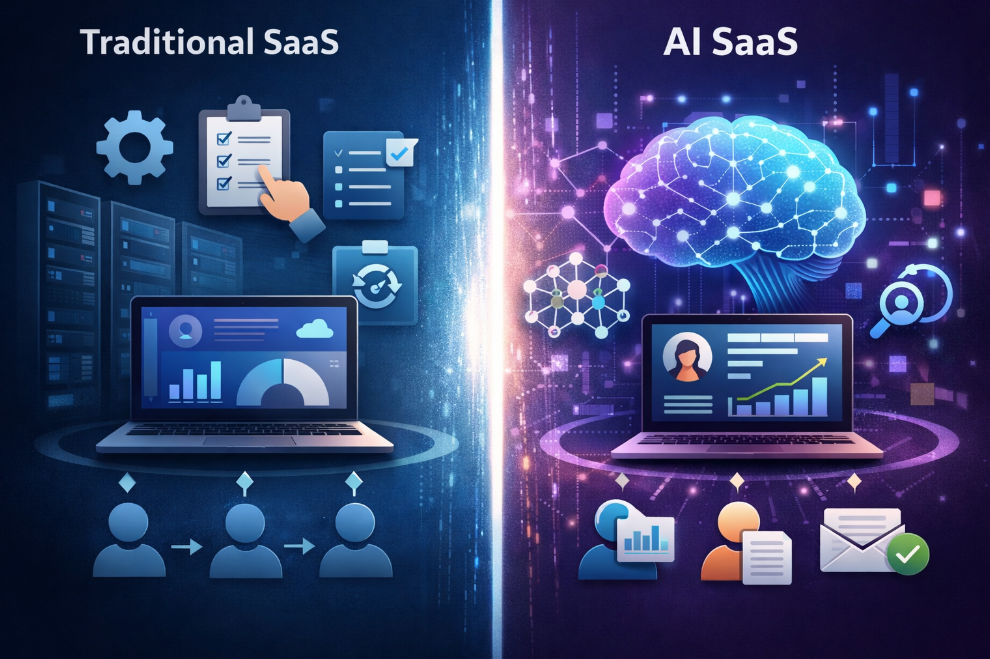
AI SaaS:
- Learns from data
- Adapts based on usage
- Improves over time
- Provides personalized outputs
This shift from static software to intelligent systems is what makes AI SaaS far more valuable—and in many cases, indispensable.
Why AI SaaS is Booming in 2026
The rapid growth of AI SaaS is not accidental. It’s the result of multiple powerful trends coming together at the right time.
1. Massive Demand for Automation
Businesses are under constant pressure to do more with less. Manual processes are slow, expensive, and prone to errors.
AI solves this by:
- Automating repetitive tasks
- Increasing speed and accuracy
- Freeing up human resources for higher-value work
This makes AI not just useful—but essential.
2. Cost Optimization is a Priority
Companies today are highly focused on reducing operational costs.
AI SaaS helps by:
- Replacing multiple tools with one intelligent system
- Reducing dependency on large teams
- Improving efficiency without increasing expenses
For many businesses, AI tools directly impact profitability.
3. Rise of APIs and No-Code Ecosystem
In 2026, building an AI SaaS product is faster than ever.
Thanks to:
- AI APIs (like language, vision, automation models)
- No-code and low-code platforms
- Pre-built integrations
Even small teams—or solo founders—can build powerful SaaS products without deep technical expertise.
4. AI Adoption Across Every Industry
AI is no longer limited to tech companies.
It is now deeply integrated into:
- Healthcare (diagnostics, automation)
- Real estate (lead generation, pricing insights)
- E-commerce (recommendations, personalization)
- Education (adaptive learning systems)
- Marketing (content, targeting, analytics)
This widespread adoption means one thing:
Every industry has problems that AI SaaS can solve.
Read Also:- Top 10 SaaS Features in 2026 Every Digital Marketer Must Use
The Perfect Timing Advantage
What makes 2026 special is the combination of:
- High demand
- Easy accessibility to tools
- Growing acceptance of AI
This creates a rare opportunity where:
- Users are actively looking for solutions
- Technology is easier to build with
- Markets are still not fully saturated
For builders and entrepreneurs, this is not just a trend—it’s a window of opportunity.
Step 1: Find a High-Demand Problem
The success of your AI SaaS product is not determined by your idea—it is determined by the problem behind the idea.
This is where most founders go wrong.
They start with:
“Let’s build something cool with AI.”
Instead of asking:
“What problem is painful enough that people will pay to solve it?”
That single shift in thinking separates successful SaaS founders from failed ones.
The Correct Building Sequence
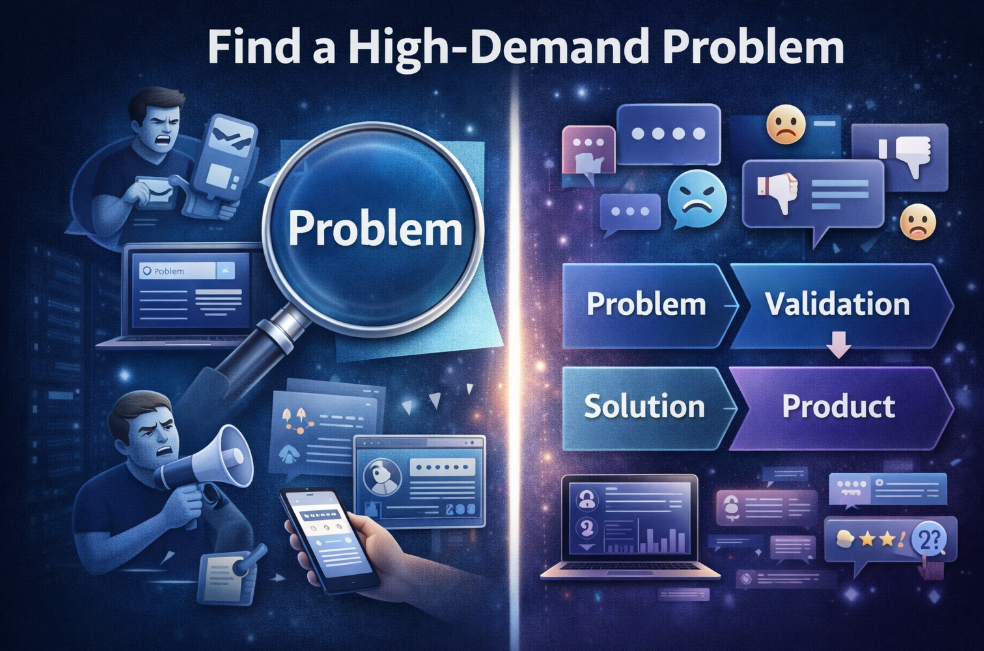
If you want to build something that actually works in the market, follow this order:
Problem → Validation → Solution → Product
Skipping the first two steps is the fastest way to waste months (or years) building something nobody uses.
How to Find Real, Profitable Problems
High-demand problems are not hidden—they are everywhere. You just need to train yourself to observe them.
1. Look Where People Complain
Go to places where users openly share frustrations:
- Online communities and forums
- Social media comments
- Product reviews
Pay attention to repeated complaints.
If multiple people are struggling with the same issue, that’s a signal.
2. Analyze Search Behavior
Search engines reveal intent.
When people type queries, they are literally telling you:
“I have this problem. I need a solution.”
Look for:
- “How to automate…”
- “Best tool for…”
- “Alternative to…”
These queries often indicate buying intent, not just curiosity.
3. Study Where Money is Already Being Spent
This is one of the most powerful (and underrated) methods.
Check freelance marketplaces and service platforms:
- What tasks are businesses outsourcing?
- What are they repeatedly paying for?
If companies are paying humans to solve a problem, there is a strong opportunity to automate it using AI.
What Makes a Problem Worth Solving?
Not all problems are equal. The best SaaS ideas come from problems that are:
- Frequent → Happens regularly
- Urgent → Needs quick resolution
- Expensive → Costs time or money when done manually
If a problem checks all three boxes, it has strong monetization potential.
Advanced Framework: Demand Validation System
Before you invest time in building, evaluate your idea using a structured scoring system.
Demand Score Criteria
1. Search Demand
Are people actively searching for this problem online?
If yes, demand already exists.
2. Problem Intensity
How painful is the issue?
Mild inconvenience ≠ strong business opportunity.
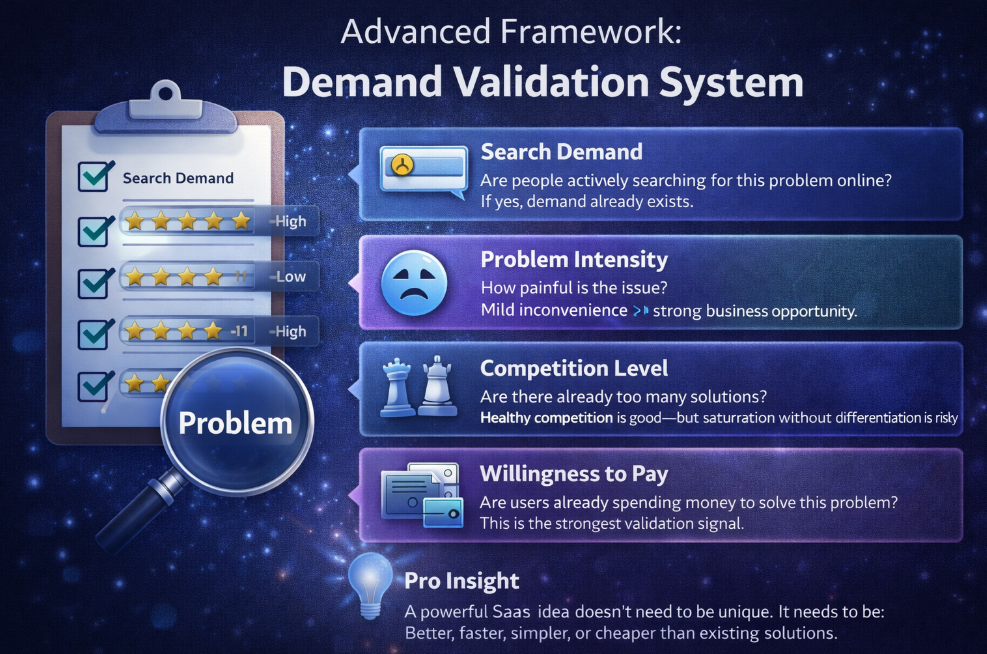
3. Competition Level
Are there already too many solutions?
Healthy competition is good—but saturation without differentiation is risky.
4. Willingness to Pay
Are users already spending money to solve this problem?
This is the strongest validation signal.
Pro Insight
A powerful SaaS idea doesn’t need to be unique.
It needs to be:
Better, faster, simpler, or cheaper than existing solutions.
Step 2: Validate Your SaaS Idea
Validation is where ideas meet reality.
You might feel your idea is great—but the market decides its true value.
And here’s the hard truth:
Most ideas fail at this stage—not because they are bad, but because they were never tested properly.
Read Also:- Hostinger vs Bluehost (2026–2027): Which Web Hosting is the Best Choice for You?
Why Validation Matters
Building a SaaS product without validation is like:
Building a shop in a desert and hoping customers will come.
Validation ensures:
- There is real demand
- People are interested
- Users are willing to pay
Practical Validation Methods
You don’t need a full product to validate an idea. You just need signals.
1. Create a Simple Landing Page
Explain:
- What your product does
- Who it is for
- What problem it solves
Add a clear call-to-action:
- “Join Waitlist”
- “Get Early Access”
If people sign up, that’s your first green signal.
2. Collect Emails (Waitlist Strategy)
Emails = interest.
The more people join your waitlist, the stronger your validation.
3. Offer Pre-Orders or Early Discounts
This is the strongest validation method.
If users are willing to pay before the product exists, your idea has real potential.
4. Talk to Real Users
Short surveys or direct conversations can reveal:
- What users actually need
- What they dislike in current solutions
- What they would pay for
Note: If you want to learn AI tools, digital marketing strategies, and earning ideas on a daily basis, you can join our WhatsApp channel where we regularly share practical and actionable insights:
https://whatsapp.com/channel/0029VbAzT8fGpLHPT8I2Sf44
The Pivot Rule
If validation signals are weak:
- Don’t force the idea
- Don’t overbuild
Instead:
Pivot early. Adjust your idea before investing more time.
Advanced Strategy: Customer Persona Mapping
Understanding your user deeply is your unfair advantage.
Most founders build for “everyone”—and end up serving no one.
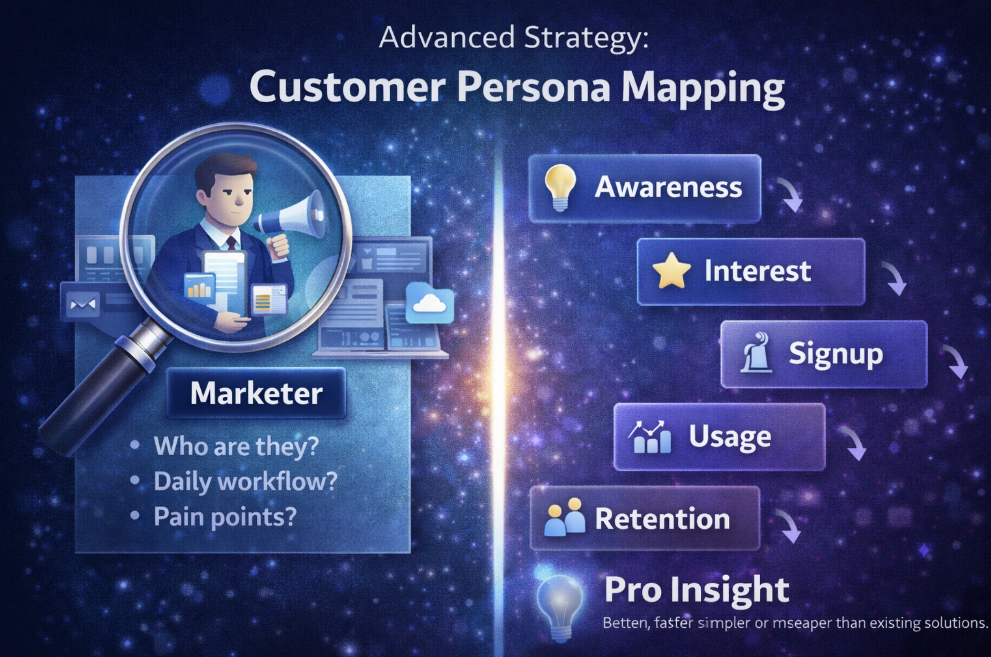
Define Your Ideal Customer
Be specific.
Ask:
- Who are they? (e.g., marketer, freelancer, agency owner)
- What is their daily workflow?
- Which tools do they already use?
- What frustrates them the most?
The clearer your persona, the better your product decisions.
Map the User Journey
Every user goes through a journey:
Awareness → Interest → Signup → Usage → Retention
Your job is to optimize each stage.
For example:
- Awareness → Clear messaging
- Signup → Simple onboarding
- Usage → Immediate value
- Retention → Consistent results
Key Insight
A successful SaaS product doesn’t just solve a problem.
It fits naturally into the user’s daily workflow.
Step 3: Choose the Right AI Technology Stack
Your technology stack is the foundation of your product—but it should support your idea, not define it.
Many founders overcomplicate this step.
The goal is simple:
Choose tools that help you build fast, scale easily, and deliver value.
Core Components of an AI SaaS
1. AI Layer
This is where intelligence comes from:
- AI APIs (fast and easy)
- Custom models (more control, more complexity)
2. Backend
Handles:
- Business logic
- Data processing
- API integrations
This is the “brain” behind your application.
3. Frontend
The user-facing part:
- Dashboard
- Input/output interface
- User experience
Even the best AI will fail if the UX is poor.
Two Practical Approaches
For Non-Technical Founders
You don’t need to code from scratch.
Use:
- No-code / low-code platforms
- Pre-built AI APIs
This allows you to:
- Build faster
- Launch quickly
- Focus on business, not code
For Technical Founders
You can:
- Build custom AI pipelines
- Optimize performance
- Create unique features
This gives more flexibility—but requires time and expertise.
Critical Insight: Prompt Quality = Product Quality
In AI SaaS, output quality depends heavily on input quality.
Poor prompts = poor results.
This directly impacts:
- User satisfaction
- Retention
- Product credibility
Advanced Insight: AI Architecture Planning
Behind every successful AI SaaS is a well-thought-out system design.
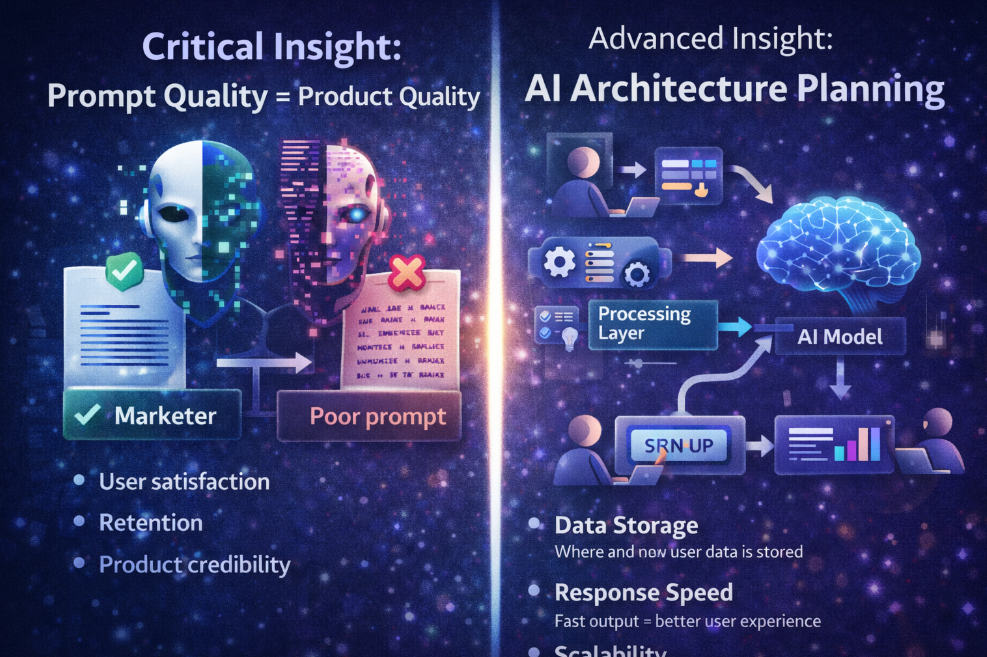
Basic System Flow
User Input → Processing Layer → AI Model → Output → User
What You Must Consider
1. Data Storage
Where and how user data is stored
2. Response Speed
Fast output = better user experience
3. Scalability
Can your system handle growth?
API vs Custom Model Decision
- API-based → Faster, cheaper, ideal for MVP
- Custom-built → Powerful, flexible, better long-term control
Your choice should depend on your:
- Budge
- Timeline
- Long-term vision
Step 4: Build an MVP (Minimum Viable Product)
Your MVP is not your final product.
It is your learning tool.
What is an MVP?
An MVP is the simplest version of your product that:
- Solves one clear problem
- Delivers one core value
Nothing more
Read Also:- Top 10 AI Tools to Make Money Online in 2026 (Beginner to Pro Guide)
The Biggest Mistake Founders Make
Trying to build a “perfect product” before launch.
This leads to:
- Delays
- Overthinking
- Wasted effort
MVP Principles
1. Focus on One Core Feature
Solve one problem exceptionally well.
2. Launch Fast
Speed is more important than perfection.
3. Collect Real Feedback
Your users will tell you:
- What works
- What doesn’t
- What to improve
Example
If you are building an AI chatbot:
Don’t build:
- Integrations
- Analytics dashboards
- Complex workflows
Start with:
- Simple input → AI response system
That’s enough to validate your idea.
Final Insight for This Stage
Your MVP is not about impressing users.
It’s about understanding them.
Build fast → Launch early → Learn quickly → Improve continuously
Advanced Framework: MVP Testing System
Launching your MVP is not the finish line—it’s the starting point of real learning.
At this stage, your goal is not perfection.
Your goal is insight.
The Build–Measure–Improve Cycle
Every successful SaaS product follows a continuous feedback loop:
1. Build
Create the simplest version of your solution and release it to real users.
2. Measure
Track how users interact with your product:
- Where do they click?
- How long do they stay?
- Which feature do they use the most?
This is where assumptions meet reality.
3. Improve
Use real data—not guesses—to:
- Fix usability issues
- Improve performance
- Enhance core features
What You Should Track Early On
Instead of tracking everything, focus on meaningful signals:
- Activation Rate → Are users getting value quickly?
- Drop-off Points → Where are users leaving?
- Engagement → Are they coming back?
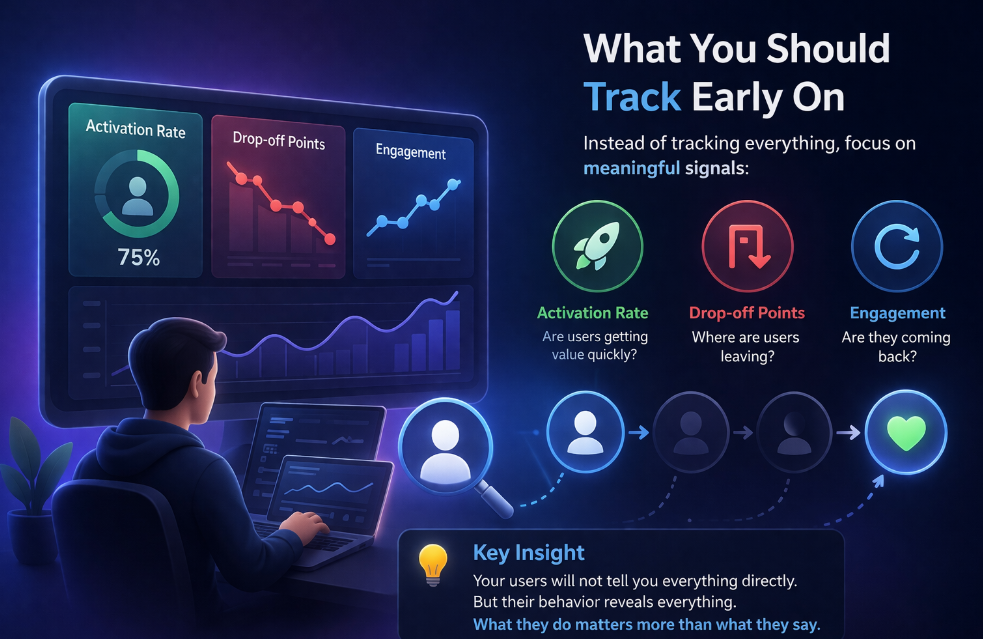
Key Insight
Your users will not tell you everything directly.
But their behavior reveals everything.
What they do matters more than what they say.
Step 5: Pricing Strategy
Pricing is not just about making money—it defines how your product is perceived.
A poorly priced product can:
- Undervalue your offering
- Attract the wrong audience
- Limit long-term growth
A well-priced product communicates:
“This is valuable, and it’s worth paying for.”
Common Pricing Models
1. Freemium Model
Users get basic access for free, with paid upgrades for advanced features.
Best for:
- Rapid user acquisition
- Products with viral potential
2. Subscription Model
Monthly or yearly recurring payments.
Best for:
- Predictable revenue
- Long-term customer relationships
3. Usage-Based Pricing
Users pay based on how much they use.
Best for
- AI-heavy tools
- Scalable consumption models
How to Choose the Right Pricing
Your pricing should align with:
- The value you deliver
- The problem intensity
- The target audience’s budget
Advanced Revenue Optimization
To build a sustainable SaaS, you need to understand the economics behind it.
Key Metrics That Matter
Customer Acquisition Cost (CAC)
How much you spend to acquire one customer.
Lifetime Value (LTV)
Total revenue a customer generates over time.
The Golden Rule
LTV must always be higher than CAC
If not, your business is not sustainable—no matter how many users you have.
Smart Ways to Increase Revenue
- Upsells → Offer advanced features
- Premium tiers → More value for power users
- Enterprise plans → High-ticket clients
- Add-ons → Pay for extra usage or features
Strategic Insight
Don’t compete on price.
Compete on value perception.
Step 6: Launch and Marketing Strategy
Building a great product is only half the battle.
Without users, even the best SaaS will fail.
Effective User Acquisition Channels
1. Content Marketing (SEO)
Create high-value content that solves problems and attracts organic traffic over time.
2. Social Media
Engage with your target audience where they already spend time.
3. Email Marketing
Nurture leads and convert them into paying users.
4. Product Launch Platforms
Launch your product in communities that actively explore new tools.
Getting Your First 100 Users
Your first users are not just customers—they are your growth partners.
Practical Approach
- Join niche communities related to your product
- Offer early access or free trials
- Personally interact with users
- Ask for honest feedback
Why Early Users Matter
They help you:
- Validate your product
- Improve features
- Build testimonials and credibility
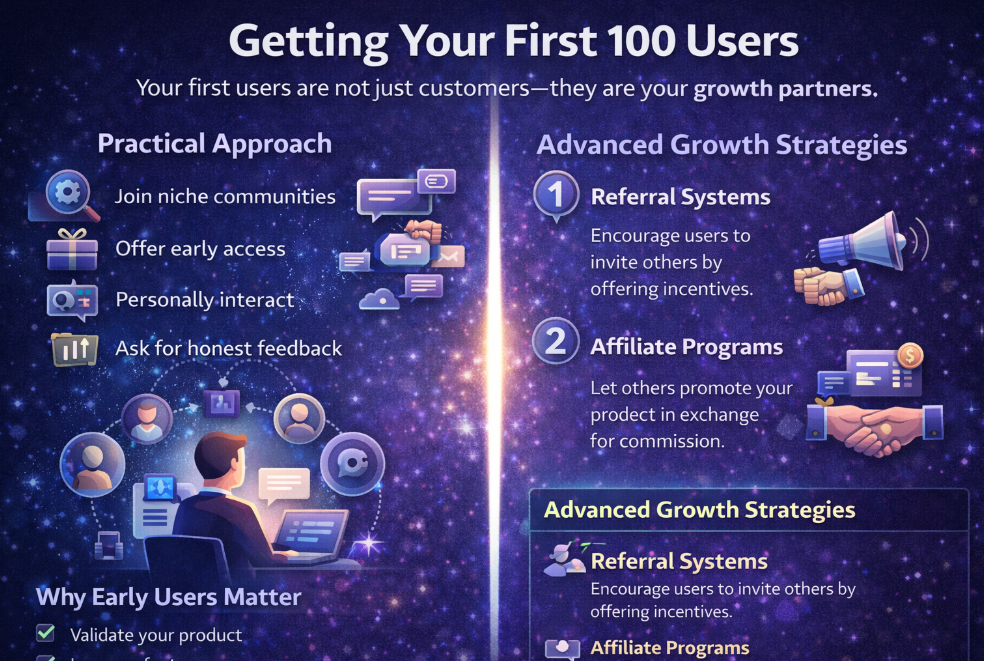
Advanced Growth Strategies
Once you have initial traction, focus on scalable systems.
1. Referral Systems
Encourage users to invite others by offering incentives.
2. Affiliate Programs
Let others promote your product in exchange for commission.
3. Content Funnels
Attract → Educate → Convert users through structured content.
4. Community Building
Create a loyal ecosystem around your product (groups, forums, etc.)
Long-Term Insight
Paid ads can bring users.
But systems bring growth.
Note: If you want to learn AI tools, digital marketing strategies, and earning ideas on a daily basis, you can join our WhatsApp channel where we regularly share practical and actionable insights:
https://whatsapp.com/channel/0029VbAzT8fGpLHPT8I2Sf44
Automation and AI Integration
As your SaaS grows, manual operations become a bottleneck.
The solution: automation.
Where to Use Automation
1. User Onboarding
Automated emails, tutorials, and walkthroughs.
2. Customer Support
AI chat systems for instant responses.
3. Workflow Automation
Automate repetitive backend processes.
Why Automation Matters
- Saves time
- Reduces human error
- Improves scalability
Strategic Insight
Automation is not about replacing humans.
It’s about amplifying efficiency.
Step 7: Scaling Your SaaS
Scaling is not just about getting more users.
It’s about building systems that can handle growth.
Core Areas to Focus On
1. Product Improvement
Continuously refine your product based on real feedback.
2. Feature Expansion
Add features only when they add clear value.
3. Team Building
Hire the right people to handle growth.
4. Operational Efficiency
Optimize processes to reduce costs and increase output.
The Biggest Scaling Mistake
Scaling too early.
If your product is not validated:
- Growth will amplify problems
- Users will churn quickly
Rule to Remember
First make it work. Then make it grow.
SaaS Metrics You Must Track
Data-driven decisions separate successful SaaS businesses from struggling ones.
Essential Metrics
Monthly Recurring Revenue (MRR)
Your predictable monthly income.
Churn Rate
Percentage of users who leave.
Retention Rate
How many users continue using your product.
Average Revenue Per User (ARPU)
How much revenue each user generates.
Why These Metrics Matter
They tell you:
- Are you growing?
- Are users satisfied?
- Is your business sustainable?
Common and Advanced Mistakes to Avoid
Even strong ideas fail due to poor execution.
Critical Mistakes
- Building too many features too early
- Skipping validation
- Targeting the wrong audience
- Ignoring user experience
- Over-dependence on external APIs
- Neglecting data privacy
Strategic Insight
Mistakes in SaaS are expensive.
But avoidable—if you learn early.
Legal and Data Considerations
As your SaaS grows, trust becomes a key factor.
Users are not just buying your product—they are trusting you with their data.
What You Must Ensure
- Strong data protection systems
- Clear privacy policies and terms
- Compliance with relevant regulations
Why This Matters
A single data issue can:
- Damage your reputation
- Lose user trust
- Impact long-term growth
Global Scaling Strategy
Once your SaaS is stable, expansion becomes the next opportunity.
How to Go Global
1. Multi-Language Support
Reach users beyond one region.
2. International Pricing
Adjust pricing based on market affordability.
3. Global Payment Integration
Support multiple currencies and payment methods.
Final Insight
The internet has removed geographical limits.
Your SaaS is not limited to your country—it can serve the world.
The Future of AI SaaS (2026–2030)
The AI SaaS landscape is evolving rapidly, and what we see today is only the beginning.
Over the next few years, the industry will shift from tools that assist users to systems that act on behalf of users.
This transition will redefine how software is built, used, and monetized.
1. Rise of Autonomous AI Agents
The future is not just AI tools—it’s AI that can take action.
Instead of asking AI to generate output, users will rely on systems that can:
- Execute tasks end-to-end
- Make decisions based on data
- Continuously optimize outcomes
For example:
An AI agent won’t just suggest marketing ideas—it will:
- Create campaigns
- Launch ads
- Optimize performance automatically
This shift from assistant → operator is where the biggest opportunity lies.
2. Hyper-Personalization at Scale
Generic tools are becoming obsolete.
Future AI SaaS products will:
- Adapt to individual users
- Learn preferences over time
- Deliver customized outputs instantly
Every user will feel like the product is built specifically for them.
This level of personalization will become a competitive advantage, not a luxury.
3. Deep Industry Integration
AI SaaS will no longer exist as standalone tools.
Instead, it will integrate deeply into:
- Business workflows
- Industry-specific systems
- Existing software ecosystems
This means:
The most successful SaaS products will not be general—they will be specialized.
Niche-focused AI solutions will dominate over broad, generic platforms.
Strategic Insight
The winners in the next wave of AI SaaS will be those who:
- Build for specific industries
- Solve deeper problems
- Create systems, not just tools
Practical Case Insight
Let’s simplify everything with a realistic scenario.
Imagine a small AI SaaS product built for a very specific audience:
- It solves one clear problem
- Targets a defined user group
- Uses a simple subscription model
At first, it may look small.
But here’s what happens over time:
- Users start seeing real value
- Retention improves
- Word-of-mouth spreads
- Features are improved based on feedback
Within months, such a product can generate consistent monthly revenue—not because it is complex, but because it is useful.
Key Lesson
You don’t need to build a “big startup” to succeed.
You need to build:
A small product that solves a big problem.
7-Day Action Plan (From Idea to Execution)
Execution speed is your biggest advantage in today’s market.
Here’s a practical roadmap to move from idea to live product in just 7 days:
Day 1: Identify a Problem
Focus on a real, painful, and frequent issue.
Day 2: Validate the Idea
Test demand using a landing page, surveys, or conversations.
Day 3–5: Build MVP
Create a simple version that solves one core problem.
Day 6: Launch
Release your product to early users—don’t wait for perfection.
Day 7: Collect Feedback
Understand user behavior, fix issues, and improve quickly.
Execution Insight
Speed matters more than perfection.
The faster you launch, the faster you learn.
Conclusion
Building a high-demand AI SaaS app is not about creating something complicated.
It’s about:
- Understanding real problems
- Delivering clear value
- Improving consistently
The Real Difference Between Success and Failure
Successful founders:
- Listen to users
- Adapt quickly
- Focus on outcomes
Unsuccessful founders:
- Overbuild
- Ignore feedback
- Chase trends without direction
Final Thought
Technology alone does not create success.
Understanding people does.
The SaaS products that win are not the ones with the most advanced AI—
they are the ones that solve meaningful problems in the simplest way possible.