SEO Update 2026:- Search engine optimization in 2026 looks very different from what most website owners learned when they first started. The rules did not just change — the entire philosophy changed.
Websites that relied on keyword stuffing, bulk AI publishing, and cheap backlink strategies are now struggling to survive in search results. Meanwhile, smaller, focused websites with real expertise and genuine content are quietly climbing to page one.
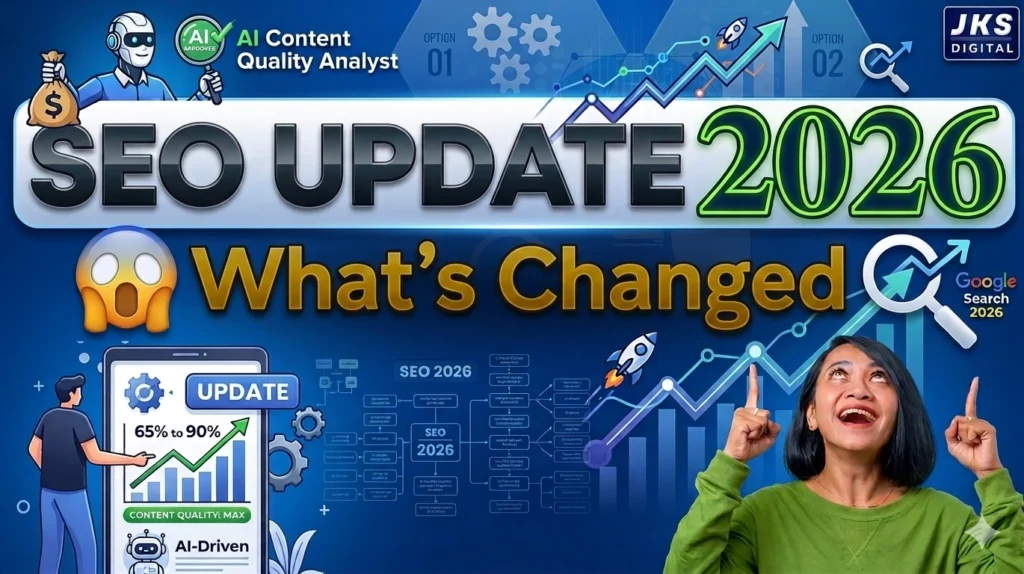
This guide covers everything: what changed, why it changed, who is winning, who is losing, and exactly what you need to do right now.
The Evolution of SEO: From Keywords to Human Value
To understand 2026, you need to understand the journey that led here.
The Early Days (1998–2010): Keywords Were Everything
In the beginning, Google was relatively simple. Rank was determined mostly by how many times a keyword appeared on a page and how many other websites linked to it.
Webmasters would stuff the same keyword dozens of times into a page — sometimes even in invisible white text on a white background — just to trick the algorithm.
It worked. For a while.
The Quality Era (2011–2018): Google Started Fighting Back
Google launched a series of major updates designed to kill low-quality content:
- Panda (2011) — Targeted thin, low-quality, and duplicate content
- Penguin (2012) — Penalized manipulative and spammy link building
- Hummingbird (2013) — Introduced semantic search; Google started understanding meaning, not just words
- RankBrain (2015) — Brought machine learning into ranking decisions
- Medic Update (2018) — Heavily impacted health, finance, and YMYL websites with weak authority
Each update pushed SEO professionals to create better, more legitimate content.
The Intent and Experience Era (2019–2024): Understanding the Human Behind the Search
- BERT (2019) made Google capable of understanding natural language at a much deeper level
- Core Web Vitals (2021) made page experience an official ranking factor
- Helpful Content System (2022–2024) was a turning point — Google began actively rewarding content written for people and penalizing content written only for rankings
Where We Are Now (2026): Authenticity, Authority, and Real Value
By 2026, Google’s systems have matured to a level where surface-level optimization is not enough. The algorithm now evaluates the person behind the content, the depth of the content, and the genuine usefulness of the page — not just its technical structure.
What Actually Changed in SEO in 2026?
The late 2025 and early 2026 algorithm refinements brought several visible shifts:
| What Changed | Impact |
|---|---|
| AI-generated spam detection improved | Bulk AI sites lost traffic |
| E-E-A-T signals became more algorithmic | Anonymous sites dropped |
| Search intent evaluation deepened | Generic articles lost rankings |
| AI Overviews expanded | Zero-click rates increased |
| Community content surfaced more | Reddit, Quora visibility grew |
| Core Web Vitals thresholds tightened | Slow sites penalized harder |
These were not isolated updates. They represent a unified direction: reward genuine helpfulness, punish manipulation.
Search Intent: The Most Underestimated Ranking Factor
Most SEO guides tell you to “target keywords.” In 2026, that advice alone is incomplete.
What actually matters is understanding why someone is searching — and then completely satisfying that reason.
The Four Types of Search Intent
Informational — “How does HIIT training work?” The user wants to learn. Content should educate thoroughly.
Navigational — “Gmail login page” The user wants to go somewhere. Your brand pages benefit here.
Commercial Investigation — “Best email marketing tools 2026” The user is comparing options. Honest comparison content wins.
Transactional — “Buy noise cancelling headphones under 5000” The user is ready to act. Product pages and landing pages dominate.
Practical Example
Suppose you have an article targeting: “How to fix WordPress 500 internal server error”
A page that only defines what a 500 error is will lose to a page that:
- Lists every common cause with explanations
- Provides step-by-step troubleshooting for each cause
- Includes screenshots of the hosting panel and WordPress dashboard
- Covers both shared hosting and VPS environments
- Adds a section on how to prevent it from happening again
The second page fully satisfies intent. The first page just mentions the topic.
Read Also:- Why Writing More Articles Hurts Your SEO in 2026 – I Learned It the Hard Way
The rule in 2026: Your content must make the user feel they never need to go back to Google.
E-E-A-T: Google’s Framework for Evaluating Content Quality
E-E-A-T stands for Experience, Expertise, Authoritativeness, and Trustworthiness. It was originally a framework for Google’s human quality raters, but by 2026 it has become deeply embedded in automated ranking signals.
Breaking Down E-E-A-T in 2026
Experience — Has the author actually done what they are writing about?
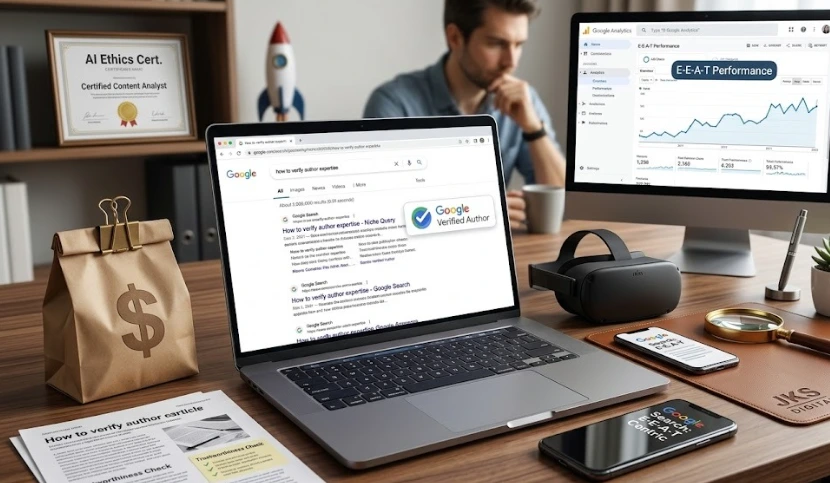
A review written by someone who bought the product, used it for 30 days, and documented real results is far more valuable than a review compiled from other reviews.
Expertise — Does the author have genuine knowledge in this field?
A cybersecurity article written by a certified ethical hacker carries significantly more weight than one written by a general content writer.
Authoritativeness — Is the website recognized as a credible source in its niche?
This is built through backlinks from respected sources, citations in publications, and consistent publication of high-quality content over time.
Trustworthiness — Is the website transparent and accurate?
This includes having clear author information, an About page, cited sources, HTTPS security, and no misleading or false claims.
Trust Signals Checklist for 2026
- Named authors with bios and credentials on every article
- Functional About and Contact pages
- Source citations for factual claims
- Clear disclosure of sponsored or affiliate content
- Up-to-date, accurate information
- HTTPS security certificate
- No deceptive popups or manipulative design patterns
Websites missing these signals are increasingly at a disadvantage — especially in competitive or YMYL (Your Money Your Life) niches like health, finance, and legal.
AI Content in 2026: The Truth Beyond the Debate
The AI content conversation is often framed as a binary: AI content is either completely fine or completely banned. Neither extreme is accurate.
What Google Actually Says
Google’s official position is clear: content is evaluated on quality and usefulness, not on how it was produced. A well-written, accurate, helpful AI-assisted article can rank. A human-written article full of misinformation and fluff will not.
What Is Actually Happening in 2026
Websites that used AI irresponsibly are paying the price:
- Mass-published AI articles with no original insights or fact-checking are losing visibility
- Template-based AI content that follows predictable structures without real depth is being devalued
- Keyword-stuffed AI blogs with no genuine expertise signal are dropping in rankings
Websites using AI intelligently are growing:
- Using AI for research, outlining, and brainstorming while experts write the final content
- Using AI to improve readability and structure of content written from personal experience
- Using AI for technical SEO tasks like meta descriptions, schema suggestions, and content gap analysis
The Right AI Workflow for 2026
- Use AI to research and outline the topic
- A human expert writes the content with real insights
- AI assists with editing and structure improvements
- A human does the final review for accuracy and tone
- Publish with full author attribution and expertise signals
AI is a tool. In 2026, the websites using tools wisely are winning.
Read Also:- Audit Your Website with Claude AI: Find SEO Errors in 2 Minutes (2026)
Why Websites Are Losing Rankings in 2026
Here are the most common reasons websites have seen traffic drops:
Thin Content Without Real Depth
Articles that skim the surface of a topic without providing actionable, specific information are struggling. Google can now evaluate whether a page truly answers the question it claims to answer.
No Demonstrable Expertise
Generic content that anyone could write — with no personal experience, no original data, and no real-world examples — is increasingly invisible in competitive searches.
Poor User Experience Signals
If users land on your page and immediately return to Google, that is a negative behavioral signal. Poor mobile layouts, slow load times, intrusive ads, and confusing navigation all contribute to this problem.
Outdated Information
An article about “Instagram algorithm tips” from 2022 that has never been updated is not just unhelpful — it can actively hurt your website’s freshness and trust signals.
Weak Internal Link Structure
Isolated content pages with no connection to related content on your website miss the opportunity to demonstrate topical depth. Google evaluates your website as a whole, not just individual pages.
Manipulative or Low-Quality Backlinks
Link schemes, paid links from irrelevant sites, and private blog networks are increasingly detected and can trigger manual or algorithmic penalties.
SEO Strategies That Work in 2026
1. Build Topical Authority Through Content Clusters
Instead of publishing random articles across different topics, build deep coverage around one focused niche.
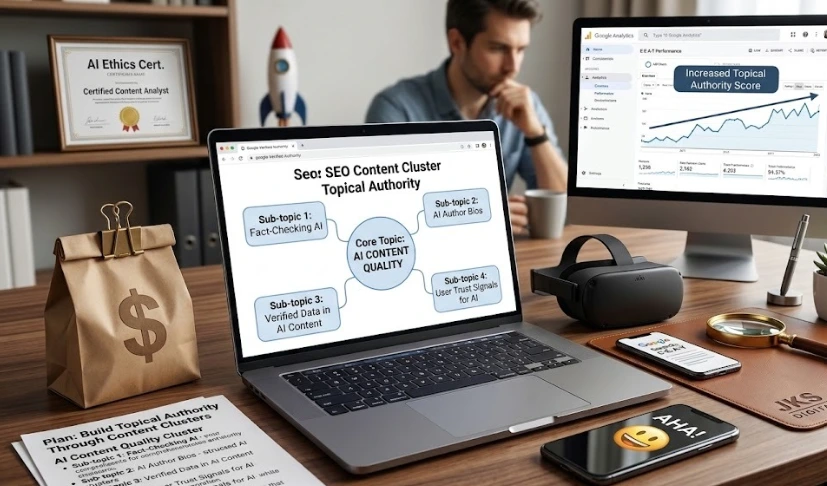
How content clusters work:
- Create one comprehensive Pillar Article covering a broad topic
- Create multiple Cluster Articles that go deep on each subtopic
- Internally link all cluster articles back to the pillar and to each other
Example for a Personal Finance Website:
Pillar: Complete Guide to Investing for Beginners in 2026
Cluster articles:
- How index funds work
- Difference between stocks and bonds explained
- How to open a brokerage account step by step
- Tax implications of investing in India/US
- How to build a portfolio with ₹5,000 per month
When every subtopic is thoroughly covered and interlinked, Google recognizes your website as a topical authority — and rewards it with stronger rankings across all related searches.
Read Also:-Best SEO Agency in Gurgaon – Why JKS Digital is the Right Choice for Your Business
2. Refresh Existing Content the Right Way
Updating old articles is one of the highest-return SEO activities available in 2026.
But a proper refresh is not just changing the year in the title. A genuine content refresh means:
- Replacing outdated statistics with current data from credible sources
- Updating screenshots and interface descriptions that have changed
- Adding new sections to cover aspects the original article missed
- Improving the H2/H3 structure for better readability
- Adding an FAQ section to capture featured snippet opportunities
- Checking and fixing all internal and external links
Google’s systems detect the depth of changes made during an update. Superficial edits do not reset freshness signals. Genuine improvements do
3. Create Content With Real Human Experience
This is the single biggest differentiator between content that ranks in 2026 and content that does not.
Practical ways to add genuine experience to your content:
- Document your actual process. If you are writing a guide on setting up Google Analytics 4, show exactly what you did, what errors you encountered, and how you solved them.
- Include specific numbers. “This strategy increased our organic traffic by 34% over 90 days” is more valuable than “this strategy can help increase traffic.”
- Share what failed. Authentic content includes honest reflections on what did not work and why.
- Use original screenshots and visuals. Stock images add nothing. Real screenshots from your actual experience add credibility.
4. Optimize for Core Web Vitals
Google’s three primary user experience metrics remain critical in 2026:
| Metric | What It Measures | Good Score |
|---|---|---|
| LCP (Largest Contentful Paint) | Main content load speed | Under 2.5 seconds |
| INP (Interaction to Next Paint) | Page responsiveness | Under 200 milliseconds |
| CLS (Cumulative Layout Shift) | Visual stability during load | Under 0.1 |
Practical improvements:
- Compress and convert images to WebP format
- Use a fast hosting provider with server response time under 200ms
- Implement a Content Delivery Network (CDN)
- Minimize render-blocking JavaScript
- Reserve space for ads and images to prevent layout shifts
Use Google’s PageSpeed Insights and Search Console’s Core Web Vitals report to identify and prioritize issues.
5. Implement Schema Markup Strategically
Schema markup tells search engines exactly what your content is about and enables rich results — enhanced search appearances that significantly improve click-through rates.
Most valuable schema types in 2026:
- Article Schema — Provides author, publish date, and update date information
- FAQ Schema — Displays questions and answers directly in search results
- How-To Schema — Shows numbered steps in search results for instructional content
- Review Schema — Displays star ratings for product and service reviews
- Breadcrumb Schema — Helps Google understand your site structure
A page with FAQ schema showing expanded answers in search results can occupy significantly more visual space on the results page — leading to higher click-through rates even without ranking at position one
6. Strengthen Backlink Profile Through Genuine Value
In 2026, the most effective link building strategies are:
- Original research and data — Create surveys, compile original datasets, or conduct industry studies. These naturally attract links from journalists and other websites.
- Digital PR — Get your expertise featured in relevant publications, podcasts, and news articles.
- Genuine guest posting — Write high-quality, original content for respected websites in your niche — not generic articles on any site that accepts submissions.
- Linkable assets — Free tools, calculators, templates, or comprehensive guides that others reference and link to.
One contextual backlink from a relevant, trusted website in your niche is worth more than a hundred low-quality links from unrelated sites.
Mobile UX: No Longer Optional
Google has used mobile-first indexing since 2019, meaning it uses the mobile version of your website to determine rankings. In 2026, mobile experience expectations have risen further.
Critical mobile UX requirements:
- Text must be readable without zooming (minimum 16px body text)
- Tap targets (buttons, links) must be large enough to use comfortably
- No horizontal scrolling
- Content must not be hidden behind aggressive popups on mobile
- Images must scale properly on all screen sizes
Use Google Search Console’s Mobile Usability report regularly. Any mobile usability errors flagged there should be treated as high-priority fixes.
The Impact of AI Overviews on Organic Traffic
Google’s AI Overviews have permanently changed the search landscape. For simple informational queries, users increasingly get their answer directly on the search results page without clicking through to any website.
Read Also:- 15 SEO Mistakes in 2026 That Are Killing Your Website Rankings
What this means for content strategy:
Pure fact-delivery content — articles that simply define terms or answer basic questions — has declining traffic value. The opportunity has shifted to:
- Content requiring depth beyond what a two-paragraph AI summary can provide
- Original data and research that AI Overviews cite (and link to)
- Interactive tools, calculators, and resources that require the user to visit your website
- Opinion pieces, case studies, and experience-based content that AI cannot authentically replicate
- Comparison and recommendation content based on genuine testing
The websites appearing as sources within AI Overviews are gaining a new type of high-authority visibility. To be cited there, you need to be a recognized authority with well-structured, accurate, clearly sourced content.
Future of SEO: What Comes After 2026
The trajectory is clear. SEO will continue moving in one direction: reward genuine value, eliminate manipulation.
Emerging trends that will shape SEO beyond 2026:
Multimodal Search — Google Lens and visual search are growing. Optimizing images with accurate alt text, file names, and surrounding context will become more important.
Answer Engine Optimization (AEO) — As users interact with AI-powered search assistants, being cited as a source within those AI responses will be a new form of SEO visibility. This requires the same things as traditional authority building: accurate content, strong trust signals, and real expertise.
Brand as a Ranking Signal — Websites that people search for by name, talk about on social media, and reference organically are receiving favorable treatment. SEO and brand building are merging.
Personalized Search — Rankings are increasingly personalized based on user history and context. Building user loyalty and return visits will correlate with better individual ranking outcomes.
The fundamental principle through all of this remains unchanged: build something genuinely worth finding, and search engines will find ways to surface it.
Frequently Asked Questions (FAQs)
Q1: Does Google penalize AI-generated content in 2026?
No. Google evaluates content based on quality and helpfulness, not production method. AI-generated content that is accurate, original, and genuinely useful can rank. Low-quality AI spam cannot.
Q2: How often should I update old blog posts?
Review your top-performing articles every six months. Update any article where statistics, screenshots, or steps have become outdated. For rapidly changing topics, quarterly reviews are appropriate.
Q3: How many words should a blog post be in 2026?
There is no universal answer. A post should be exactly as long as needed to completely satisfy the search intent — no more, no less. A 1,200-word article with genuine depth can outperform a 4,000-word article padded with unnecessary information.
Q4: Are backlinks still important in 2026?
Yes, but quality matters far more than quantity. Ten contextually relevant backlinks from trusted websites in your niche are more valuable than 500 links from unrelated, low-authority sites.
Q5: What is topical authority and how do I build it?
Topical authority means your website comprehensively covers a specific subject area. Build it by creating content clusters — a main pillar article covering a broad topic, supported by detailed articles on every related subtopic, all internally linked together.
Q6: How does E-E-A-T affect my rankings?
E-E-A-T (Experience, Expertise, Authoritativeness, Trustworthiness) influences how Google’s systems evaluate the quality and credibility of your content. Websites lacking clear author information, demonstrable expertise, and trust signals are at a disadvantage — especially in competitive niches.
Q7: What is the most important SEO change in 2026?
The most significant shift is Google’s improved ability to distinguish genuinely helpful content from content created purely for rankings. This has made authenticity, real expertise, and content depth more important than any individual technical optimization.
Q8: How do I protect my website from future algorithm updates?
The most reliable protection is consistently publishing content that genuinely helps your audience, maintaining strong trust signals, keeping your content updated and accurate, and building real authority in your niche. Websites that focus on genuine value are consistently less affected by algorithm updates than those built on technical shortcuts.
Conclusion: The New Mindset of SEO in 2026
The most important shift in SEO is not technical. It is philosophical.
SEO in 2026 is not about finding loopholes in an algorithm. It is about building a website that deserves to rank.
Every major change Google has made — from Panda in 2011 to the Helpful Content System to the algorithm refinements of 2026 — has moved in the same direction: closer to rewarding what genuinely serves the user.
The websites thriving in 2026 share a common characteristic. They are not chasing rankings. They are building genuine expertise, sharing real experience, and creating content that makes their readers’ lives better in some specific way. The rankings follow.
The formula is straightforward, even if the execution requires consistent effort:
Real expertise + genuine experience + deep content + technical excellence + authentic trust = sustainable SEO.
That formula did not change in 2026. It just became impossible to fake.