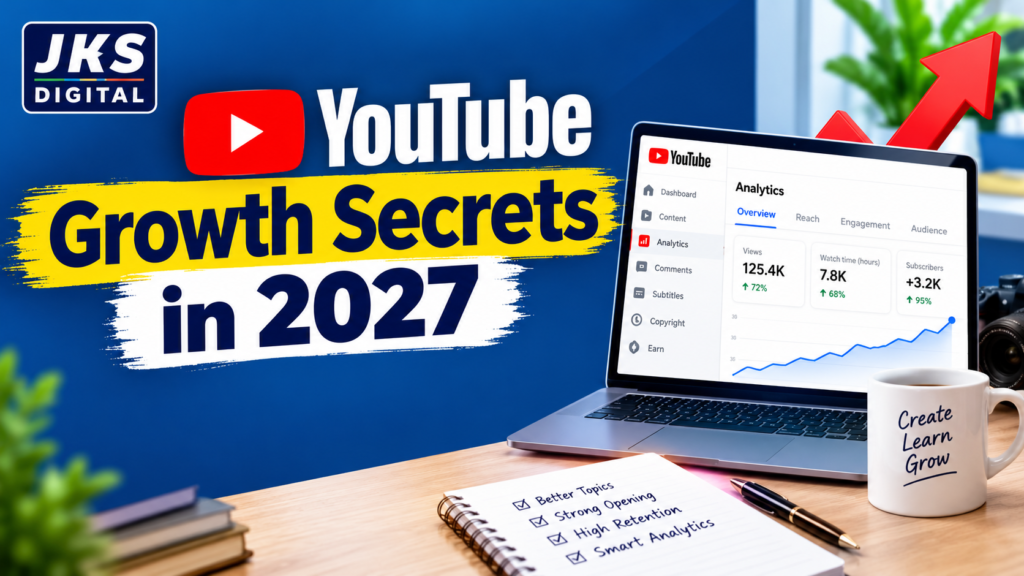
YouTube Growth Secrets in 2027:- YouTube has become more than a platform for uploading videos. It is a place where creators build communities, share knowledge, develop personal brands, and create business opportunities. However, getting consistent views is not always easy. Some videos attract thousands of viewers, while others struggle to reach even a small audience despite hours of research, recording, and editing.
The difference is not always the camera quality, the number of subscribers, or how frequently a creator uploads. Sometimes, a video fails because it targets the wrong audience, answers a question nobody is actively searching for, or does not deliver what its title promises.
Growing a YouTube channel in 2027 requires more than uploading videos regularly. Creators need to understand their audience’s interests, identify topics worth covering, and give viewers a clear reason to watch. Rather than chasing every viral trend, focus on producing relevant content that answers real questions and keeps your intended audience interested. Instead of relying on random viral tricks, focus on building a repeatable strategy that helps the right viewers find your content.
This guide explores YouTube SEO, keyword research, video titles, thumbnails, audience behaviour, and practical growth strategies to help you make more informed decisions about your channel.
How the YouTube Algorithm Works in 2027
One of the biggest misconceptions about YouTube is that a single ranking formula determines the success of every video. In reality, YouTube uses different systems to help viewers discover content that matches their interests. The factors that matter can vary depending on whether someone is searching for a tutorial, browsing the homepage, or watching a related video.
For example, imagine that a person searches for “how to edit videos on a mobile phone.” YouTube needs to identify videos that are relevant to that query and useful to that viewer. Another person might open YouTube to watch entertainment videos without searching for anything specific. Their homepage recommendations will be personalised according to their viewing interests and other signals.
YouTube’s official guidance explains that Search considers relevance, engagement, and quality, while recommendation systems also use information such as watch history, search history, and viewer feedback. Video performance and audience personalisation help determine which videos are suitable for different viewers. Read YouTube’s official explanation of Search and Discovery.
Understanding YouTube Search, Home, and Suggested Videos
To improve discoverability, creators should understand the three major ways viewers can find their content.
YouTube Search: This is important when people actively look for answers, tutorials, reviews, explanations, or solutions. Your title, description, and actual video content should clearly relate to the subject people are searching for.
YouTube Home: The homepage offers personalised recommendations based on viewers’ interests and activity. A video does not necessarily need to target a popular search term to reach people through this surface.
Suggested Videos: These recommendations appear alongside or after videos that viewers are watching. Creating useful, related content can help your videos become relevant to people interested in similar subjects, although placement is never guaranteed.
These discovery methods require slightly different approaches. A tutorial answering a specific question may be designed primarily for Search, while an engaging case study or compelling story may also appeal to viewers browsing their homepage.
The key is to understand how your intended audience discovers information and create content that fits that behaviour.
How to Choose YouTube Video Topics Your Audience Is Searching For
Keyword research is one of the most useful starting points for a channel that wants to attract viewers through search. However, choosing a keyword simply because it has a large search volume can lead to disappointing results.
A broad topic may attract considerable interest but also face intense competition. A more specific topic may reach fewer people overall while attracting viewers who are genuinely interested in the solution you provide.
For instance, consider the difference between “digital marketing” and “how to get your first digital marketing client without paid ads.” The first topic is extremely broad. The second addresses a particular problem and gives the creator a clearer direction for planning the video.
Use YouTube Search Suggestions to Discover Topic Ideas
Start by entering a broad subject into YouTube’s search bar and observing the suggested queries. These suggestions can help you discover the different ways people phrase their questions.
Read Also:- How to Optimize Your LinkedIn Profile in 2027 and Grow Followers, Connections & Opportunities
Suppose your channel covers YouTube growth. You could explore ideas such as:
- How to grow a YouTube channel from zero
- How to improve YouTube video rankings
- Why a new YouTube channel gets no views
- How to create better thumbnails
- How to increase audience retention
Treat these suggestions as research ideas, not proof of exact search volume. You can then compare the topics with existing search results, questions in relevant video comments, and the performance of your own content.
YouTube Studio’s Research features, where available, can also help creators explore topics their audiences may be interested in.
Choose Keywords Based on Search Intent
Search intent means understanding what a person actually wants when entering a query.
Someone searching for “YouTube thumbnail size” probably wants a specific technical answer. Someone searching for “how to make YouTube thumbnails that get clicks” is looking for a broader process or strategy.
Although these topics are related, they need different video formats and levels of explanation.
Before choosing a keyword, ask yourself three questions:
- What problem is the viewer trying to solve?
- What information would make the video genuinely useful?
- Can I explain or demonstrate the solution better, more clearly, or more specifically than my current content?
Your answers will help you create videos with a clear purpose instead of publishing content simply to include a popular keyword.
Discover Opportunities Your Competitors Have Missed
One practical way to improve your content strategy is to look beyond the topics competitors have already covered. Instead of copying their most popular videos, investigate what their viewers still want to know.
Imagine that several videos explain how to start a YouTube channel. Their comment sections may reveal additional questions about selecting a niche, planning the first ten videos, understanding analytics, or improving thumbnails with limited resources.
Each unanswered question could become a focused video that solves one specific problem.
Use the Search Intent Gap to Create More Useful Content
A search intent gap exists when the content available to a viewer does not fully satisfy the information they need. You can look for this opportunity by reviewing competing videos and asking:
- Does the explanation provide clear, practical steps?
- Are important beginner questions left unanswered?
- Does the creator demonstrate the process or only describe it?
- Are examples relevant to small channels as well as established creators?
- Is the information supported by reliable sources when factual claims are involved?
For example, a basic video might explain what YouTube audience retention means. Your video could go further by showing how to interpret a retention graph, identify where viewers leave, and decide what to improve in the next upload.
That additional usefulness gives viewers a reason to choose your content.
However, do not assume that a topic is automatically an opportunity just because competitors have not covered it. Check whether the subject is relevant to your audience and whether you can deliver a credible answer.
Create YouTube Titles That Attract the Right Audience
Your video title helps viewers understand what they will get from watching. It also provides YouTube with information about the subject of your content.
A strong title combines clarity, relevance, and a specific benefit. It should make the intended viewer curious without promising something the video cannot deliver.
Compare these examples:
Generic title: YouTube SEO Tips
More specific title: How to Improve YouTube Search Rankings for a New Channel
The second title gives viewers a clearer idea of the subject and who may benefit from it.
Another example:
Generic title: YouTube Analytics Guide
More useful title: How to Use YouTube Analytics to Find Out Why Viewers Leave Your Videos
The stronger version identifies a problem and suggests what the viewer will learn.
Read Also:- Best Affiliate Marketing Platforms in 2027: Which Is Right for You?
Follow These Title Optimisation Principles
Place the main topic naturally. If your video is about YouTube keyword research, make that subject clear without repeating the same phrase unnecessarily.
Communicate a genuine benefit. Tell viewers what they can learn, understand, or accomplish.
Be specific when it helps. Mention the relevant audience, problem, or technique if doing so makes the title more informative.
Avoid misleading promises. Claims such as “guaranteed viral growth overnight” create unrealistic expectations and may leave viewers dissatisfied.
Keep the title consistent with the video. A compelling title is useful only when the content delivers on its promise.
You can also review the titles of your existing videos to identify opportunities for improvement. If you change a title, evaluate the result in context rather than assuming the change itself will improve rankings.
Keep Viewers Watching With a Strong Video Opening
Getting someone to click on your YouTube video is only the beginning. The next challenge is giving them a good reason to stay. If your opening takes too long to reach the main topic, viewers may leave before discovering the value your video offers.
A useful opening quickly establishes what the video is about, why the subject matters, and what the viewer can expect to learn. You do not need dramatic music, exaggerated claims, or a complicated introduction. You need a clear message that connects with the reason someone clicked on your video.
For example, if your video explains how to improve YouTube rankings, you could begin by highlighting a common problem: a creator publishes useful videos but struggles to attract search traffic. Then introduce the specific areas you will explain, such as topic relevance, audience retention, and performance analysis.
This approach gives viewers context without wasting their time.
What Should You Include in the First 30 Seconds?
The opening should reflect the video’s subject and the audience’s expectations. Consider including these elements where they fit naturally:
- A relevant problem: Introduce a challenge your target audience recognises.
- A clear promise: Explain what viewers will understand or be able to do after watching.
- An immediate starting point: Begin delivering useful information instead of spending too much time on greetings.
- A natural transition: Move directly into the first major explanation or demonstration.
Avoid treating the first 30 seconds as a strict algorithm rule. Different topics and formats need different openings. A detailed educational tutorial may require a little context, while a quick practical demonstration can often begin immediately.
The goal is to make the opening useful enough that viewers understand why continuing to watch is worthwhile.
Improve Audience Retention Without Making Videos Feel Longer
Audience retention helps creators understand how viewers respond to their videos over time. It shows which sections hold attention and where people tend to stop watching. Instead of trying to make every video longer, focus on making each section contribute something meaningful.
A six-minute tutorial that solves a specific problem clearly may serve its audience better than a fifteen-minute video filled with repeated explanations. The appropriate length depends on the subject, the viewer’s needs, and how much explanation the topic genuinely requires.
Use YouTube‘s Retention Graph to Find Weak Sections
After publishing a video, open YouTube Studio and review its audience retention report when sufficient data is available. Look for patterns rather than assuming that every decline means the content is poor.
For example, imagine that a tutorial receives steady initial views but loses a large proportion of its audience during a long explanation of basic concepts. This could indicate that the section is too slow, repeats information, or does not match what viewers expected.
Compare that section with the rest of the video and consider whether you could improve it by:
- Removing unnecessary repetition.
- Showing the actual process instead of explaining every step verbally.
- Adding a practical example where the explanation becomes difficult to follow.
- Moving essential information earlier.
- Using clearer transitions between related ideas.
A sudden drop can have several causes, so examine what is happening in the video before deciding what to change.
Make Every Section Earn the Viewer’s Attention
Before publishing, review your script and ask a simple question: does this paragraph help the viewer understand something, solve a problem, or follow the explanation?
If a section does none of these things, shorten it or remove it. This does not mean cutting every pause or making the video unnecessarily fast. Some topics need careful explanations, demonstrations, and time for viewers to understand unfamiliar concepts.
The aim is to maintain a useful balance between clarity and pace. When viewers can follow the information without unnecessary distractions, the viewing experience becomes more satisfying.
Understand Click-Through Rate and Watch Time Together
YouTube creators sometimes focus heavily on click-through rate (CTR) because it indicates how often people click after seeing a video thumbnail and an eligible impression. However, CTR alone cannot explain whether a video is performing well overall.
A compelling thumbnail may attract attention, but the content must fulfil the expectation it creates. Similarly, a video can provide excellent information yet struggle to attract clicks if its title does not communicate the subject clearly.
That is why it is useful to evaluate CTR alongside impressions, audience retention, watch time, and traffic sources.
What Different Analytics Patterns Can Tell You
Consider the following situations when reviewing your channel’s performance.
When impressions are increasing but CTR is relatively low: Review whether the title communicates a clear benefit and whether the thumbnail is easy to understand. Also consider where the impressions come from, because CTR can vary across traffic sources and audiences.
When CTR looks promising but viewers leave early: Check whether the opening delivers on the title’s promise. The issue could involve a slow introduction, unclear explanations, or a mismatch between the intended audience and the video.
When viewers watch for a substantial portion of the video but reach remains limited: Investigate the topic’s audience demand, competition, and current sources of traffic. Good retention does not automatically guarantee broad distribution.
When one video performs well but similar uploads struggle: Compare the topics, audience expectations, traffic sources, and retention patterns. Do not assume that repeating the same title format or thumbnail style will reproduce the result.
These patterns are diagnostic clues, not fixed rules. Evaluate them using the context of each video rather than judging performance from one metric alone.
Read Also:- How to Get Your First Client Using ChatGPT in 2027 Without Spending on Ads
Develop Related Videos to Increase Discovery Opportunities
A viewer who enjoys one of your videos may have related questions. Creating useful follow-up content gives that person another opportunity to discover your channel.
For example, a channel about YouTube growth could publish a sequence of connected tutorials:
- Choosing topics for a new YouTube channel.
- Writing clearer titles and designing effective thumbnails.
- Understanding audience retention reports.
- Improving videos based on performance data.
Each video addresses a different problem, while the overall collection serves an audience with a shared interest.
This approach is more useful than publishing unrelated subjects simply because they are trending. It also helps creators plan content in advance and develop deeper knowledge of a particular niche.
Connect Videos Through Playlists and End Screens
Use playlists to organise related videos so viewers can easily find additional material. End screens can direct viewers to another relevant video or playlist when the feature is available for the content.
Choose destinations that make sense for the viewer’s next step. Someone watching a beginner’s guide may appreciate a more advanced tutorial, while a viewer who has just learned keyword research may benefit from a video about creating a content plan.
The objective is not to keep viewers clicking indefinitely. It is to make discovering the next useful resource easier.
Remember that recommendations depend on individual viewers and their interests. Related videos, playlists, and end screens can support navigation, but they do not guarantee that YouTube will recommend every video in the sequence.
Use YouTube Analytics to Make Better Content Decisions
Publishing a video gives you an opportunity to learn how your audience responds. YouTube Studio provides several reports that can help you understand which topics attract viewers, how people discover your content, and where improvements may be needed.
Instead of checking views alone, examine the metrics that relate to your particular goal.
Focus on the Most Relevant Reports
Reach: Review impressions, click-through rate, and traffic sources to understand how people discover your videos.
Engagement: Examine watch time, average view duration, and audience retention to understand viewing behaviour.
Audience: Explore available information about returning viewers and your audience’s viewing habits to identify patterns that may inform future topics.
Content performance: Compare videos covering similar subjects to understand which approaches appear more useful to your audience.
For example, if several tutorials about beginner SEO attract returning viewers, that may be a reason to develop another practical tutorial for the same audience. If a video attracts search traffic over time, examine the questions it answers and whether related questions remain unexplored.
Test Improvements Instead of Guessing
When a video underperforms, avoid changing everything at once. Start with the most plausible issue and make a deliberate improvement.
You might revise a confusing thumbnail, improve the opening of a future video, or explain a difficult concept with a demonstration. Then compare the results with relevant previous videos, keeping differences in topic and audience in mind.
Where YouTube’s thumbnail testing feature is available, creators can use it to compare eligible thumbnail variations. Results should be interpreted in the context of the test and the metrics YouTube reports.
A useful growth process is built on observation, experimentation, and learning. The more carefully you understand your audience’s response, the better equipped you become to plan future content.
Turn YouTube Viewers Into Loyal Subscribers
Getting views is an important milestone, but building an audience that returns for your content can create more sustainable growth. A person may watch one video because it answers a specific question, yet subscribe only when they believe your channel will continue providing information they value.
This is why subscriber growth should be treated as a result of audience trust rather than simply a number to chase.
Start by making your channel’s purpose clear. If someone discovers your video about YouTube SEO, they should be able to understand what other useful topics your channel covers. Consistent subject matter helps interested viewers decide whether your future uploads are relevant to them.
Give Viewers a Reason to Subscribe
A subscription request is more meaningful when viewers understand the value of staying connected with your channel.
For example, a creator teaching digital marketing could explain that upcoming videos will cover keyword research, content planning, analytics, and client acquisition. This gives the audience a clearer idea of what to expect than a generic request to subscribe.
Read Also:- Google AdSense Approval Guide 2027: 15 Smart Ways to Prepare Your Website for Monetization
You can improve this process by:
- Publishing content that serves a clearly defined audience.
- Creating follow-up videos that answer related questions.
- Delivering the information promised in your titles.
- Using a natural call to action at a relevant moment.
- Reviewing which videos attract returning viewers and subscribers.
Remember that a video with many views will not necessarily generate the most subscribers. A highly specific tutorial may attract fewer viewers but connect strongly with people who want more content on that subject.
Use YouTube Shorts and Long-Form Videos Strategically
Shorts and long-form videos offer different ways to present information. Rather than assuming one format is always better, choose the format that suits the topic and the way your audience prefers to consume it.
YouTube Shorts can introduce your content to viewers through brief, focused explanations, demonstrations, or entertaining moments. Long-form videos allow more room for detailed tutorials, case studies, interviews, and step-by-step guidance.
For a digital marketing channel, a Short might demonstrate one common thumbnail mistake, while a longer video explains how to evaluate thumbnails, titles, and audience retention together.
Build a Connection Between Different Video Formats
A useful content strategy gives viewers a natural next step. If a Short introduces a topic that needs a deeper explanation, you can create a related long-form video and direct interested viewers to it through available linking features.
However, do not assume that everyone who watches a Short will want to watch a longer video. The audiences and viewing preferences can differ, so evaluate each format on its own merits.
Track the performance of your Shorts and long-form videos separately. Look at relevant metrics, audience behaviour, and whether each format is helping you achieve your specific goal.
The objective is to create complementary content, not to force every viewer through the same viewing journey.
Avoid YouTube Growth Mistakes That Waste Your Time
Many creators spend considerable effort on tactics that do not address their channel’s actual problems. Understanding these mistakes can help you focus on improvements that matter.
Depending Too Much on Tags and Hashtags
Tags can help YouTube understand certain details, including common spelling variations, but they are not a substitute for relevant content. Adding large numbers of unrelated tags will not turn an uninteresting or poorly matched video into a successful one.
Use relevant metadata, but prioritise the topic, title, thumbnail, and viewer experience.
Copying Competitors Instead of Learning From Them
Studying successful channels can reveal useful patterns, but copying their scripts, thumbnails, or video concepts without adding original value can make your content less distinctive.
Instead, investigate why a topic may appeal to viewers. Consider the question being answered, the level of detail provided, and the audience that benefits from it. Then develop your own explanation, examples, and presentation.
Publishing More Videos Without Reviewing Results
A frequent upload schedule can help you practise and build a library of content, but uploading every day is not a universal ranking requirement.
If producing daily videos reduces research quality or leaves no time to evaluate performance, a more manageable schedule may be a better choice.
Choose a publishing routine you can maintain while giving each video enough attention. Use the results of previous uploads to improve your next topic, script, and presentation.
Treating Viral Views as the Only Measure of Success
A sudden increase in views can be encouraging, but it does not automatically mean your channel has built a loyal audience.
Look at several indicators together, including returning viewers, relevant subscriber growth, watch time, and traffic sources. A video that consistently reaches the right audience may provide more long-term value than a brief spike in unrelated traffic.
A Practical 30-Day Plan to Improve Your YouTube Channel
The best way to apply these strategies is to turn them into a manageable routine. The following plan provides a starting point for creators who want to improve their content systematically.
Week 1: Research Your Audience and Plan Topics
Identify the audience you want to reach and the problems your channel can solve. Review YouTube search suggestions, relevant comments, competing videos, and your existing analytics where available.
Select a small group of related topics rather than choosing unrelated ideas at random. For each topic, write down the viewer’s main question and the practical answer your video will provide.
Week 2: Create and Publish Useful Videos
Prepare clear scripts, relevant examples, and titles that accurately describe each video’s content. Design thumbnails that communicate one main idea and remain easy to understand at smaller sizes.
Before publishing, check that the opening addresses the topic quickly and that the video delivers the promised information. Add a relevant description and organise the video with useful chapters when appropriate.
Week 3: Review Performance and Identify Problems
Open YouTube Studio and examine the available Reach, Engagement, and Audience reports.
Look for patterns in impressions, click-through rate, average view duration, audience retention, and traffic sources. Compare videos covering similar topics where possible.
Avoid drawing firm conclusions from very limited data. New channels and videos with relatively few views may need more time to reveal meaningful patterns.
Week 4: Improve Your Next Content Decisions
Use the findings from the previous weeks to decide what to test next.
If viewers appear interested in a particular subject, explore a related question. If an opening loses viewers quickly, improve the structure of a future video. If a title does not communicate the video’s purpose clearly, consider a more accurate and specific alternative.
At the end of the month, document what you learned and use it to plan the next cycle. The goal is not to follow a rigid formula but to build a process that becomes more informed with each upload.
Frequently Asked Questions About YouTube Growth in 2027
Can a new YouTube channel rank in search results?
Yes. New channels can appear in YouTube Search when their videos are relevant to a query. However, visibility depends on several factors, including relevance, competition, viewer response, and the specific search.
Does uploading videos every day increase rankings?
No universal daily-upload requirement guarantees better rankings. A consistent, sustainable schedule can help you develop your channel, but the usefulness and relevance of your videos remain important.
How long does it take to grow a YouTube channel?
There is no fixed timeline. Growth varies according to the niche, audience demand, competition, content quality, and how viewers respond to your videos. Focus on measurable improvements rather than expecting a particular result by a specific date.
Are hashtags necessary for YouTube SEO?
Hashtags can help associate videos with relevant topics, but they are not a guaranteed ranking shortcut. Use them selectively and keep them closely related to the content.
Can YouTube SEO guarantee viral views?
No. SEO can improve how clearly a video communicates its subject and help it become discoverable for relevant searches, but no legitimate strategy can guarantee viral reach. Recommendations and viewer behaviour are not completely predictable.
Conclusion
Growing a YouTube channel in 2027 requires more than chasing trending topics or searching for a hidden algorithm trick. Creators need to understand their audiences, select useful subjects, communicate their value clearly, and learn from the performance of their videos.
Start by researching questions your audience genuinely wants answered. Develop content that provides meaningful solutions, create accurate titles and thumbnails, and use YouTube Analytics to understand what happens after publication.
Most importantly, treat every video as an opportunity to learn. Some topics will perform better than others, and not every experiment will succeed. Reviewing those results and making thoughtful improvements can help you develop a stronger content strategy over time.
Sustainable growth comes from creating videos that people have a genuine reason to discover, watch, and return to—not from relying on a single secret formula.