How to Monetize Your YouTube Channel in 2027:- Getting a YouTube channel monetized is one of the biggest goals for new creators. But once you start working toward the required watch hours, you quickly realize that getting views and building meaningful watch time are two different things.
A video can get thousands of views and still contribute less watch time than you expected. On the other hand, a smaller channel can steadily build watch hours when viewers stay longer and continue watching more videos.
That is why the right question isn’t simply:
“How do I get more views?”
It is:
“How do I make people stay and watch?”
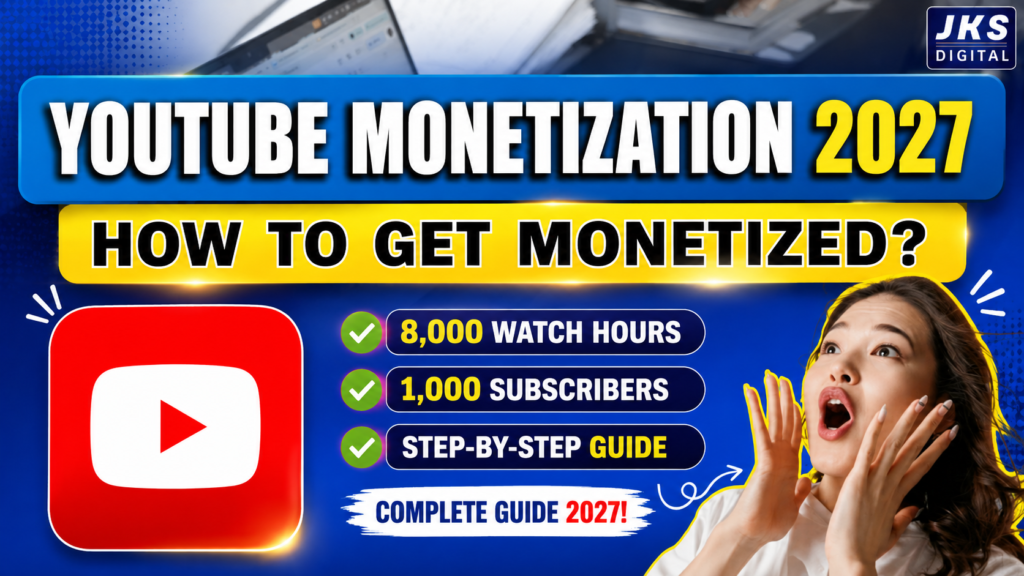
If you’re working toward the 8,000-watch-hour target for YouTube monetization in 2027, this guide focuses on the practical side of that journey—how to choose better topics, structure your videos, improve retention and turn individual viewers into regular viewers.
Important: YouTube’s Partner Program requirements can change. Before applying, always check the latest eligibility information shown by YouTube for your channel.
YouTube Monetization 2027: What Should You Focus on First?
Before planning your content, you need to understand one important thing:
Watch hours don’t come from uploading videos alone.
They come from people actually watching those videos.
That means your strategy should bring together four things:
- The right topic
- A title and thumbnail that create interest
- A video that keeps people watching
- More content that gives viewers a reason to continue watching
Think of your channel as a journey.
Someone discovers your video → watches it → finds another useful video → watches that one too → subscribes because they like your content.
That’s the kind of audience behaviour that can steadily build a channel.
What Does 8,000 Watch Hours Really Mean?
8,000 hours sounds intimidating when you look at it as one big number.
Let’s break it down.
8,000 hours = 480,000 minutes of watch time.
Now imagine that your average viewer watches your videos for 5 minutes.
You would need approximately:
480,000 ÷ 5 = 96,000 views
If your average viewer watches for 8 minutes, the calculation changes:
480,000 ÷ 8 = 60,000 views
These are only simple examples to help you understand the relationship between views and watch time. Your actual results will depend on your videos, audience, traffic sources and the watch time that YouTube considers eligible.
The bigger lesson is this:
More views don’t automatically mean more watch hours.
If viewers click your video but leave quickly, your view count may look good while your watch time remains disappointing.
That’s why viewer retention should be one of your biggest priorities.
1. Choose a Clear Niche Before Chasing Watch Hours
One of the easiest ways to make a channel confusing is to upload whatever topic happens to be trending.
Today it’s technology.
Tomorrow it’s cooking.
The next day it’s news.
Then suddenly there’s a motivational video.
You may get occasional views, but you’re making it harder to build a consistent audience.
Instead, choose a clear area and create different types of content around it.
For example, a digital marketing channel could cover:
- SEO
- Google Ads
- YouTube Marketing
- Social Media Marketing
- Canva
- AI tools
- Online business
These are different topics, but they still attract a broadly similar audience.
When someone watches one useful video, there is a good chance they may be interested in another video from the same channel.
That’s exactly what you want.
Ask yourself three questions:
Who am I making videos for?
What problems do they have?
Why would they watch my next video?
If you can answer those clearly, your content strategy becomes much easier.
2. Create Videos Around Questions People Actually Have
You don’t need to invent a completely new topic every time you upload.
In fact, some of your strongest video ideas can come directly from questions people are already asking.
For example:
- How to increase YouTube watch time?
- Why are my YouTube videos not getting views?
- How to get your first 1,000 subscribers?
- How does YouTube recommend videos?
- How to improve YouTube audience retention?
- Why do people click my video but leave quickly?
These topics work because they address a real problem.
Where can you find these questions?
Look at:
- YouTube search suggestions
- Comments under popular videos
- Google Search
- Reddit discussions
- Google Trends
- Questions from your own audience
- Competitors’ most-viewed videos
Don’t simply copy another creator’s video.
Instead, look at the question they’re answering and ask:
“Can I explain this more clearly or make it more useful?”
That’s where original content starts.
3. Long-Form Videos Can Be Your Main Watch-Time Engine
If your goal is to build eligible long-form watch hours, long-form videos deserve a central place in your content strategy.
Consider two videos.
Video A:
10 minutes long, average viewer watches 2 minutes.
Video B:
10 minutes long, average viewer watches 7 minutes.
Both videos have the same length.
But Video B is creating far more watch time per viewer.
This is why simply making longer videos isn’t the answer.
Don’t stretch a 6-minute topic into 20 minutes.
Instead:
Make the video as long as necessary to answer the viewer’s question properly.
A useful 8-minute video is better than a boring 20-minute video that people abandon halfway through.
4. Your First 30 Seconds Matter More Than You Think
A viewer who clicks your video has already shown some interest.
Your job is to give them a reason to stay.
One common mistake is spending the opening of the video on a long introduction.
For example:
“Hello guys, welcome back to my channel. I hope you all are doing well. In today’s video, we are going to talk about…”
There is nothing necessarily wrong with being friendly.
The problem is that the viewer came for an answer.
Give them that reason immediately.
Read Also:- Why Is YouTube Suspending Accounts? 10 Reasons Your Channel Could Be Suspended
For example:
“Agar aapke YouTube channel par views aa rahe hain, lekin watch hours bahut slowly increase ho rahe hain, to is video mein main aapko exactly woh changes bataunga jo aap apne content mein kar sakte hain.”
Now the viewer knows what they’re going to get.
A simple opening formula:
Problem → Promise → Reason to stay
For example:
Problem: “Watch hours complete nahi ho rahe?”
Promise: “Aaj hum ek practical content strategy dekhenge.”
Reason to stay: “Aur end mein main ek simple calculation bhi dikhाऊंगा jisse aap apna target estimate kar sakte hain.”
No unnecessary build-up.
Get to the point.
5. Don’t Make Viewers Wait for the Useful Part
A video should deliver value throughout—not only near the end.
Suppose your title promises:
“How to Increase YouTube Watch Time”
But the first five minutes are just an introduction to YouTube.
The viewer may leave before reaching the actual strategy.
Instead, organize the information so that every section gives the viewer something useful.
For example:
Video Structure
0:00 — The real reason your watch time is low
0:45 — How watch time actually works
2:00 — Content strategy
4:00 — Retention strategy
6:00 — Getting viewers to watch another video
8:00 — Common mistakes
This creates a clear flow without unnecessary repetition.
6. Use Content Series to Increase Total Watch Time
One video shouldn’t always be the end of the viewer’s journey.
Imagine you create a series like this:
YouTube Monetization Series
Video 1: YouTube Monetization Rules 2027
Video 2: How to Complete 8,000 Watch Hours
Video 3: How to Reach 1,000 Subscribers
Video 4: How to Improve YouTube Retention
Video 5: YouTube Monetization Mistakes to Avoid
Someone who watches Video 2 may naturally want to watch Video 3.
This creates a much stronger viewing journey than uploading unrelated videos.
You can connect videos through:
- Playlists
- End screens
- Cards, where available
- Pinned comments
- Natural mentions inside videos
- Links in descriptions
But don’t force viewers into another video.
Recommend the next video only when it genuinely helps them.
7. Make Your Playlists Work Like Mini Courses
A playlist shouldn’t just be a collection of random videos.
Use playlists to solve a particular problem.
For example:
YouTube Beginner Course
- How YouTube Works
- How to Create a YouTube Channel
- YouTube SEO Basics
- How to Make Better Thumbnails
- How to Improve Watch Time
- YouTube Monetization
Now a viewer who starts the playlist has a logical reason to continue.
This can make your content feel more organized and useful.
8. Improve Watch Time by Understanding Audience Retention
YouTube Analytics can tell you much more than just how many people watched your video.
Pay attention to:
- Average view duration
- Average percentage viewed
- Audience retention
- Watch time
- Traffic sources
- Returning viewers
Suppose your video gets 5,000 views but most viewers leave within the first minute.
Instead of simply thinking:
“I need more views.”
Ask:
“Why are people leaving?”
Maybe the introduction is too long.
Maybe the title promises something the video doesn’t deliver quickly.
Maybe the video moves too slowly.
Maybe the information is repetitive.
That analysis can help you improve the next upload.
9. Your Thumbnail Gets the Click, Your Video Earns the Watch Time
A thumbnail and title have one job:
Give the right viewer a reason to click.
But the video has a different job:
Give that viewer a reason to stay.
This distinction is important.
A sensational thumbnail may bring clicks, but if the video doesn’t deliver what was promised, viewers can leave quickly.
Instead, make the title and thumbnail interesting without misleading the audience.
For example:
Weak:
“WATCH THIS!!!”
Better:
“Why Your YouTube Watch Time Is Stuck”
The second one tells the viewer exactly what problem you’re solving.
Read Also:- YouTube Monetization Requirements 2027: How Many Subscribers and Watch Hours Do You Need?
10. Don’t Upload Just for the Sake of Uploading
There is no magic number of videos that automatically gives you 8,000 watch hours.
You could upload 100 videos and still struggle if nobody wants to watch them.
Another creator might upload fewer videos but build a stronger audience because each video solves a specific problem.
Before publishing, ask:
“Why would someone click this?”
“Why would they continue watching?”
“What will they learn or gain?”
“What should they watch next?”
If you can answer all four, the video has a much stronger foundation.
11. Build a Simple 90-Day Watch-Time Plan
You don’t need to make your YouTube strategy complicated.
Start with three stages.
Month 1: Build the Foundation
Focus on:
- Choosing your niche
- Understanding your audience
- Researching topics
- Creating useful long-form videos
- Improving titles and thumbnails
- Learning basic YouTube Analytics
Don’t worry if everything isn’t perfect.
Your first month should also be a learning period.
Month 2: Find What Is Working
Now look at your analytics.
Which videos are getting:
- Better retention?
- More watch time?
- More returning viewers?
- More search traffic?
- More engagement?
Find patterns.
If three videos about the same subject perform well, that’s a signal.
Create more content around that audience interest instead of moving randomly to another topic.
Month 3: Double Down on Your Winners
By now, you should have some idea of what your audience responds to.
Take your strongest topics and explore them further.
Create:
- Follow-up videos
- Beginner and advanced versions
- Comparisons
- Case studies
- Tutorials
- Mistakes and solutions
- Frequently asked questions
This is much smarter than starting from zero with a completely unrelated topic every week.
What You Should NOT Do to Complete 8,000 Watch Hours
When creators see a large watch-time target, some start looking for shortcuts.
Avoid them.
Don’t:
- Buy watch hours
- Buy fake views
- Use bots
- Re-upload other creators’ videos
- Create dozens of nearly identical videos
- Mislead viewers with clickbait
- Use copyrighted material without the necessary rights
- Depend entirely on low-effort AI-generated content
The goal isn’t simply to make the number go up.
You want to build a channel that can continue growing after monetization.
The Real Secret to 8,000 Watch Hours
There isn’t one magic trick.
The strongest channels usually get there by doing a few basic things well:
They choose topics people care about.
They make the video easy to watch.
They keep improving based on audience behaviour.
They give viewers another useful video to watch.
And most importantly, they don’t give up after a few uploads.
You may publish a video today and get very little response. That doesn’t necessarily mean the channel is failing.
Sometimes the tenth video teaches you something that makes your twentieth video much better.
That’s how a channel grows.
Final Takeaway
If you’re aiming to complete 8,000 watch hours for YouTube monetization in 2027, don’t treat the target as a number you have to somehow “hit.”
Treat it as the result of building a channel people actually enjoy watching.
Start with a clear niche. Find real questions. Make useful videos. Improve your opening. Watch your retention data. Connect related videos. And keep creating around the topics your audience responds to.
The goal isn’t to make people watch more because you asked them to. The goal is to make the next minute of your video worth watching.
From Growing Your Channel to Monetization
Reaching the required watch hours is a major milestone, but it is not the finish line.
A channel also needs a genuine audience, consistent content and compliance with YouTube’s monetization policies. If you’re getting close to the eligibility requirements, this is the stage where you should stop thinking only about numbers and start checking whether your entire channel is ready for monetization.
Here’s how to move from channel growth to the actual monetization process.
1. Focus on Building 1,000 Subscribers Naturally
Watch hours alone aren’t enough if your monetization route also requires a subscriber threshold.
The good news is that you don’t need to beg viewers to subscribe after every sentence.
People are more likely to subscribe when they understand what they will get from your channel in the future.
For example, instead of repeatedly saying:
“Please subscribe to my channel.”
Try making the reason clear:
“Agar aap YouTube growth aur monetization ke practical tips chahte hain, to channel subscribe kar sakte hain. Main isi topic par regular videos share karta hoon.”
Read Also:- YouTube Monetization New Rule 2027: 8,000 Watch Hours Required
That’s a much more natural reason to subscribe.
A few things that can help:
- Create content around one clear audience
- Make related videos instead of random topics
- Build content series
- Give viewers a reason to return
- Use Shorts to introduce new viewers to your long-form content
- Mention your next relevant video naturally
The goal isn’t simply to collect subscribers.
You want subscribers who actually watch your content.
2. Use Shorts to Bring New Viewers to Your Channel
Shorts can be useful for reaching people who have never discovered your channel.
For example, suppose you have a detailed 10-minute video about YouTube monetization.
You could create several short videos from related ideas:
- “Why your YouTube watch hours aren’t increasing”
- “One mistake killing your audience retention”
- “How long should a YouTube video be?”
- “Can Shorts help grow a new channel?”
These Shorts can introduce people to your topic.
Then you can naturally direct interested viewers toward your longer content.
But don’t turn every Short into a sales pitch for your long video.
Give the Short enough value on its own.
If the viewer finds it useful, they’re much more likely to explore your channel.
3. Use YouTube Analytics Before Making Your Next Video
One of the biggest advantages of YouTube is that your own channel gives you data about what your audience likes.
You don’t have to guess everything.
Open YouTube Studio regularly and look at your content performance.
Pay particular attention to:
Watch Time
This shows how much time viewers are spending with your content.
Average View Duration
This helps you understand how long viewers typically stay.
Average Percentage Viewed
This tells you how much of the video people are watching on average.
Impressions Click-Through Rate
This can help you understand how often people click after seeing your thumbnail and title.
Returning Viewers
This is particularly useful because returning viewers indicate that people are coming back to your channel.
Don’t judge a video using only one number.
A video with fewer views may still teach you something valuable if viewers watch a large portion of it.
4. Find Your Winning Topics
After publishing several videos, you’ll usually notice patterns.
Maybe your tutorials perform better than your opinion videos.
Maybe beginners’ guides get more search traffic.
Maybe comparison videos bring more viewers.
Maybe one particular subject consistently keeps people watching longer.
Pay attention to those patterns.
For example, if videos about YouTube SEO consistently perform better than your general marketing videos, you can create more content around YouTube SEO.
You could then build a complete content cluster:
- YouTube SEO basics
- YouTube keyword research
- YouTube title optimization
- YouTube description SEO
- YouTube thumbnail strategy
- YouTube Analytics
- YouTube monetization
This gives viewers multiple related videos to explore.
5. Don’t Change Your Entire Strategy After One Bad Video
Every creator eventually publishes a video that doesn’t perform well.
That’s normal.
One poor-performing video doesn’t automatically mean your niche is wrong.
Before making a major change, look at the details.
Ask:
- Did people click the video?
- Did they leave quickly?
- Was the topic actually relevant to my audience?
- Was the thumbnail clear?
- Did the title match the content?
- Was the video too long?
- Did the introduction take too long?
Sometimes the problem isn’t the topic.
It could simply be the packaging or presentation.
Give yourself enough data before making major decisions.
6. Make Your Channel Ready for Monetization
Once you’re approaching the required eligibility thresholds, don’t wait until the last moment to review your channel.
Look at your older videos.
Ask yourself:
“If YouTube reviews my channel today, does this content represent the kind of channel I want to build?”
Pay attention to videos that may create policy concerns.
Your channel should have content that is:
- Original
- Useful
- Clearly created with viewer value in mind
- Consistent with YouTube’s policies
- Free from unauthorized copyrighted material
This is particularly important if you’ve experimented with AI tools, stock footage, compilations or heavily reused material.
7. Can AI Videos Be Monetized on YouTube?
AI has made video production much easier.
You can use AI for:
- Research
- Brainstorming
- Script assistance
- Captions
- Editing
- Voice cleanup
- Thumbnail ideas
- Translation
But using AI doesn’t automatically make a video valuable.
The bigger question is:
What did you actually add to the content?
A channel publishing large numbers of nearly identical, low-value videos can face monetization problems.
For example, simply generating a script, adding an AI voice and putting generic stock footage behind it doesn’t guarantee that the content will be considered suitable for monetization.
Instead, add genuine value through:
- Original explanations
- Personal experience
- Demonstrations
- Commentary
- Research
- Examples
- Screen recordings
- Case studies
- Meaningful editing
Think of AI as a tool that helps you create.
Don’t let the tool become the entire content.
8. Be Careful With Reused and Repetitive Content
This is another area creators should take seriously.
Using someone else’s content and making only minor changes doesn’t automatically turn it into original content.
The same applies to repetitive videos where only a few words or images change from one upload to another.
Before publishing, ask:
“If I remove the original source material, what unique value is my video providing?”
If the answer is difficult to explain, the content probably needs more original input.
For a monetized channel, building a reputation for useful and original content is far safer than trying to produce hundreds of low-effort uploads.
9. Which Watch Time Should You Pay Attention To?
Not every type of viewing activity should simply be added together and assumed to count toward the required public watch-hour threshold.
For example, YouTube distinguishes between eligible public watch hours and other types of watch time.
Certain activity, such as watch time from private, unlisted or deleted videos, may not qualify toward the relevant public watch-hour requirement.
Similarly, watch time generated through Shorts has different treatment from eligible long-form public watch hours.
That’s why you should rely on the Earn section in YouTube Studio rather than manually adding every number shown in Analytics.
This is especially important when you’re close to the eligibility threshold.
10. Don’t Buy Watch Hours or Subscribers
When a creator is close to monetization, shortcuts can look tempting.
You may find websites promising:
- 1,000 subscribers
- Thousands of watch hours
- Guaranteed monetization
- Fast channel growth
Avoid these services.
Fake or artificial engagement doesn’t create a real audience.
Even if the numbers temporarily increase, it can damage your channel’s performance and put your monetization goals at risk.
More importantly, you want viewers who genuinely care about your content.
Real viewers are more valuable than artificial numbers.
11. Check Your Monetization Eligibility in YouTube Studio
When you believe your channel has reached the required threshold, don’t rely on a third-party website or a random calculator.
Go directly to YouTube Studio and check the Earn section.
YouTube will show the eligibility information relevant to your channel.
Depending on your location and the current YPP requirements, you may need to complete additional steps before your channel can be reviewed.
These can include things such as:
- Accepting the relevant terms
- Connecting an AdSense account
- Completing required verification steps
- Ensuring the channel follows YouTube policies
The exact process can change, so always follow the instructions YouTube displays for your account.
12. What Happens After You Apply for Monetization?
Reaching the required numbers doesn’t necessarily mean that ads immediately appear on every video.
After applying, YouTube may review your channel and its content to determine whether it meets the relevant monetization policies.
This is why it’s important not to wait until application day to think about content quality.
Your channel history matters.
Before applying, review your content and remove or address material that could create policy concerns, where appropriate.
Also remember that being accepted into YPP doesn’t mean every individual video is automatically eligible for every monetization feature.
Individual videos can have their own advertising or policy considerations.
13. Monetization Mistakes That Can Delay Your Progress
A creator can spend months building a channel and still make avoidable mistakes.
Here are some of the most common ones.
1. Uploading Completely Random Content
If every video targets a different audience, it’s difficult to build returning viewers.
2. Making Videos Longer Just to Increase Watch Time
Longer doesn’t automatically mean better.
3. Using Misleading Titles
Clicks don’t help much if viewers immediately leave after discovering that the video isn’t what the title promised.
4. Publishing Low-Value AI Content
AI can speed up production, but it shouldn’t replace originality.
5. Ignoring Audience Retention
If people consistently leave early, your content strategy needs attention.
6. Buying Engagement
Fake subscribers and watch hours aren’t a sustainable growth strategy.
7. Stopping After a Few Uploads
YouTube growth rarely follows a perfectly straight line.
Some videos will fail.
Some will surprise you.
The important thing is learning from both.
14. A Simple YouTube Monetization Checklist
Before applying, go through this list carefully:
- Required subscriber threshold reached
- Required eligible public watch hours reached, where applicable
- YouTube Studio shows that you’re eligible
- Channel follows YouTube monetization policies
- Content is original and provides genuine value
- No unnecessary reused or repetitive content
- Copyright issues have been reviewed
- AdSense requirements are completed
- Required account verification/security steps are completed
- YPP application is submitted through YouTube Studio
Don’t rush the application simply because you have reached a number.
Take a few minutes to review the channel first.
Frequently Asked Questions
How many watch hours are required for YouTube monetization in 2027?
The applicable requirement depends on YouTube’s current Partner Program eligibility rules and the monetization route available to your channel. If the 8,000-hour requirement applies to your route, those hours must also meet YouTube’s definition of eligible public watch hours.
Always verify the current requirement in YouTube Studio before applying.
How can I complete 8,000 watch hours faster?
There isn’t a guaranteed shortcut.
The most sustainable approach is to create useful long-form videos around topics your audience is actively interested in, improve audience retention and connect related videos so viewers have more reasons to continue watching.
Do Shorts watch hours count toward the 8,000-hour requirement?
Shorts and long-form videos have different eligibility calculations. Don’t assume that every minute shown in your overall Analytics automatically counts toward the public watch-hour requirement.
Check the Earn section in YouTube Studio for the figure relevant to monetization eligibility.
Can AI-generated videos be monetized?
AI use by itself doesn’t automatically decide whether a channel can be monetized.
What matters is whether the content provides genuine value and follows YouTube’s monetization policies. Low-value, repetitive or mass-produced content can create problems.
Can I buy 8,000 watch hours?
You should not buy watch hours or artificial engagement.
Building genuine watch time may take longer, but it creates an audience that can continue watching your content after monetization.
What happens after I reach the required watch hours?
Once your channel meets the applicable eligibility requirements, you can check the Earn section in YouTube Studio and follow the application process shown there.
Your channel may then go through YouTube’s review process.
Does reaching the monetization threshold guarantee approval?
No.
Meeting the numerical requirements is only one part of eligibility. Your channel and content must also comply with the applicable YouTube Partner Program and monetization policies.
Final Thoughts
YouTube monetization shouldn’t be treated as a race to reach a particular number.
If you build your entire strategy around “How can I complete 8,000 hours as quickly as possible?”, you may end up creating videos people don’t actually want to watch.
A better approach is to build the kind of channel where watch time happens naturally.
Choose a clear audience. Solve real problems. Make your videos worth finishing. Give viewers another useful video to watch. Study your Analytics instead of guessing. And when you use AI or other tools, make sure the final content still carries your own ideas, experience and value.
The number may get you to the application stage, but the quality of your content is what gives people a reason to stay subscribed after monetization.