Remember the days when repeating “best shoes online” 20 times on a single page was enough to rank on Google? Or when buying 500 backlinks from any random website would shoot you to the number one spot?
Those days are long gone.
In 2026, SEO has evolved into a complex, AI-driven, intent-focused system where obsessing over just one thing — whether that’s keywords or backlinks — can directly hurt your website.
And yet, the debate is still very much alive: “Are backlinks more important, or keywords?”
This article gives you a straight, practical, experience-based answer to that question. No generic advice, no recycled content — only what actually works in 2026.
Section 1: Keywords — The Foundation of SEO
What Exactly Is a Keyword?
A keyword is the phrase your potential reader types into Google when they want to learn something, find something, or buy something.
For example:
- “how to make money from home 2026”
- “best budget smartphones under $200”
- “free digital marketing course”
These phrases are not just words — they are an expression of what a user needs.
What Role Do Keywords Play in 2026?
Earlier, keywords simply helped Google understand what topic your page was about. Today, their role has become far more nuanced.
Google now analyzes keywords on three distinct levels:
Level 1 — Literal Match: What the user typed
Level 2 — Semantic Understanding: What the user actually wants to know
Level 3 — Intent Classification: Whether the user wants to buy, learn, or compare
This means that if you’re targeting “best coffee maker,” Google also evaluates whether your content is suited for a comparison, a buying guide, or a recipe — not just whether the phrase appears on your page.
Why Does Keyword Stuffing No Longer Work?
Because Google’s Helpful Content System and AI Overview, which became significantly more aggressive after 2025, have shifted entirely to context-based understanding.
If you write “SEO tips SEO tips SEO tips” repeatedly, Google flags it as unnatural and drops your ranking accordingly.
The right approach: Include your primary keyword naturally — in the title, in the opening paragraph, in one or two subheadings, and in the conclusion. Use semantic variations throughout the rest of the article.
Section 2: Backlinks — The Trust Currency of SEO
What Is a Backlink, Really?
A backlink is simply a link that another website places within its own content, pointing to your website.
For example: If a publication like Forbes places a link to your fintech blog inside one of their articles, that is an extremely powerful signal to Google that your content is trusted and valuable.
Read Also:- Why Writing More Articles Hurts Your SEO in 2026 – I Learned It the Hard Wa
Why Does Google Consider Backlinks?
Think of it this way:
If one friend tells you “that restaurant is really good,” you might give it a shot. But if 50 different people, independently, tell you the same restaurant is fantastic — you’re going without a second thought.
That is exactly the logic Google applies to backlinks. The more quality websites that link to you, the more trust Google places in your content.
What “Backlink Quality” Actually Means in 2026
Link count alone no longer moves the needle. Google’s SpamBrain AI system now detects all of the following:
- Is the linking site relevant to your niche?
- Is the link placed naturally within the content, or is it forced?
- Does the linking website itself carry any real authority?
- Are there suspicious patterns within your overall backlink profile?
One backlink from a high-DA, niche-relevant website is worth infinitely more than 500 spam directory links.
Section 3: Backlink vs Keyword — The Real Difference
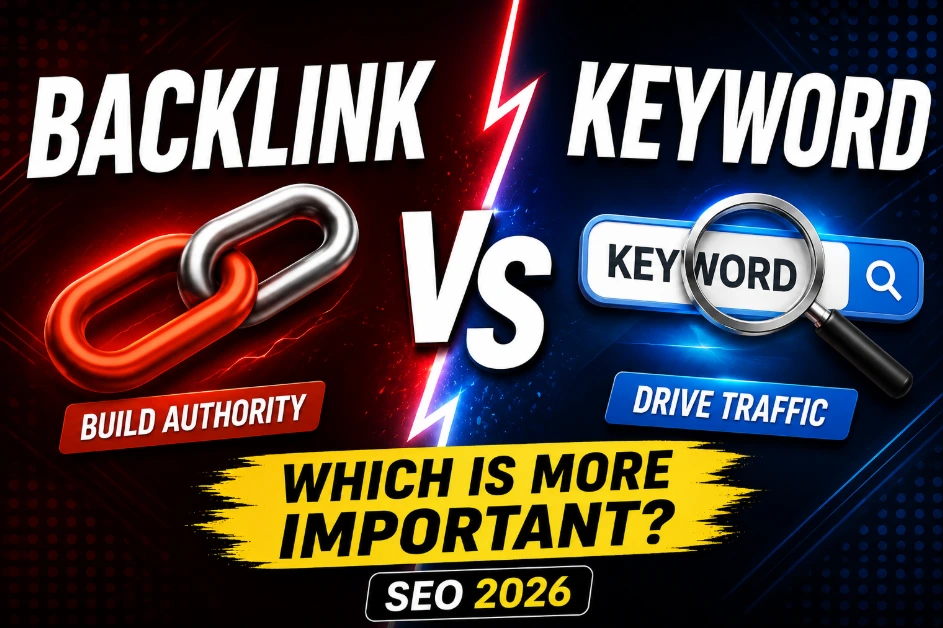
Most people treat this debate as a “who wins” competition. That is entirely the wrong framing.
Think of it this way:
Keywords = A Map
They give Google the direction — where your content fits within search results.
Backlinks = Your Reputation
They tell Google how reliable and trustworthy you are in that direction.
Without the map, reputation has no context.
Without reputation, even the best map won’t make anyone take you seriously.
| Factor | Keywords | Backlinks |
|---|---|---|
| Primary Role | Establish content relevance | Build domain authority |
| SEO Type | On-page | Off-page |
| Level of Control | Entirely in your hands | Partially external |
| Short-term Impact | High — content gets indexed quickly | Medium — takes time to build |
| Long-term Impact | Medium — needs regular updates | High — authority accumulates over time |
| Risk Factor | Over-optimization penalty | Spam link penalty |
| 2026 Priority | Intent + semantics | Quality + relevance |
Section 4: Google’s 2026 Ranking Algorithm — A Real Breakdown
Google’s ranking system is not a simple formula. It is a multi-layered AI system that simultaneously weighs all of the following:
Factor 1: Content Helpfulness (Carries the Most Weight)
Since Google’s Helpful Content Update, the “helpfulness” of your content has become the single biggest ranking driver.
Read Also:- Best SEO Agency in Gurgaon – Why JKS Digital is the Right Choice for Your Business
Helpful content means:
- Answering the user’s question completely
- Demonstrating real experience or expertise
- Avoiding unnecessary filler
- Providing original insights that cannot be found elsewhere
Factor 2: E-E-A-T (Experience, Expertise, Authoritativeness, Trustworthiness)
Google’s Quality Rater Guidelines clearly state that websites demonstrating real expertise and trustworthiness consistently rank better.
Ways to strengthen your E-E-A-T:
- Include real credentials in your author bio
- Cite your sources
- Keep your content updated
- Make your About page and contact information clear and accessible
Factor 3: Search Intent Match
You can use the best keywords in the world and have hundreds of powerful backlinks — but if your content does not match what the user was actually looking for, you will not rank.
Example: A user searches “how to fix a leaking tap” and your page shows them an ad to hire a plumber. That is a textbook intent mismatch.
Factor 4: Page Experience Signals
Core Web Vitals remain relevant in 2026:
- Largest Contentful Paint (LCP): How fast the main content loads
- Cumulative Layout Shift (CLS): How visually stable the page is
- Interaction to Next Paint (INP): How responsive the page is after a user interaction
Factor 5: Brand Signals
This is one of the most underrated factors right now. In 2025–26, Google treats branded searches, direct traffic, and brand mentions — even without a hyperlink — as strong authority signals.
Read Also:- 7 SEO Hacks 2026 That Actually Work (Tested with Real Results)
Section 5: Keyword Strategy 2026 — What Actually Works
Step 1: Start With a Seed Keyword
Choose a broad topic, such as “home loan.”
Step 2: Segment by Intent
Different people search the same topic for different reasons:
- “how to get a home loan” → Informational
- “best home loan interest rates 2026” → Commercial
- “apply for home loan online” → Transactional
Each intent deserves its own dedicated page.
Step 3: Use Semantic Clustering
Cover one primary keyword and all closely related supporting terms on a single page.
Primary keyword: “home loan eligibility”
Supporting terms: income requirements, credit score, age limit, property documents, loan approval process
This creates a comprehensive page that is far more valuable in Google’s eyes.
Step 4: Keyword Placement — The Formula
| Location | Priority |
|---|---|
| Title tag (H1) | Mandatory |
| Opening paragraph (first 100 words) | High |
| One or two H2 headings | Recommended |
| Image alt text | Helpful |
| Meta description | Important for CTR |
| URL slug | Keep it short and clean |
Step 5: Add LSI and NLP Terms
Google uses Natural Language Processing. This means that having related terms on your page — for instance, “EMI,” “bank,” “interest rate,” and “approval” on a home loan page — automatically makes it more relevant, even without stuffing the exact keyword.
Section 6: Backlink Strategy 2026 — Quality Over Quantity
Strategy 1: Guest Posting (Done the Right Way)
Guest posting still works — but only when:
- You are writing within a relevant niche
- The website has a genuine, engaged readership
- The link is placed naturally within the content
Writing guest posts on random sites purely for the backlink is something Google now detects with ease.
Strategy 2: Digital PR — The Most Powerful Method
Create newsworthy content and pitch it to journalists. A single mention in a reputed publication like Forbes, The Guardian, or a major industry outlet can dramatically improve your domain authority.
Newsworthy content ideas:
- Original research or survey results
- An industry report backed by data
- An expert opinion piece on a trending topic
Strategy 3: Resource Link Building
Build the ultimate resource page in your field — something like “The Complete Guide to Filing Taxes in 2026” — and then reach out to relevant websites, asking them to link to it.
Read Also:- How to Get Traffic on a New Website in 2026: When There Is Absolutely No Traffic
Strategy 4: HARO and Similar Platforms
Help a Reporter Out (HARO) and similar platforms connect journalists with subject-matter experts. If you regularly provide valuable, quotable insights, reputable publications will start linking back to you.
Strategy 5: Broken Link Building
Find popular pages within your niche that no longer exist. Reach out to websites that were linking to those dead pages, inform them of the broken link, and suggest your own similar content as a replacement.
Backlinks to Avoid — Even in 2026
- PBN (Private Blog Network) links
- Paid link schemes
- Forum spam links
- Low-quality article directory submissions
- Footer or sidebar links on completely irrelevant websites
Section 7: Common Mistakes 90% of Beginners Make
Mistake 1: Skipping Keyword Research
“I already know what people search for” — this assumption is expensive. Always rely on data-driven keyword research using tools like Ubersuggest, Google Search Console, or Ahrefs.
Mistake 2: Only Targeting High-Volume Keywords
Ranking for a keyword with 100,000 monthly searches is almost impossible for a new website. Start with long-tail keywords (500–1,000 searches/month) — competition is lower, intent is clearer, and conversion rates are typically higher.
Mistake 3: Writing Content and Ignoring Backlinks
Good content is necessary, but it is not sufficient in competitive niches. A solid off-page strategy is equally essential.
Mistake 4: Publish Once, Forget Forever
Google favors fresh, regularly updated content. Articles that haven’t been updated in six months often see their rankings slip. Build a content calendar and revisit important pages every three to six months.
Mistake 5: Ignoring Mobile Optimization
In 2026, over 70% of searches happen on mobile. If your site is slow or broken on mobile, Google automatically pushes it down the rankings.
Mistake 6: Forgetting Internal Linking
Internal links help Google understand your site’s structure and distribute link equity across your pages. Every new post you publish should link back to relevant older posts.
Section 8: The Winning SEO Formula for 2026
This is no secret. Google‘s own documentation tells you exactly what it wants. Here is how to break it down into an actionable framework:
Pillar 1 — Strong Foundation (Technical SEO)
- Fast loading speed (LCP under 2.5 seconds)
- Mobile-first design
- Clean URL structure
- Proper sitemap and robots.txt
- HTTPS enabled
Pillar 2 — Content Excellence (On-Page SEO)
- Thoroughly researched, intent-matched content
- Smart keyword placement — no stuffing
- Original data, examples, and insights
- Proper heading hierarchy (H1 → H2 → H3)
- Engaging meta title and description
- Schema markup wherever relevant
Pillar 3 — Authority Building (Off-Page SEO)
- Consistent acquisition of high-quality backlinks
- Brand mentions and digital PR
- Social signals
- Guest contributions to reputable platforms
Pillar 4 — User Experience
- Low bounce rate
- High dwell time
- Clear navigation
- Helpful calls to action
- No intrusive popups
Balancing all four pillars together is the only formula that consistently produces top rankings in 2026.
Section 9: Niche-Wise Priority — Keyword or Backlink?
This is an important nuance that most SEO guides overlook entirely. What you should prioritize depends heavily on your niche.
Low Competition Niche (Local Businesses, Specific Micro-Topics):
Here, keyword optimization and quality content alone can deliver solid results. Backlinks are helpful but not immediately mandatory.
Medium Competition Niche (Lifestyle, Education, Travel):
Both matter here. Start with keywords, then gradually build your backlink profile over time.
High Competition Niche (Finance, Insurance, Health, Real Estate):
Keywords and content alone will not cut it. Without a strong backlink profile and established brand authority, breaking into the top 10 is nearly impossible.
Section 10: Tools You Should Be Using in 2026
For Keyword Research:
- Google Search Console — Free, accurate, and the best starting point for your own site
- Ubersuggest — Affordable and beginner-friendly
- Ahrefs / Semrush — Comprehensive tools for professional-level research
For Backlink Analysis:
- Ahrefs — The most accurate backlink database available
- Moz Link Explorer — Solid for checking domain authority
- Google Search Console — Shows you your existing backlinks at no cost
For Content Optimization:
- Surfer SEO / Frase — NLP-based content optimization
- Yoast / RankMath — On-page SEO for WordPress users
For Technical SEO:
- Screaming Frog — Comprehensive site audit tool
- PageSpeed Insights — Google’s own speed testing tool
- GTmetrix — Detailed performance analysis
Conclusion
The biggest myth in SEO 2026 is that you have to choose between backlinks and keywords.
Here is the real picture:
Keywords tell you where to go.
Backlinks give you the credibility to get there.
Content earns you the right to stay.
User experience determines how long you last.
Anyone who thinks “I’ll just focus on keyword research” or “I’ll just keep building backlinks” is trying to win a complete game with an incomplete strategy.
Starting today, make this decision:
Build a solid keyword strategy. Build a consistent content plan. And build an ethical, quality-focused backlink acquisition plan.
All three together — that is the only proven formula for ranking on Google in 2026.
Frequently Asked Questions (FAQ)
Q1: Is it possible to rank without backlinks?
Yes — but only for low-competition, long-tail keywords. In competitive niches, backlinks are nearly non-negotiable.
Q2: How many backlinks do I need to rank?
There is no fixed number. Your competitors’ average backlink count is the most useful starting benchmark. Quality always beats quantity.
Q3: What should keyword density be in 2026?
No more than 1–2%. Use your primary keyword naturally, and rely on semantic variations for the rest of the article.
Q4: Do social media backlinks help with SEO?
Social media links are typically “nofollow” — they do not pass direct SEO authority. However, they drive traffic and brand visibility, which create indirect benefits over time.
Q5: How long before I see results?
For a new website, the honest answer is 6–12 months. It depends on your niche, competition level, and how consistent you are. Be skeptical of anyone promising top rankings in 30 days.