Brand Awareness vs Reach:- A person can see your business online today and completely forget about it tomorrow. Another person may see the same brand several times and eventually recognize its name, content style, or product when they need it.
This difference is at the heart of an important digital marketing question: What matters more—reaching more people or making your brand memorable?
The answer starts with understanding two terms that are often confused: reach and brand awareness.
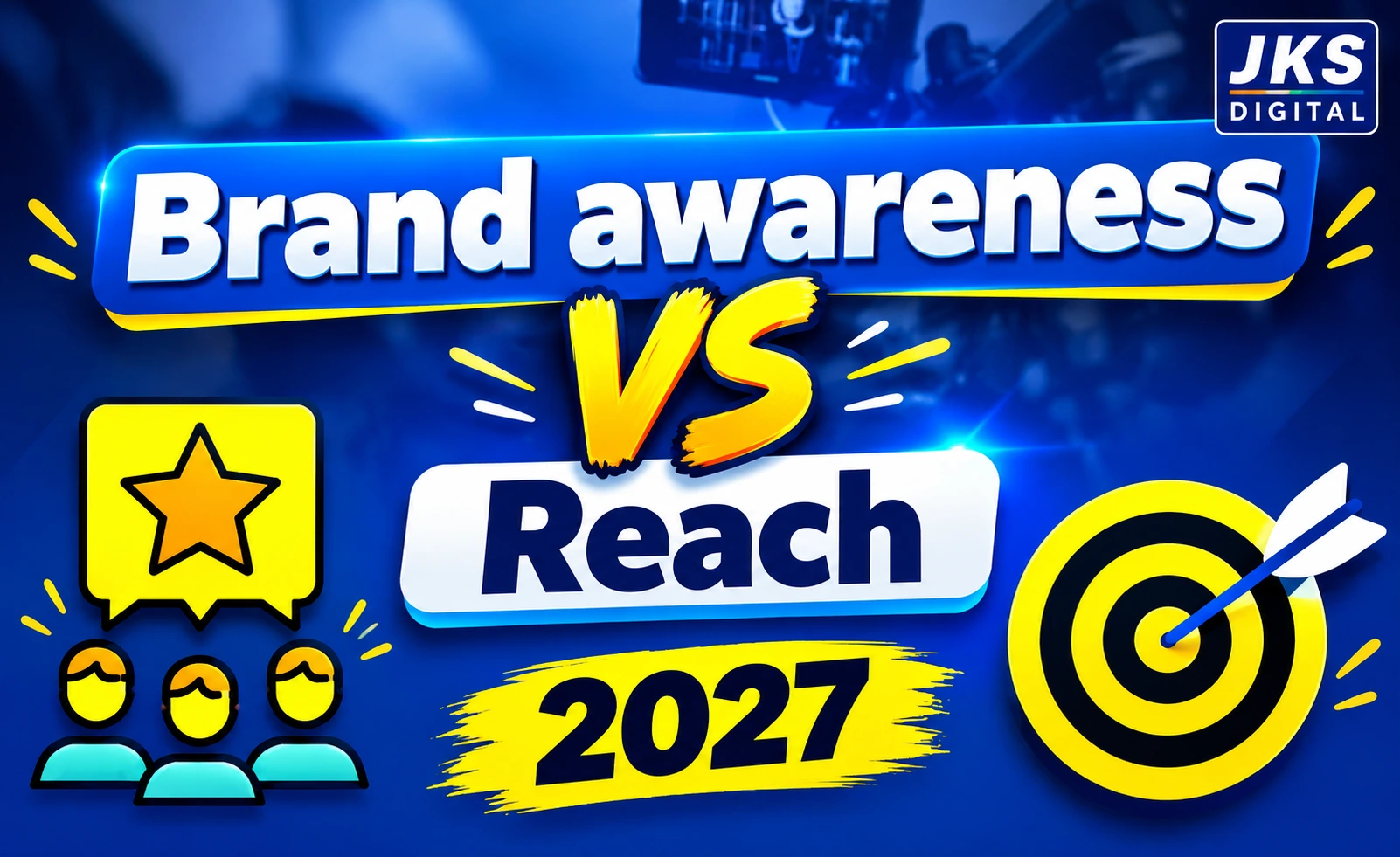
They are connected, but they do not measure the same thing. Reach is concerned with the size of the audience exposed to your content, while brand awareness is concerned with the level of familiarity people develop with your brand.
For businesses planning their digital marketing strategy in 2027, understanding this distinction can make campaign reporting and decision-making much clearer.
Understanding Brand Awareness
Brand awareness is the familiarity people have with a particular business or brand.
It can appear in different ways. Someone might recognize your logo, identify your brand from its colors, remember your name after seeing an advertisement, or immediately associate your business with a particular type of product or service.
For example, imagine someone needs a website for their small business. They may have encountered several agencies online over the previous few weeks. When they finally start searching for an agency, one familiar name may stand out simply because they have already encountered it through content, social media, search results, videos, or advertising.
That familiarity is valuable because customers do not always make decisions based on the first advertisement they see.
Brand Awareness Is More Than Recognition
Recognition is only one part of the picture.
A stronger level of awareness can mean that people can:
- Identify your brand among competitors
- Remember what your business offers
- Connect certain visual elements with your company
- Recall your brand when a relevant need arises
- Associate your business with particular ideas or experiences
This is one reason consistent branding matters. If your business uses completely different messaging, visuals, and positioning across every platform, it can become harder for an audience to form a clear impression of the brand.
How Brand Awareness Develops
Brand awareness usually does not come from one isolated interaction.
A person might first discover a business through a Google search. Later, they may see one of its Instagram posts, watch a YouTube video, read an article, or encounter an advertisement.
Each interaction can contribute to familiarity.
However, exposure alone does not guarantee that people will remember a business. The quality and consistency of the communication also matter.
A recognizable visual identity, useful information, clear positioning, relevant content, and consistent messaging can all help create a stronger impression over time.
Understanding Reach
Reach answers a much more specific question:
How many unique people or accounts were exposed to this content or campaign?
Suppose a social media campaign reports a reach of 25,000. In simple terms, the content was delivered to 25,000 unique accounts or people according to the platform’s reporting system.
This makes reach particularly useful when a business wants to understand the size of the audience it has managed to expose to a message.
But reach does not tell you everything.
A campaign can reach thousands of people without generating meaningful engagement, website visits, enquiries, purchases, or long-term brand recognition.
That is why reach should be interpreted alongside other campaign data rather than treated as a complete measure of marketing success.
Reach and Impressions Are Different
One of the easiest digital marketing metrics to mix up is reach versus impressions.
Imagine an advertisement is displayed several times to the same audience.
If 10,000 unique people see it, the reach could be 10,000.
But if those people collectively see the advertisement 18,000 times, the impressions could be 18,000.
So:
Reach = unique audience exposed
Impressions = total number of times the content was displayed
The difference becomes especially useful when marketers want to understand how frequently an audience is being exposed to a message.
What Reach Can Tell You
Reach can help answer questions such as:
- How large was the audience exposed to this campaign?
- Did the campaign expand beyond the existing audience?
- How many unique users were reached?
- Did a campaign reach the intended geographical or audience segment?
These insights can be useful when launching a business, promoting an event, introducing a service, or expanding into a new market.
However, a high reach figure should not automatically be interpreted as high customer interest.
What Brand Awareness Can Tell You
Brand awareness looks at a different part of the customer journey.
It helps businesses think about questions such as:
- Do people recognize the brand?
- Can potential customers remember the business?
- Is the brand becoming familiar within its target market?
- Do people associate the brand with a particular product or service?
- Is the business becoming easier to recall when a relevant need appears?
Unlike a simple reach number, awareness is more closely connected with how an audience perceives and remembers a brand.
Brand Awareness vs Reach at a Glance
| Factor | Brand Awareness | Reach |
|---|---|---|
| Main focus | Familiarity with a brand | Size of unique audience exposed |
| Main question | “Do people recognize or remember us?” | “How many unique people saw us?” |
| Role in marketing | Helps build familiarity | Helps measure distribution |
| Time perspective | Often develops through repeated interactions | Can change from campaign to campaign |
| Useful for | Brand-building activities | Audience exposure and campaign distribution |
The two should therefore not be treated as interchangeable terms.
A business may achieve substantial reach during a campaign while still being relatively unfamiliar to the people who saw it. On the other hand, an established brand may already have considerable awareness among its audience without needing every campaign to reach a massive number of new people.
Why the Difference Matters in 2027
Digital marketing is becoming increasingly crowded. Businesses compete for attention across search engines, social networks, video platforms, websites, email, and paid advertising.
In this environment, simply counting how many people saw a message may not provide enough information.
Marketers need to understand both sides of the equation:
ReadDigital Marketing Trends 2027: 35 Trends Shaping the Future of Marketing
How many people did we reach?
and
What impression are we creating with those people?
Reach helps businesses understand distribution. Brand awareness helps them think about recognition and familiarity.
The most useful approach is therefore to connect these metrics with the actual objective of a campaign rather than judging performance from a single number.
Brand Awareness vs Reach: How to Use Both in Your Digital Marketing Strategy
Understanding the difference between reach and brand awareness is useful, but the real challenge begins when you have to apply these concepts to an actual marketing campaign.
A business may want to introduce itself to new customers, promote a new service, increase visibility in a particular location, or stay memorable among an existing audience. Each situation can require a different approach.
This is where campaign objectives, audience selection, creative content, and performance measurement become important.
Brand Awareness and Reach in Meta Ads
Meta advertising gives businesses several ways to approach audience exposure and brand-building campaigns.
For example, a business may use the Awareness objective when its primary purpose is to increase recognition or communicate a message to an audience. Within advertising campaigns, marketers can then look at metrics such as reach, impressions, frequency, video plays, engagement, or other available results depending on the campaign setup.
This distinction is important because reach is a measurement of audience exposure, while Awareness is a campaign objective.
They should therefore not be treated as two identical options.
Before launching a campaign, ask what you actually want the audience to do or remember after seeing the advertisement.
How Different Businesses Can Approach the Two
There is no single setup that works for every business.
A New Business
A newly launched business may first need to introduce its name, service, positioning, and visual identity to its target audience.
For example, a new salon could create informative videos, introduce its services, show its location, and run paid campaigns to relevant local audiences.
Here, the business is not only trying to generate exposure. It is also trying to make the audience familiar with the brand.
An Established Business
An established company may already have a recognizable name among its customers.
Its marketing objective could therefore be different for individual campaigns. It might want to promote a new product, communicate an offer, enter a new location, or remain visible to a particular audience.
In such cases, reach can be one useful metric for understanding how widely a particular campaign was distributed.
A New Product or Service
Launching something new creates another situation.
Even if customers already know the company, they may not know about its new offering.
A business can therefore use content and advertising to introduce the new product while monitoring exposure, engagement, website activity, enquiries, or other relevant actions.
This shows why the existing level of brand familiarity and the goal of an individual campaign should both be considered.
Can Reach and Brand Awareness Work Together?
Read Also:- Best Digital Marketing Agency in Connaught Place: Grow Your Business Today
Yes.
A business does not have to treat them as competing ideas.
Think of marketing as a journey.
First, your message needs to reach people who could potentially be interested. Then, your communication needs to give those people a reason to remember the business.
That could involve:
- Consistent brand visuals
- Repeated but useful messaging
- Educational content
- Short-form videos
- Customer stories
- Product demonstrations
- Helpful website content
- Social media communication
- Retargeting where appropriate
The objective is not simply to show the same advertisement again and again. Repetition should add value rather than create unnecessary ad fatigue.
Read Also:- Best Digital Marketing Agency In Laxmi Nagar
Practical Ways to Build Visibility and Recognition
Keep Your Brand Consistent
Use recognizable colours, fonts, design elements, tone, and messaging across important marketing channels.
Consistency makes it easier for an audience to connect different pieces of content with the same business.
Create Content People Can Remember
A brand does not become memorable simply because it publishes frequently.
Focus on content that gives people something useful, interesting, informative, or relevant.
A strong idea can sometimes create more lasting recognition than a large number of generic posts.
Match the Message to the Audience
A local business does not necessarily need to communicate with everyone.
If a service is available only in a particular area, advertising to a relevant local audience may make more sense than trying to maximize exposure without considering location.
The same principle applies to age groups, interests, customer types, and other targeting factors where relevant.
Look Beyond Reach
Reach is useful, but it should not be examined in isolation.
Depending on the campaign, marketers may also monitor:
- Impressions
- Frequency
- Engagement
- Video views
- Website visits
- Click-through rate
- Leads
- Conversions
- Cost per result
The relevant metrics depend on what the campaign is designed to achieve.
A Simple Example: A Local Coffee Shop
Consider a coffee shop opening in a new neighbourhood.
During the opening period, the business wants nearby people to discover that the shop exists. Its advertising and social media activity can help distribute that information to the local audience.
But exposure alone is not the entire marketing story.
The coffee shop also needs people to remember its name, recognize its branding, understand what makes it different, and associate it with a particular experience.
It could achieve this through behind-the-scenes videos, menu content, customer experiences, staff stories, location-based posts, and consistent visual branding.
In this example, reach helps with exposure, while consistent communication can contribute to brand familiarity.
Common Mistakes Businesses Should Avoid
Mistake 1: Treating Reach as the Final Goal
A large reach number can look impressive, but it does not automatically mean that a campaign generated customers or stronger brand recognition.
Always connect the metric with the campaign objective.
Mistake 2: Confusing Impressions With Unique People
A campaign can generate many impressions because the same people may see an advertisement multiple times.
That is why reach and impressions should be interpreted separately.
Mistake 3: Changing Branding Too Often
Constantly changing your logo, colours, messaging, or communication style can make it harder for an audience to develop a consistent association with your business.
Mistake 4: Measuring Every Campaign in the Same Way
A campaign designed to increase awareness should not necessarily be judged using exactly the same primary metrics as a campaign designed to generate leads or sales.
The measurement framework should match the purpose.
Frequently Asked Questions
Is brand awareness the same as reach?
No. Reach describes the number of unique people or accounts exposed to content, while brand awareness refers to how familiar an audience is with a brand.
Is higher reach always better?
Not necessarily. A larger audience can be useful, but the value of that exposure depends on whether the audience is relevant to the business and whether the campaign is achieving its intended objective.
What is the difference between reach and impressions?
Reach refers to unique audience exposure, while impressions refer to the total number of times content was displayed.
Should a new business focus on awareness or reach?
The answer depends on its specific marketing objective, audience, budget, and stage of growth. A new business may need both audience exposure and consistent communication that helps people become familiar with the brand.
Can Meta Ads help with brand awareness?
Yes. Meta provides an Awareness campaign objective that businesses can use when brand or message awareness is an intended advertising goal. The exact campaign settings and available performance options can change over time, so advertisers should check the current Meta Ads interface when creating a campaign.
Final Thoughts
Reach and brand awareness describe different parts of digital marketing.
Reach helps businesses understand the scale of their audience exposure. Brand awareness focuses more on familiarity, recognition, and the ability of people to remember a business.
Neither should automatically be treated as the single measure of marketing performance.
A more useful approach is to begin with the business objective, identify the audience, choose an appropriate campaign strategy, and then measure the results that actually relate to that objective.
In 2027, businesses have more channels and more data available than ever. The challenge is not simply getting more people to see a message. It is understanding who is seeing it, why they are seeing it, and what happens after that exposure.