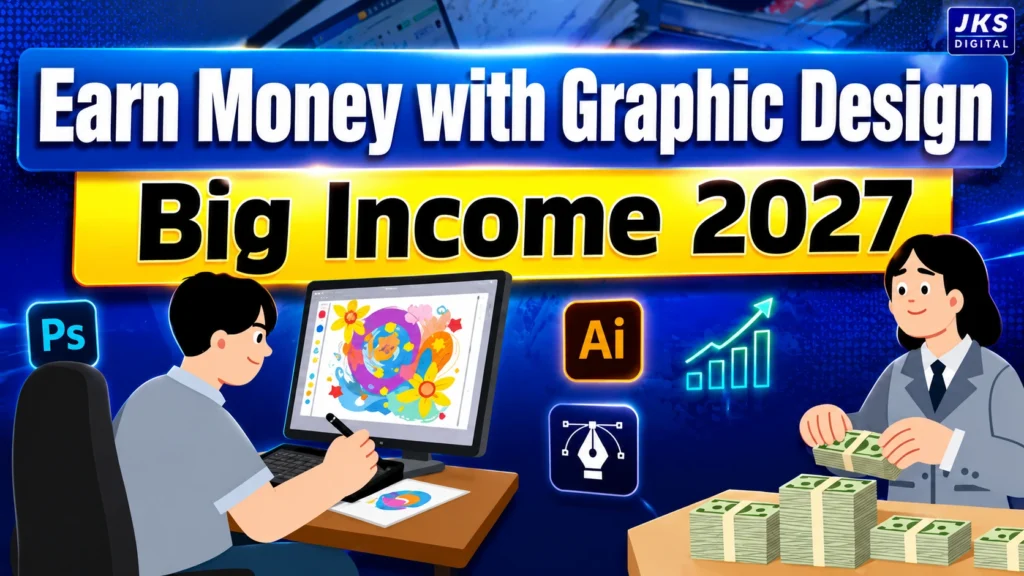
How to Make Money with Graphic Designing in 2027:- Have you ever wondered why some brands instantly grab your attention while others are easy to forget? In most cases, the difference isn’t just the product—it’s the way the brand presents itself. From logos and social media posts to product packaging and website banners, every visual element is carefully designed to leave a lasting impression.
That’s where graphic design comes in.
Over the past few years, graphic design has evolved from being just a creative profession into one of the most valuable digital skills. Today, businesses of every size need eye-catching visuals to promote their products, build trust with customers, and stand out in a highly competitive market. As a result, skilled graphic designers are in demand across almost every industry.
The best part is that you don’t need a large investment or a traditional office job to get started. With a laptop, an internet connection, and the right skills, you can work with clients from anywhere in the world, build your own brand, or even create multiple income streams online.
In this guide, you’ll learn what graphic design really is, why it’s becoming one of the most profitable digital careers, the skills you need to succeed, and how you can prepare yourself to start earning from this creative profession.
Why Graphic Design Is One of the Most In-Demand Skills Today
The digital world has changed the way businesses operate.
Almost every company now relies on online marketing to attract customers. Whether it’s a local café, an e-commerce store, a YouTube creator, or a multinational company, every business needs professional graphics to communicate with its audience.
Think about the number of visuals you see every day. Instagram posts, Facebook advertisements, YouTube thumbnails, website banners, product labels, mobile apps, and business presentations are all created by graphic designers.
This growing demand has opened countless opportunities for designers to earn money through freelancing, remote jobs, digital products, and even their own agencies.
Unlike many careers that require years of education, graphic design is a practical skill that can be learned through consistent practice and real-world projects.
What Is Graphic Design?
Graphic design is the art of communicating ideas through visual elements.
Instead of using only words, designers combine typography, colors, illustrations, icons, images, and layouts to create designs that inform, attract, and inspire people.
Every successful design serves a purpose. It may encourage someone to buy a product, click on a video, trust a brand, or simply understand information more clearly.
For example, when you notice an attractive restaurant menu, a memorable company logo, or a social media advertisement that catches your attention, you’re seeing graphic design in action.
In simple terms, graphic design helps businesses communicate their message in a visually engaging way.
Real-Life Examples of Graphic Design
Many beginners believe graphic designers only create logos. In reality, the profession is much broader.
A graphic designer may work on projects such as:
- Company logos
- Brand identity kits
- Business cards
- Social media posts
- Instagram carousel designs
- Facebook advertisements
- YouTube thumbnails
- Website banners
- Landing page graphics
- Product packaging
- Brochures and flyers
- Restaurant menus
- Wedding invitations
- Resume templates
- E-book covers
- Amazon product images
- Presentation designs
- T-shirt graphics
- Product labels
- Marketing materials
As businesses continue expanding online, the demand for these design services continues to grow.
Why Do Businesses Hire Graphic Designers?
Good design is no longer a luxury—it’s a necessity.
Customers often judge a business within a few seconds of seeing its website, social media profile, or advertisement. Professional visuals create trust, improve credibility, and make a brand appear more reliable.
Businesses hire graphic designers because strong visuals help them:
- Build a professional brand identity
- Increase customer trust
- Improve marketing performance
- Create engaging social media content
- Increase product sales
- Stand out from competitors
- Deliver information more effectively
In many cases, a well-designed advertisement performs significantly better than a poorly designed one, even when both have the same marketing budget.
Can Anyone Learn Graphic Design?
One of the biggest misconceptions about graphic design is that you must be naturally artistic or exceptionally creative.
The truth is very different.
Graphic design is a skill that improves with learning and practice. While creativity certainly helps, understanding design principles is far more important than being able to draw.
Many successful designers started with no professional experience at all.
Today, beginner-friendly tools like Canva, Adobe Express, and AI-powered design software have made learning graphic design easier than ever before.
If you practice consistently, study professional designs, and keep improving your skills, you can become a professional designer regardless of your background.
Essential Skills Every Graphic Designer Should Learn
Owning design software isn’t enough to become a successful graphic designer. The real difference comes from understanding the principles behind great design.
1. Color Theory
Colors influence how people feel and react.
Blue often represents trust and professionalism, green symbolizes growth and nature, while red creates excitement and urgency.
Learning how colors work together helps you create visually appealing designs that communicate the right message.
2. Typography
Typography is the art of choosing and arranging fonts.
Good typography improves readability and creates a professional appearance. Using too many different fonts in one design can make it look cluttered and unprofessional.
Successful designers understand how to balance style with readability.
3. Layout and Composition
Every design should guide the viewer’s attention naturally.
Proper spacing, alignment, visual hierarchy, and balanced composition can transform an average design into a professional one.
A clean layout often has a greater impact than adding unnecessary design elements.
4. Branding Fundamentals
Every business has its own visual identity.
A designer should understand how logos, colors, fonts, and design styles work together to create a consistent brand image.
Branding projects are also among the highest-paying graphic design services.
5. Social Media Design
Social media has become one of the biggest marketing channels for businesses.
Designers who know how to create engaging Instagram posts, Facebook ads, LinkedIn graphics, and YouTube thumbnails are always in demand.
Learning platform-specific design techniques can significantly increase your earning opportunities.
6. Basic Marketing Knowledge
Design is not only about making something look attractive.
A professional designer understands the purpose behind every design.
Is the goal to increase sales?
Generate leads?
Promote a product?
Build brand awareness?
When you understand marketing, your designs become more effective, making you far more valuable to clients.
Read Also:- How to Make Money with SEO: 15 Proven Ways to Earn Online
7. AI Tools and Modern Design Workflows
Artificial intelligence is transforming the design industry.
Rather than replacing designers, AI helps speed up repetitive tasks, generate ideas, remove backgrounds, improve images, and simplify workflows.
Designers who combine creativity with AI tools often complete projects faster while maintaining high quality.
Best Graphic Design Tools for Beginners and Professionals
Choosing the right software depends on your goals and experience.
Here are some of the most widely used tools in the industry.
Canva
Perfect for beginners who want to create social media posts, presentations, marketing materials, and simple business graphics without advanced technical knowledge.
Adobe Photoshop
An industry-standard application for photo editing, banner design, image manipulation, and digital artwork.
Adobe Illustrator
The preferred software for creating logos, vector illustrations, icons, and complete brand identity systems.
Figma
One of the most popular tools for designing websites, mobile applications, and user interfaces.
Adobe Express
An easy-to-use platform for creating quick marketing graphics and social media content.
CorelDRAW
Widely used in the printing industry for vector graphics, brochures, banners, and promotional materials.
Why Your Portfolio Matters More Than Your Resume
When clients hire a graphic designer, they don’t usually ask about degrees first.
They want to see your work.
Your portfolio is the strongest proof of your skills.
Even if you’ve never worked with a real client, you can still create an impressive portfolio by designing fictional brands, redesigning existing products, or building personal projects that showcase your creativity.
A well-organized portfolio often creates a stronger impression than years of experience listed on a resume.
Where Should You Showcase Your Portfolio?
Your portfolio should be available where potential clients can easily find it.
Some of the best platforms include:
- Behance
- Dribbble
- Personal portfolio website
- Instagram design page
As your portfolio grows, it becomes easier to attract higher-paying clients and larger projects.
How Much Can a Graphic Designer Earn?
There is no fixed income in graphic design.
Your earnings depend on your skills, experience, specialization, portfolio, and ability to find clients.
Many beginners start by taking on smaller projects to build experience and gain testimonials. As their portfolio improves and their reputation grows, they can gradually increase their prices and work with better clients.
Some designers earn extra income through freelance projects, while others build full-time careers, launch design agencies, or sell digital products that generate passive income.
Graphic design offers flexibility that very few professions can match, making it an attractive career for students, freelancers, entrepreneurs, and creative professionals alike.
Conclusion
Graphic design is far more than learning how to use design software. It is the ability to communicate ideas visually, solve business problems, and create experiences that connect with people.
If you’re serious about building a successful career, focus first on mastering design fundamentals, practicing consistently, and developing a professional portfolio. These three elements will lay the foundation for every income opportunity you’ll explore later.
10 Proven Ways to Make Money with Graphic Designing
1. Start Freelancing as a Graphic Designer
Freelancing is one of the easiest and most popular ways to begin earning as a graphic designer. Instead of working for one company, you work with multiple clients and choose projects that match your skills and interests.
This option gives you complete flexibility. You can work from home, set your own schedule, and gradually increase your rates as your experience grows.
What Services Can You Offer?
As a freelance graphic designer, you can offer services such as:
- Logo Design
- Social Media Graphics
- Business Cards
- Flyers and Brochures
- Website Banners
- Presentation Design
- Product Packaging
- YouTube Thumbnails
- Advertisement Creatives
- Brand Identity Design
Best Platforms to Find Freelance Clients
Some of the most trusted freelancing platforms include:
- Fiverr
- Upwork
- Freelancer
- PeoplePerHour
- Guru
- Contra
- Toptal (for experienced professionals)
Read Also:- How to Earn Money from WhatsApp in 2026: 15 Proven Ways to Make Money Online
How Much Can You Earn?
Your earnings depend on your experience, portfolio, and client quality. Many beginners start with smaller projects to build credibility, while experienced freelancers often charge significantly higher rates for specialized work.
The key is to focus on delivering quality work and collecting positive client reviews, as these help attract better opportunities over time.
Tips for Success
- Build a strong portfolio before applying for jobs.
- Specialize in one or two services instead of offering everything.
- Always communicate professionally.
- Deliver projects before deadlines.
- Ask satisfied clients for reviews and referrals.
2. Offer Logo Design Services
A logo is the face of every business. Whether it’s a startup, restaurant, clothing brand, or online store, every company needs a professional logo.
Because of this, logo design remains one of the highest-demand graphic design services.
Who Needs Logo Designers?
Potential clients include:
- Startups
- Local businesses
- Restaurants
- Cafes
- E-commerce brands
- Real estate companies
- Educational institutes
- Digital agencies
- Personal brands
Where Can You Find Clients?
You can promote your logo design services through:
- Fiverr
- Upwork
- Behance
- Dribbble
- Facebook business groups
You can also approach newly registered businesses that may not have established branding yet.
Tips for Better Results
Instead of simply creating attractive logos, learn how to build complete brand identities. Businesses usually prefer hiring someone who understands branding rather than someone who only designs a logo.
3. Design Social Media Graphics for Businesses
Businesses need fresh content every day to stay active on platforms like Instagram, Facebook, LinkedIn, Pinterest, and X.
Many business owners don’t have the time or design skills to create professional posts themselves, so they hire graphic designers on a monthly basis.
This creates recurring income instead of one-time projects.
Services You Can Offer
- Instagram posts
- Carousel graphics
- Facebook ads
- LinkedIn creatives
- Story designs
- Promotional banners
- Festival creatives
- Product launch graphics
Potential Clients
- Restaurants
- Coaches
- Doctors
- Fitness trainers
- Realtors
- Local shops
- Marketing agencies
- Small businesses
- Influencers
Pro Tip
Offer monthly content packages instead of charging for individual posts. This helps you build long-term relationships with clients and creates predictable monthly income.
4. Create YouTube Thumbnails
Millions of videos are uploaded to YouTube every day, and creators compete for clicks.
A compelling thumbnail often determines whether someone watches a video or scrolls past it.
That’s why many YouTubers hire professional thumbnail designers.
Why This Service Is in Demand
Creators need new thumbnails regularly, making it an excellent recurring service.
Who Can Become Your Clients?
- Gaming channels
- Educational creators
- Business channels
- Vloggers
- Podcast creators
- Finance channels
- Tech reviewers
Read Also:- Top Earning Apps in USA 2026: Make Money Online Without Investment
Where to Find Clients
- YouTube
- Twitter (X)
- Discord creator communities
- Facebook creator groups
Pro Tip
Create thumbnail redesigns for popular YouTubers and post them on your portfolio. Many creators discover designers through creative redesign concepts.
5. Sell Complete Brand Identity Packages
Instead of selling only a logo, you can offer complete branding solutions.
Businesses often prefer working with one designer who can create a consistent visual identity.
A Brand Identity Package May Include
- Logo
- Color palette
- Typography guide
- Business card
- Letterhead
- Social media templates
- Brand guidelines
- Email signature
- Presentation template
Because branding directly impacts business image, these projects usually carry much higher value than individual design services.
Best Clients
- New businesses
- Startups
- Agencies
- E-commerce brands
- Personal brands
Pro Tip
Learn basic brand strategy along with design. Understanding a company’s target audience makes your branding projects much stronger.
6. Design Product Packaging
Product packaging has become one of the fastest-growing areas in graphic design.
Whether it’s food, cosmetics, supplements, skincare products, or beverages, brands need attractive packaging to compete on store shelves and online marketplaces.
Good packaging increases customer trust and influences purchasing decisions.
Potential Clients
- Food manufacturers
- Cosmetic brands
- Organic products
- Health supplements
- Handmade products
- FMCG companies
- Amazon sellers
Skills Required
- Adobe Illustrator
- Print-ready file preparation
- Packaging layouts
- Branding knowledge
Why This Is Profitable
Packaging projects often lead to long-term collaborations because businesses regularly launch new products and update existing packaging.
7. Design Website Banners and Landing Pages
Every website needs professional visuals.
Businesses running Google Ads, Facebook Ads, or email campaigns constantly require landing page graphics, promotional banners, and website visuals.
Services You Can Offer
- Homepage banners
- Hero section graphics
- Website illustrations
- Landing page visuals
- Promotional offers
- Pop-up banners
Best Clients
- Digital marketing agencies
- SaaS companies
- E-commerce stores
- Educational institutes
- Online course creators
- Corporate businesses
Pro Tip
Learning basic UI design can significantly increase your opportunities in this field.
8. Sell Canva Templates
If you enjoy creating organized, reusable designs, Canva templates can become an excellent source of passive income.
Instead of working with clients repeatedly, you create templates once and sell them multiple times.
Popular Canva Templates
- Instagram templates
- Resume templates
- Business presentations
- Media kits
- Invoice templates
- Planners
- Calendars
- E-books
- Proposal templates
- Social media bundles
Where to Sell
- Etsy
- Creative Market
- Gumroad
- Design Bundles
- Your own website
Passive income grows over time as more people purchase your templates.
9. Start a Print-on-Demand Business
Print-on-Demand allows you to sell custom-designed products without managing inventory.
You simply create the design, upload it, and the platform handles printing, packaging, and shipping whenever someone places an order.
Products You Can Design
- T-shirts
- Hoodies
- Coffee mugs
- Phone cases
- Tote bags
- Stickers
- Wall art
- Posters
- Notebooks
Popular Platforms
- Redbubble
- TeePublic
- Printify
- Printful
- Spring
- Amazon Merch on Demand
Why Designers Love It
Every design you upload has the potential to generate sales for years, creating a long-term passive income stream.
10. Build Your Own Graphic Design Agency
Once you’ve gained experience and developed a steady client base, you can expand beyond freelancing by building your own agency.
Instead of completing every project yourself, you create a team of designers and manage client relationships.
This allows you to handle larger projects while increasing your overall earning potential.
Services Your Agency Can Offer
- Logo Design
- Branding
- Social Media Management
- Website Graphics
- UI Design
- Packaging Design
- Marketing Creatives
- Motion Graphics
Read also:- How to Make Money with AI Prompt Writing in 2026: Step-by-Step Guide
How to Grow
- Hire freelance designers.
- Build standard operating procedures.
- Focus on recurring clients.
- Create monthly service packages.
- Invest in marketing and referrals.
Many successful agencies start with just one designer working from home before gradually expanding into a full business.
Which Method Is Best for Beginners?
If you’re just starting your graphic design journey, don’t try to master everything at once. Focus on building one strong skill, create a portfolio around it, and start offering that service consistently.
A simple growth path could look like this:
- Start with social media post design and YouTube thumbnails.
- Learn logo and branding design.
- Move into packaging and website graphics.
- Sell Canva templates for passive income.
- Build a freelance business.
- Eventually, grow into your own design agency.
This step-by-step approach helps you gain experience, improve your portfolio, and increase your income over time without feeling overwhelmed.
Conclusion
Graphic designing offers far more opportunities than most beginners realize. Whether you enjoy working directly with clients, selling digital products, or building a creative business, there are multiple ways to turn your skills into a sustainable income.
The key is not to chase every opportunity at once. Choose one path, become excellent at it, build a strong portfolio, and consistently deliver high-quality work. As your experience grows, you can expand into additional income streams and create a long-term career in graphic design.
Where to Find Graphic Design Clients – Best Platforms and Proven Client Outreach Strategies
Learning graphic design is only half the journey. The next challenge is finding people who are willing to pay for your skills.
Many beginners believe that clients will automatically come once they create a portfolio. Unfortunately, that’s rarely how it works. Even highly talented designers can struggle if they don’t know where to market themselves or how to approach potential clients.
The good news is that thousands of businesses are actively searching for graphic designers every day. The key is knowing where those businesses are and how to present your services professionally.
In this section, you’ll discover the best platforms to find graphic design clients, practical outreach strategies, and smart ways to build a consistent pipeline of projects.
1. Freelance Marketplaces
Freelance platforms are often the easiest place for beginners to land their first paid project. These websites already have businesses looking for designers, so you don’t need to convince people why they need graphic design—you simply need to show why you’re the right person for the job.
Fiverr
Fiverr allows you to create service listings, known as “Gigs,” where clients can purchase your design services directly.
Popular Graphic Design Services on Fiverr
- Logo Design
- Social Media Posts
- YouTube Thumbnails
- Packaging Design
- Business Cards
- Flyers
- Presentation Design
- Banner Design
Tips for Success
- Write clear service descriptions.
- Use high-quality portfolio images.
- Offer multiple pricing packages.
- Respond quickly to inquiries.
- Deliver projects before the deadline.
Consistency is important. Many successful Fiverr sellers didn’t receive orders immediately—they improved their profiles over time and built trust through positive reviews.
Upwork
Unlike Fiverr, Upwork allows freelancers to apply for projects posted by clients.
Businesses publish job listings, and designers submit proposals explaining why they’re a good fit.
Best Practices
- Personalize every proposal.
- Mention relevant portfolio examples.
- Avoid copying the same proposal for every job.
- Keep your introduction short and professional.
- Focus on solving the client’s problem instead of talking only about yourself.
Other Freelancing Platforms Worth Exploring
Don’t rely on just one website. Expanding your presence across multiple platforms increases your chances of getting consistent work.
Some popular freelance websites include:
- Freelancer
- PeoplePerHour
- Guru
- Contra
- Toptal (for experienced designers)
Each platform has a different client base, so experimenting with multiple options is a smart strategy.
2. Showcase Your Portfolio on Design Communities
Many businesses hire designers after discovering their work on professional portfolio websites.
These platforms are not just for displaying your designs—they also help build credibility and attract inbound leads.
Behance
Behance is one of the world’s largest creative portfolio platforms.
Here, you can publish complete case studies instead of simply uploading images.
A strong project should include:
- Project objective
- Design process
- Color palette
- Typography choices
- Mockups
- Final outcome
Case studies often attract more attention than standalone images because they demonstrate your creative thinking.
Dribbble
Dribbble is another excellent platform where designers share their best work.
Many startups, agencies, and recruiters regularly browse Dribbble to discover talented designers.
Upload your strongest projects instead of everything you’ve ever created.
Remember, quality always wins over quantity.
3. Use LinkedIn to Find High-Paying Clients
LinkedIn is often overlooked by beginner designers, but it can be one of the most powerful platforms for finding serious business clients.
Instead of focusing only on recruiters, connect with:
- Startup founders
- Marketing managers
- Business owners
- Agency founders
- Coaches
- Consultants
- E-commerce entrepreneurs
Optimize Your LinkedIn Profile
Your profile should clearly communicate:
- What you do
- Who you help
- What services you offer
- Examples of your work
- Client testimonials (if available)
A professional headline is far more effective than simply writing “Graphic Designer.”
For example:
Helping Businesses Build Strong Brands Through Professional Graphic Design
4. Turn Instagram into Your Portfolio
Instagram is no longer just a social media platform—it has become a visual portfolio for designers.
Instead of posting random graphics, treat your profile like your online showroom.
Share Content Such As
- Logo redesigns
- Branding projects
- Carousel designs
- Before-and-after transformations
- Behind-the-scenes design process
- Client work (with permission)
- Design tips
When potential clients visit your profile, they should immediately understand your style and expertise.
Read Also:- How to Earn Money from Instagram Reels in 2026: Complete Guide for India
5. Find Local Businesses Through Google Maps
One of the simplest ways to find clients is by searching local businesses on Google Maps.
Many restaurants, salons, gyms, clinics, coaching centers, boutiques, and cafes have outdated branding or poor-quality social media graphics.
These businesses often need professional design support.
What Should You Look For?
- Businesses without a professional logo
- Low-quality social media posts
- Poor website banners
- Weak branding
- Outdated promotional materials
Create a list of potential businesses and contact them professionally.
6. Join Facebook Communities
Facebook still has thousands of active business and freelancer communities where companies regularly post design requirements.
Join groups related to:
- Small businesses
- Startup founders
- Marketing agencies
- E-commerce
- Digital marketing
- Entrepreneurs
Avoid spamming your services.
Instead:
- Share valuable design tips.
- Post portfolio updates.
- Answer questions.
- Build relationships before promoting yourself.
People are more likely to hire someone they already recognize.
7. Connect with Marketing Agencies
Many agencies outsource graphic design projects when their workload increases.
Instead of finding one client at a time, building relationships with agencies can provide ongoing work.
Reach out to:
- Digital marketing agencies
- Branding agencies
- SEO companies
- Web development agencies
- Social media agencies
Agencies often need reliable freelance designers for long-term collaboration.
8. Reach Out to YouTubers and Content Creators
Every content creator needs visuals.
From thumbnails and banners to channel branding and social media graphics, creators constantly require design support.
Potential Clients Include
- YouTubers
- Podcasters
- Instagram creators
- Coaches
- Online educators
- Streamers
One satisfied creator can become a recurring client for months or even years.
Read also:- How to Earn Money from Myntra in 2026 (Complete Step-by-Step Guide)
9. Sell Digital Design Products
Not every income source requires working with clients.
You can also create digital products and sell them repeatedly.
Examples include:
- Canva Templates
- Resume Templates
- Social Media Bundles
- Presentation Templates
- Media Kits
- Business Proposal Templates
- Invoice Templates
- Printable Planners
Popular marketplaces include:
- Etsy
- Creative Market
- Gumroad
- Design Bundles
This approach allows you to build passive income over time.
10. Ask for Referrals
One of the easiest ways to get new clients is through existing ones.
After completing a project successfully, politely ask your client whether they know someone else who might need design services.
Happy clients are often willing to recommend designers they trust.
Word-of-mouth referrals usually convert much faster than cold outreach.
How to Reach Out to Potential Clients Professionally
Finding clients is one thing.
Starting the conversation professionally is another.
Many beginners lose opportunities because they send messages like:
“Hi Sir, I am graphic designer. Please give me work.”
This approach rarely gets results.
Instead, focus on showing that you’ve taken time to understand the client’s business.
A good outreach message should:
- Introduce yourself briefly.
- Mention something specific about their business.
- Explain how your design services can help.
- Offer value instead of immediately asking for work.
- Include your portfolio link.
- End with a simple call to action.
Professional communication creates a much stronger first impression.
Simple Outreach Workflow That Actually Works
Instead of sending hundreds of random messages every day, build a consistent routine.
Daily Client Acquisition Plan
Morning
- Search for new businesses.
- Save potential leads.
- Research their branding.
Afternoon
- Send personalized outreach messages.
- Apply for freelance jobs.
- Update your portfolio.
Evening
- Follow up with previous leads.
- Share one design on LinkedIn or Instagram.
- Learn a new design technique.
Following this routine consistently is often more effective than spending an entire week searching for clients and then stopping completely.
Common Client Hunting Mistakes
Many beginners struggle because they repeat the same mistakes.
Avoid these habits:
- Sending copy-paste messages.
- Contacting businesses without researching them.
- Having no portfolio.
- Charging extremely low prices.
- Following up too aggressively.
- Ignoring LinkedIn.
- Waiting for clients instead of actively searching.
- Applying for every project instead of specializing.
Remember, clients don’t hire the cheapest designer—they hire the one who gives them confidence.
Finding clients is not about luck. It is a skill that improves with practice.
The more consistently you build your portfolio, improve your communication, and reach out to the right people, the easier it becomes to attract better opportunities.
Many successful graphic designers didn’t become successful because they were the most talented. They succeeded because they combined good design skills with smart marketing and consistent outreach.
Once you understand where your ideal clients are and how to communicate your value, you’ll no longer have to rely on random opportunities.
Pricing, Winning Clients, Getting Paid, and Building a Long-Term Graphic Design Career
Learning graphic design and finding clients are important milestones, but they are only part of the journey. Many talented designers struggle not because they lack creativity, but because they don’t know how to price their services, communicate with clients, or manage their business professionally.
The difference between a designer who earns occasionally and one who builds a full-time career often comes down to business skills. Knowing how to present your work, set fair prices, manage projects, and build long-term client relationships can have a bigger impact on your income than simply learning another design tool.
In this final part, you’ll learn how to price your services, close clients confidently, receive payments securely, manage projects efficiently, and build a sustainable graphic design career.
How to Price Your Graphic Design Services
One of the first questions every beginner asks is:
“How much should I charge?”
There isn’t a universal answer because pricing depends on several factors, including your experience, portfolio, project complexity, turnaround time, and the value you bring to the client.
Instead of copying someone else’s prices, build your pricing around your skills and the results you deliver.
Before sending a quotation, ask yourself:
- How much time will this project take?
- Does it require research?
- How many revisions are included?
- Will the client use the design commercially?
- Is this a one-time project or a long-term partnership?
Answering these questions helps you create fair and sustainable pricing.
Different Pricing Models
Professional designers usually use one of these pricing methods depending on the project.
Hourly Pricing
You charge based on the number of hours you spend working.
This works well for:
- Small revisions
- Ongoing support
- Consultation work
Fixed Project Pricing
You charge one agreed price for the complete project.
This is ideal for:
- Logo design
- Social media packages
- Branding projects
- Brochure design
- Website graphics
Clients often prefer fixed pricing because they know the total cost in advance.
Monthly Retainer
Instead of charging for individual projects, you work with clients every month for a fixed fee.
This model is popular for:
- Social media design
- Marketing creatives
- Website updates
- Ongoing branding support
Monthly retainers create stable and predictable income.
Never Compete Only on Price
Many beginners believe lowering prices is the fastest way to get clients.
Unfortunately, this often attracts clients who negotiate constantly and rarely value your work.
Instead of becoming the cheapest designer, focus on becoming the designer who provides the best experience.
Clients are often willing to pay more for someone who communicates clearly, delivers on time, and produces high-quality work.
Value creates long-term success—not low prices.
How to Create a Professional Proposal
A proposal is more than just a quotation.
It explains exactly what the client will receive and helps prevent misunderstandings later.
A good proposal should include:
- Project overview
- Scope of work
- Deliverables
- Timeline
- Number of revisions
- Pricing
- Payment terms
- Contact information
A clear proposal builds trust before the project even begins.
How to Close More Clients
Winning clients isn’t about convincing people to hire you.
It’s about understanding their problems and showing how your design can solve them.
During conversations, avoid talking only about yourself.
Instead, ask questions like:
- What are your business goals?
- Who is your target audience?
- What challenges are you facing?
- What kind of visual style do you prefer?
The more you understand your client’s business, the better your solutions become.
People don’t buy design.
They buy results.
Build Long-Term Client Relationships
Many designers focus only on finding new clients.
Successful designers also focus on keeping existing ones.
After completing a project:
- Deliver files in an organized manner.
- Thank the client professionally.
- Ask if they need any future design support.
- Stay connected through email or LinkedIn.
- Follow up occasionally.
One satisfied client can provide multiple future projects and valuable referrals.
Long-term relationships are often more profitable than constantly searching for new clients.
Payment Methods for Graphic Designers
Receiving payments professionally is just as important as completing great work.
If you’re working with clients in India, common payment methods include:
- UPI
- Bank Transfer
- Digital Wallets
For international clients, designers commonly use:
- PayPal
- Wise
- Payoneer
Always discuss the payment method before starting the project.
Why You Should Always Ask for an Advance Payment
One of the biggest mistakes beginners make is completing an entire project before receiving any payment.
A professional approach is to request an advance before starting work.
This shows that both parties are committed to the project.
For larger projects, many designers divide payments into milestones, with the remaining balance due before delivering the final editable files.
This helps reduce payment-related issues and creates a smoother workflow.
Should You Use a Design Contract?
Yes.
Even for small projects, having written terms helps protect both you and your client.
A contract should clearly mention:
- Scope of work
- Timeline
- Deliverables
- Number of revisions
- Payment terms
- Ownership of final files
- Cancellation policy
Clear expectations reduce confusion and make projects more professional.
Create Professional Invoices
Every completed project should include an invoice.
An invoice records:
- Client information
- Your business details
- Project description
- Payment amount
- Payment status
- Invoice number
- Date
Professional documentation improves credibility, especially when working with business clients.
Time Management Tips for Graphic Designers
As your workload increases, managing time becomes essential.
Some simple habits can improve productivity:
- Plan your day before starting work.
- Prioritize high-value projects.
- Avoid checking social media while designing.
- Break large projects into smaller tasks.
- Set realistic deadlines.
- Keep backup copies of your work.
- Organize project folders properly.
Working efficiently allows you to take on more projects without compromising quality.
AI Tools That Can Improve Your Workflow
Artificial Intelligence is changing how designers work.
Rather than replacing creativity, AI helps automate repetitive tasks.
Useful AI-powered tools can assist with:
- Removing backgrounds
- Upscaling images
- Generating design ideas
- Writing marketing copy
- Creating mockups
- Organizing design assets
- Improving workflow efficiency
Learning to work alongside AI can save hours every week and help you complete projects faster.
Common Mistakes Every Beginner Should Avoid
Most designers make mistakes when starting out, but learning from them early can save time and help you grow faster.
Some of the most common mistakes include:
- Skipping design fundamentals.
- Copying other designers instead of developing your own style.
- Creating a weak portfolio.
- Ignoring communication skills.
- Missing deadlines.
- Accepting every project without specialization.
- Charging too little.
- Failing to collect testimonials.
- Not backing up project files.
- Stopping learning after getting a few clients.
Success in graphic design comes from continuous improvement, not perfection.
Tips to Build a Successful Graphic Design Career
If you want graphic design to become more than just a side hustle, focus on long-term growth rather than quick wins.
Some habits that successful designers consistently follow include:
- Practice regularly, even when you don’t have client work.
- Keep improving your portfolio.
- Learn new design trends without copying them blindly.
- Understand branding and marketing.
- Develop communication and presentation skills.
- Build a personal brand on social media.
- Ask for client feedback after every project.
- Continue learning new tools and technologies.
- Deliver more value than clients expect.
Small improvements made consistently often lead to significant career growth over time.
The Future of Graphic Designing
Graphic designing continues to evolve with technology, but one thing remains constant: businesses will always need creative professionals who can communicate ideas visually.
While AI has made design tools more accessible, it hasn’t eliminated the need for skilled designers. In fact, businesses increasingly value professionals who can combine creativity, strategic thinking, branding, and technology to produce meaningful results.
Designers who adapt to new tools, stay curious, and continue learning will remain in demand across industries.
The future belongs to designers who solve problems—not just create attractive visuals.
Frequently Asked Questions (FAQs)
Can I start graphic designing without a degree?
Yes. Most clients care more about your portfolio, creativity, and ability to solve design problems than your academic qualifications.
Do I need expensive software to begin?
No. Many beginners start with free or affordable tools and gradually upgrade as their skills and client base grow.
How long does it take to become a professional graphic designer?
It depends on your consistency. With regular practice and real-world projects, many beginners develop job-ready skills within a few months.
Can graphic designing become a full-time career?
Absolutely. Many designers work as freelancers, join agencies, build personal brands, or even start their own design businesses.
Is graphic designing still a good career despite AI?
Yes. AI can speed up certain tasks, but creativity, strategy, branding, and communication are still human strengths. Designers who learn to use AI effectively will have a competitive advantage.
Final Thoughts
Graphic designing is more than a creative skill—it’s a career that offers flexibility, continuous learning, and multiple ways to earn. Whether you choose freelancing, branding, digital products, or building your own agency, success comes from combining strong design skills with professionalism, consistency, and a willingness to keep improving.
Don’t wait until you feel “perfect” to start. Build your portfolio, take on small projects, learn from every client, and gradually raise the value of your work. Every experienced designer started exactly where you are today—with a willingness to learn and the courage to take the first step.
The opportunities are already there. Your next project, your next client, and your next career milestone all begin with the skills you choose to build today.