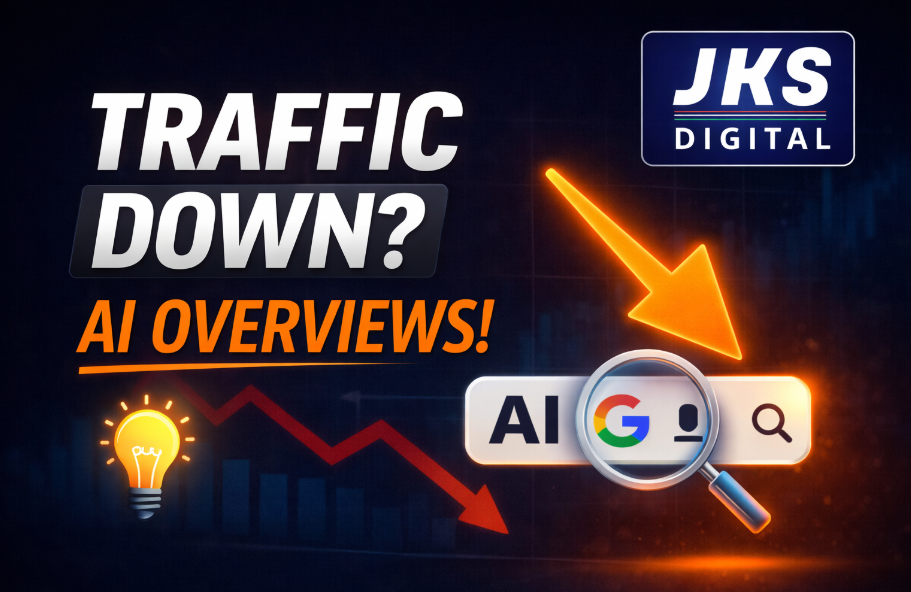
What Are Google AI Overviews?:- If your website traffic has dropped recently, it is not just a coincidence. A major shift is happening in search behavior, and many website owners are struggling to understand it.
Google AI Overviews are changing how users interact with search results. Instead of exploring multiple websites, users are now getting direct, summarized answers on the search page itself. This reduces the need to click on individual links.
This shift is not temporary. It represents a structural change in how information is delivered online.
The real question is no longer “How do I rank on Google?”
The real question is “Why would someone click on my website when Google is already answering their query?”
This article focuses on that exact question. Not just what AI Overviews are, but how to think differently and adapt your strategy to protect and grow your traffic in 2026.
What Are Google AI Overviews?
Google AI Overviews are AI-generated summaries that appear at the top of search results. They combine information from multiple sources and present a single, concise answer to the user.
This reduces friction in search. Users get what they want faster, with fewer clicks.
From a user’s perspective, this is efficient. From a publisher’s perspective, this disrupts the traditional traffic model.
Earlier, Google acted as a bridge between users and websites. Now, it is increasingly becoming the destination itself.
The Fundamental Shift: From “Search Engine” to “Answer Engine”
To understand the real impact, you need to look beyond features and focus on behavior.
Google is evolving from a search engine into an answer engine.
Earlier model:
User → Google → Website → Answer
Current model:
User → Google → Answer
This change directly reduces organic traffic, especially for informational queries.
In my observation, this is not about losing traffic randomly. It is about losing traffic where your content does not offer anything beyond what AI can already summarize.
Why Traffic Is Dropping (Deeper Analysis)
Most explanations stop at “AI gives answers, so clicks are reduced.” That is true, but incomplete.
Here are deeper reasons:

1. Content Commoditization
Basic information has become a commodity.
Definitions, simple guides, and generic tips are no longer valuable because AI can generate them instantly.
If your content falls into this category, it is competing with a system that is faster and more scalable.
2. Loss of Curiosity Gap
Earlier, users clicked links because they were curious about what they would find inside.
Now, AI Overviews remove that curiosity by revealing the core information upfront.
If your title promises something and the AI already delivers it, the user has no reason to click.
3. Decline of Surface-Level SEO
Traditional SEO focused on:
- Keywords
- Backlinks
- Basic optimization
While these still matter, they are no longer enough.
Search is now influenced by perceived value, not just relevance.
Read Also:- AI Agents for Digital Marketing: How to Build Your First Automated Campaign (Step-by-Step)
4. Shift in User Intent Satisfaction
Google’s goal is not to send traffic.
Its goal is to satisfy intent as quickly as possible.
If the intent is fully satisfied on the search page, your website becomes optional.
Who Will Survive and Who Will Struggle
This change is not affecting everyone equally.
Content That Will Struggle:
- Articles written only to rank
- Rewritten or paraphrased content
- Generic “how-to” guides without depth
- List-based articles with no real insight

Content That Will Survive:
- Experience-driven content
- Opinion-based analysis
- Case studies and real data
- Content that introduces new thinking
The difference is simple:
If your content can be replaced by a summary, it will be replaced.
A New Content Philosophy: Beyond Information
To adapt, you need to change your mindset.
Stop thinking:
“I need to provide information”
Start thinking:
“I need to provide interpretation, perspective, and application”
Information is everywhere.
Insight is rare.
The Reality After 2024: Why AI Overviews Started Affecting Traffic in 2025
Google introduced AI Overviews in 2024 as an evolution of its earlier Search Generative Experience (SGE), marking a major shift in how search results are delivered. However, the real impact on SEO became much more visible in 2025 and continues to grow in 2026.
This is not just a theory — it is something many bloggers, including myself, have experienced.
I started my blogging journey around late September 2024. At that time, things were already changing, but the impact of AI Overviews was not fully visible. Over time, I noticed a clear pattern: even when articles were ranking well, the traffic was not increasing as expected.
In fact, in many cases, impressions were growing, but clicks remained extremely low.
High Impressions, Low Clicks: The New SEO Problem
One of the biggest frustrations for bloggers today is this:
You may get thousands of impressions, but only a handful of clicks.
For example, even after getting around 16,000 impressions, if only 50–70 users actually visit your website, it raises a serious question — is blogging still worth it?
The reason behind this is simple but powerful.
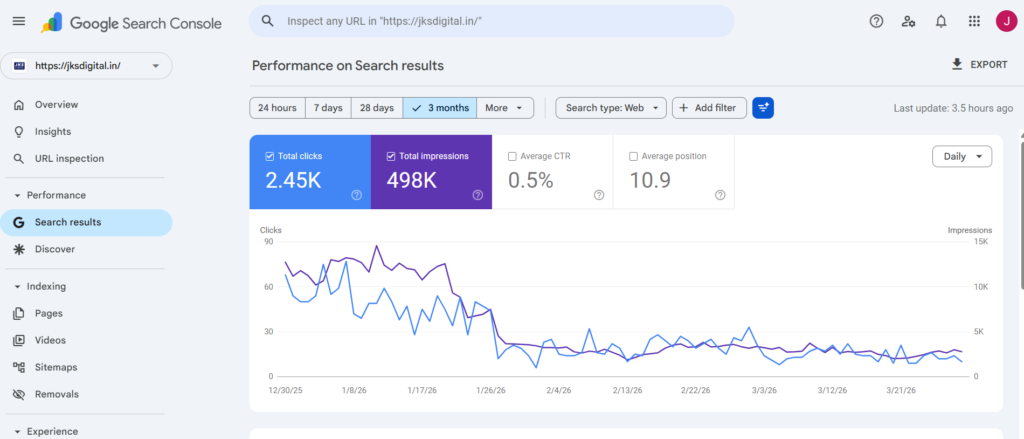
Google AI Overviews often provide detailed answers directly on the search results page. When users find what they need instantly, they don’t feel the need to click on any website.
This creates a situation where your content is visible, but not visited.
If this trend continues, many bloggers may start questioning the value of investing time in content creation, especially when the returns in terms of traffic and growth are becoming less predictable.
Even Featured Snippets Are Losing Value
Earlier, getting a featured snippet was a big achievement. It guaranteed visibility and a good number of clicks.
But now, even that is changing.
Many times, your content may appear in a featured snippet or be used in AI-generated summaries, but users still don’t visit your site. They read the answer on Google and leave.
This reduces the actual benefit of ranking.
In other words, visibility no longer guarantees traffic.
The Emotional Reality of Modern Blogging
This shift is not just technical — it is also frustrating.
When you spend hours writing, optimizing, and publishing content, and still don’t get traffic, it can feel discouraging.
Many bloggers are starting to question:
“Is there still any benefit in doing blogging?”
This is a valid concern.
But the answer is not to quit. The answer is to adapt.
A Smarter Way to Think: Not All Content Is Equal Anymore
At this stage, it becomes important to understand one key idea:
Not every type of content is equally affected by AI Overviews.
Highly Affected Content:
- Informational articles
- Definitions and basic guides
- Simple “how-to” content
Less Affected Content:
- Local and location-based searches
- Service-based queries
- Transactional keywords
Read Also:- Surfer SEO vs Semrush 2026: Which Tool Actually Gets You Ranked? (An Honest, Hands-On Comparison)
Can You Choose Topics That AI Cannot Fully Replace?
This is a very practical strategy.
Instead of competing with AI in informational content, you can focus on areas where AI Overviews are less effective.
For example:
1. Local and “Near Me” Searches

Searches like:
- “Digital marketing agency near me”
- “Best salon in Gurgaon”
These require real business listings, location relevance, and trust — something AI cannot fully replace.
2. Price-Based and Comparison Queries
Searches like:
- “Shoes under ₹2000”
- “Best laptop under 50000”
These require updated data, comparisons, and user preferences.
3. Service-Based Niches
For example:
- Digital marketing services
- Website design
- Local business solutions
Users in these categories are looking to take action, not just read information.
But Here’s the Important Truth
Choosing the right niche helps, but it is not the complete solution.
Even in informational content, you can still succeed — if you change your approach.
Because the real problem is not AI.
The real problem is content that does not go beyond basic information.
The Real Shift: From Information to Insight
AI can provide answers.
But it cannot fully replace:
- Personal experience
- Deep explanation
- Unique thinking
This is where you win.
If your content only answers “what” and “how,” AI can replace it.
But if your content explains:
- Why something works
- What mistakes to avoid
- What you personally observed
Then users will still click.
What You Should Do Moving Forward
Instead of fighting AI, you need to work around it.
1. Add Real Experience
Even small experiences matter.
2. Write Beyond the Summary
Don’t just give answers — give depth.
3. Focus on Actionable Content
Help users do something, not just understand something.
4. Combine Informational + Practical
Read Also:- Facebook Account Disabled 2026: Ultimate Guide to Reasons, Hidden Causes & Instant Recovery Tricks
Example:
Not just “What is SEO”
But “How I improved SEO results step by step”
Yes, blogging has become harder.
Yes, traffic is not as easy as before.
But blogging is not dead.
It is evolving.
Earlier, average content could rank and get traffic.
Now, only meaningful content survives.
If you understand this shift early, you are not behind — you are ahead of most people.
How to Protect Your Website Traffic (Advanced Strategies)
1. Build “Non-Summarizable” Content
The most important strategy is to create content that cannot be easily compressed into a short summary.
This includes:
- Personal experiences
- Unique frameworks
- Contrarian opinions
- Detailed breakdowns
For example, instead of explaining what SEO is, explain how a specific SEO strategy worked in a real situation and what you learned from it.
2. Introduce Original Thinking
Original thinking does not require years of experience. It requires observation.
You can write:
- Patterns you are noticing
- Mistakes people are making
- What is changing and why
For example:
“AI Overviews are not killing SEO. They are filtering out low-effort content and increasing the value of real expertise.”
This type of thinking positions you as an authority.
3. Create Layered Content
Most content today is flat. It answers one level of a question.
Instead, create layered content:
- Basic explanation
- Deeper reasoning
- Practical application
- Strategic takeaway
This ensures that even if AI covers the basics, users still need your content for depth.
4. Optimize for “Click Motivation,” Not Just Keywords
Your title and introduction must create a reason to click beyond the obvious answer.
You need to introduce:
- A gap in understanding
- A hidden problem
- A unique angle
For example:
Instead of saying “How to Protect Traffic,”
you explain why most strategies fail and what people are missing.
5. Develop Topical Depth, Not Just Topical Breadth
Publishing many articles is no longer enough.
You need to dominate a topic by covering it from multiple angles:
- Beginner level
- Intermediate level
- Advanced strategies
- Mistakes and case studies
This builds authority and makes your website harder to ignore.
6. Use Strategic Storytelling
Even in informational content, storytelling increases engagement.
You can include:
- A short scenario
- A real challenge
- A transformation
This makes your content memorable and harder to replace.
7. Focus on Reader Transformation
Ask yourself:
“What will change for the reader after reading this?”
If the answer is “they will know something,” that is weak.
If the answer is “they will be able to do something,” that is strong.
8. Strengthen Your Content Identity
Your content should have a recognizable voice.
This can be:
- Analytical
- Practical
- Beginner-friendly
Consistency builds trust, and trust increases return visitors.
9. Reduce Dependence on Google
This is a strategic necessity.
You should gradually build:
- Direct audience
- Email subscribers
- Social media presence
Traffic from Google is no longer guaranteed.
Ownership of audience is becoming more important.
10. Continuously Upgrade Existing Content
Your old articles are not finished assets. They are evolving resources.
Improve them by:
- Adding insights
- Updating examples
- Expanding depth
This signals freshness and relevance.
The Future of Search and Content
The future will not reward those who produce the most content.
It will reward those who produce the most meaningful content.
AI will handle:
- Definitions
- Basic explanations
- Repetitive information
Humans will win with:
- Perspective
- Experience
- Interpretation
The role of a content creator is shifting from “information provider” to “insight creator.”
Final Perspective
Google AI Overviews are not just a feature. They are a filter.
They are filtering out:
- Low-effort content
- Repetitive information
- Surface-level writing
And they are rewarding:
- Depth
- Clarity
- Original thinking
If your content evolves in this direction, your traffic will not disappear. It will become more qualified and more valuable.
Action Plan
Start with these steps:
- Identify which of your articles are purely informational
- Rewrite them with insights, examples, and depth
- Focus on topics where you can add real perspective
- Improve your introductions to create curiosity
- Build consistency in your content style