Drop Servicing Business in 2027:- If you want to start an online service business without personally doing every piece of client work, drop servicing can be one business model to explore. Instead of completing the service yourself, you find a client, sell the service at a price that includes your margin, and hire a freelancer or service provider to complete the work.
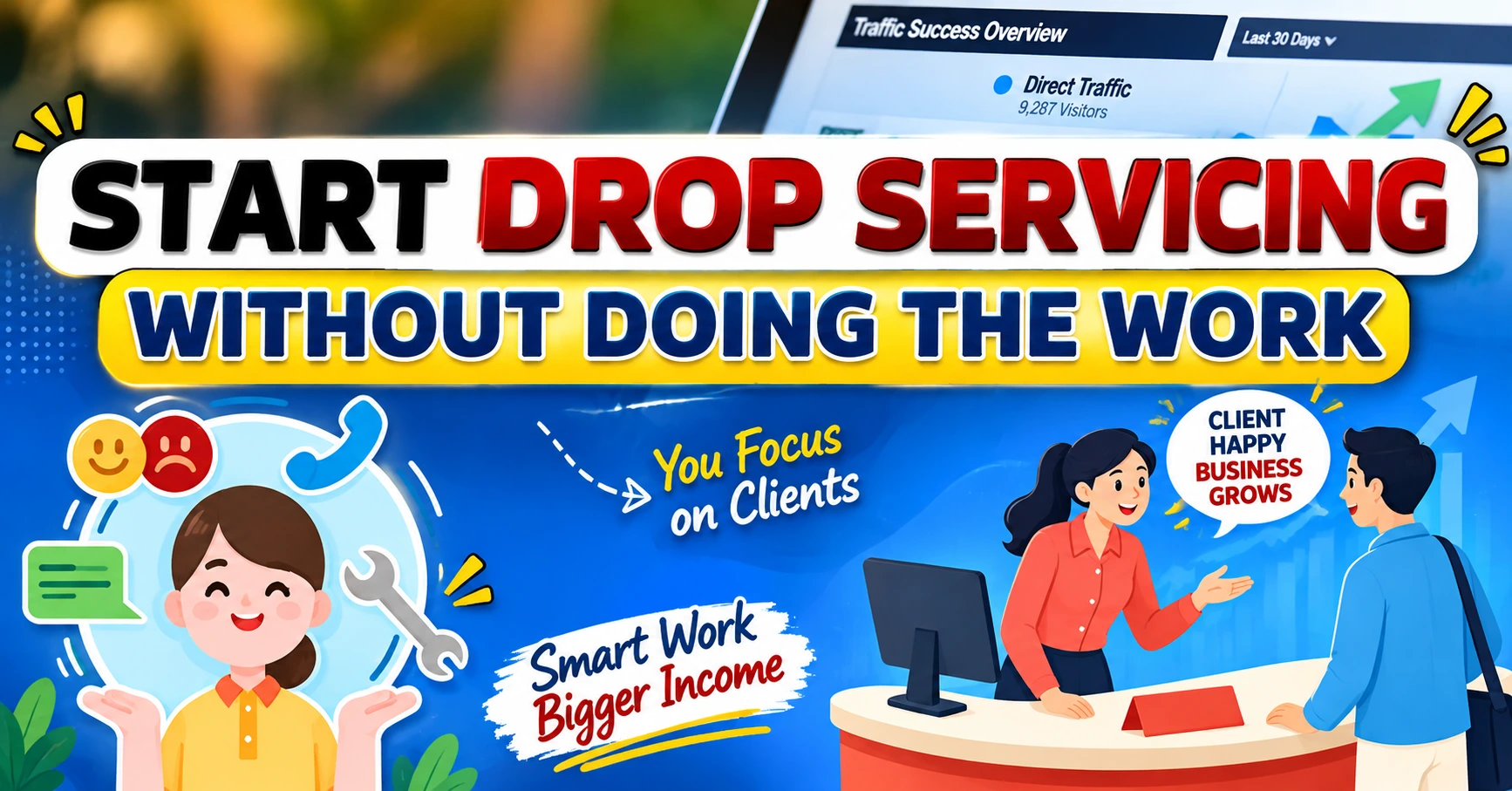
The important part is that drop servicing is not simply about finding a cheap freelancer and charging a higher price. You are responsible for understanding what the client needs, choosing the right service provider, checking the quality of the work, communicating with the client, and making sure the final service is delivered as promised.
This guide explains how the model works, what you need to start, which services you can consider, how to choose a niche, and what you should understand before trying to build a drop servicing business in 2027.
What Is Drop Servicing?
Drop servicing is a service-based business model in which you sell a service to a customer and outsource the actual fulfillment to a freelancer, specialist, or agency.
For example, imagine that a local business wants 10 short-form videos for Instagram.
You could:
- Find the client.
- Offer a video-editing package for ₹15,000.
- Hire a reliable video editor for ₹8,000.
- Give the editor the client’s requirements.
- Review the completed videos.
- Send the approved work to the client.
- Keep the remaining amount after your costs as your gross profit.
The business model is similar in concept to dropshipping, but instead of selling physical products, you are selling services.
Your role is not just to act as a middleman. You are managing the relationship between the client and the person completing the work.
How Does Drop Servicing Work?
A simple drop servicing workflow looks like this:
Find a market → Choose a service → Create an offer → Find clients → Close a client → Hire a service provider → Manage the project → Check quality → Deliver the work → Collect feedback
Suppose you sell SEO services.
A client pays you ₹25,000 for an SEO package. You may hire an SEO specialist for ₹15,000 to handle specific work. The remaining amount is not automatically pure profit because you may have other business costs.
This is why you should calculate your actual costs and profit before accepting an order.
The basic formula is:
Gross Profit = Client Payment − Fulfillment Cost − Other Direct Costs
This simple calculation can prevent you from accepting projects that look profitable but actually leave you with very little margin.
Drop Servicing vs Freelancing vs Agency vs Dropshipping
These business models can look similar, but their responsibilities are different.
| Business Model | What You Sell | Who Usually Does the Work? |
|---|---|---|
| Freelancing | Your own skill/service | You |
| Drop Servicing | A service | Freelancer or external provider |
| Agency | Services/solutions under an agency | Team, employees, freelancers, or contractors |
| Dropshipping | Physical products | Supplier fulfills the order |
For example, a freelance graphic designer creates designs personally. A drop servicing business may sell graphic design packages while hiring another designer to complete them.
The distinction matters because outsourcing the work does not remove your responsibility to the client.
If your service provider delivers poor work, the client will generally come to you—not the freelancer you hired.
Is Drop Servicing Profitable in 2027?
Drop servicing can be profitable, but it should not be presented as an easy-money business.
Your profitability depends on several factors:
- Whether people actually need the service
- How effectively you can find clients
- How much clients are willing to pay
- Your freelancer or provider costs
- Your ability to control quality
- Your revision and refund policies
- Your ability to manage projects
- Your operating costs
A high selling price does not automatically mean high profit.
For example:
Client payment: ₹20,000
Freelancer cost: ₹12,000
Other direct costs: ₹2,000
Gross profit: ₹6,000
If the project then requires many additional revisions or takes far more management time than expected, your effective profit becomes even lower.
So before selling a service, ask:
“Can I deliver this service reliably at a cost that leaves enough margin after all reasonable expenses?”
That question is more useful than simply asking how much you can charge.
How Much Money Do You Need to Start Drop Servicing?
You can test the business model with very little upfront spending by using free platforms and tools.
For example, you can initially use:
- LinkedIn or other social platforms to present your service
- Google Drive for files
- Email or WhatsApp for communication
- Free project-management tools
- Freelance marketplaces to research service providers
- Free portfolio platforms
However, “low-cost” does not mean “completely free.”
You may eventually need money for a domain, website, software, payment processing, professional tools, advertising, or other business expenses.
Your biggest initial investment may actually be your time—researching the market, creating offers, finding prospects, communicating with clients, testing providers, and managing projects.
What Services Can You Sell Through Drop Servicing?
You can potentially build a drop servicing business around many digital services.
Some examples include:
1. Graphic Design
You could sell services such as:
- Logo design
- Social media creatives
- Banners
- Presentation design
- Business graphics
You would need a designer capable of consistently producing work that matches your client’s requirements.
Read Also:- Drop Shipping and Drop Servicing in 2026: Which Business Model Is Better for Beginners?
2. SEO Services
SEO can include:
- Keyword research
- On-page optimization
- Technical SEO
- Content optimization
- Local SEO
- SEO audits
SEO requires particular care because clients may expect measurable results, while search rankings cannot be guaranteed.
3. Content Writing
You could offer:
- Blog articles
- Website content
- Product descriptions
- Social media content
- Email content
Your responsibility is to ensure that the delivered content meets the agreed requirements and quality standards.
4. Video Editing
You could offer:
- YouTube video editing
- Instagram Reels
- YouTube Shorts
- Promotional videos
- Podcast clips
This can work well when you have a clear editing style, defined deliverables, and a reliable editor.
5. Website Development
You could sell:
- Business websites
- Landing pages
- E-commerce websites
- Website redesigns
- Website maintenance
Website projects require particularly clear specifications because scope changes can quickly reduce your profit.
How to Choose the Right Drop Servicing Niche
One of the biggest mistakes beginners make is choosing a service simply because they think it is popular.
Instead, evaluate a potential niche using four questions:
1. Is There Real Demand?
People need to be willing to pay for the service.
A service can be technically easy to outsource but still be a poor business opportunity if there are not enough paying customers.
2. Can You Find the Right Customers?
Think about exactly who would buy the service.
For example:
Video editing → creators, coaches, local businesses, podcasters
SEO → small businesses, e-commerce stores, service businesses
Website development → startups, local businesses, professionals
The more clearly you define your customer, the easier it becomes to create a relevant offer.
3. Can the Work Be Reliably Outsourced?
Not every service is equally easy to outsource.
Before selling a service, find potential providers and check:
- Their portfolio
- Their communication
- Their turnaround time
- Their pricing
- Their reviews or previous work
- Their ability to handle revisions
Ideally, test a provider before giving them an important client project.
4. Is There Enough Margin?
Suppose customers generally pay ₹10,000 for a service but reliable providers charge ₹9,000.
You have only ₹1,000 left before other costs and your own management time.
That may not be an attractive model.
Look for services where you can provide real value beyond simply marking up someone else’s work.
A Simple Niche-Selection Framework
Before choosing your first service, score it from 1 to 10:
| Factor | Score |
|---|---|
| Customer demand | /10 |
| Ease of finding customers | /10 |
| Availability of skilled providers | /10 |
| Delivery reliability | /10 |
| Potential profit margin | /10 |
| Competition | /10 |
You do not need a perfect score.
The purpose is to force yourself to think about the business from several angles instead of choosing a service based only on popularity.
Create a Clear Service Offer
Once you select a service, do not simply tell people:
“I provide digital marketing services.”
That is too broad.
Instead, create a specific offer.
For example:
Instagram Content Package
- 12 social media posts
- 4 short-form videos
- Captions
- Basic content calendar
- Monthly delivery
Now the client can understand what they are actually buying.
A clear offer should explain:
- What is included
- How many deliverables the client receives
- Expected delivery time
- Number of revisions
- Price
- What the client needs to provide
- What is not included
The clearer the offer, the fewer misunderstandings you are likely to face later.
Do You Need to Know the Skill Yourself?
You do not necessarily need to personally perform every service you sell.
But you should understand the service well enough to:
- Explain it to potential clients
- Understand the client’s requirements
- Judge whether the delivered work is acceptable
- Communicate with your freelancer
- Identify unrealistic requests
- Estimate how long the work should take
- Protect your profit margin
For example, you do not have to be a professional video editor to sell video editing. But if you cannot tell the difference between acceptable and poor-quality editing, you may struggle to manage the service successfully.
Outsourcing the work is not the same as outsourcing responsibility.
Build a Basic Portfolio Before Looking for Clients
A common problem for beginners is:
“How can I get clients when I don’t have previous clients?”
Read Also:- How to Earn Money from Instagram in India Without Investment: 10 Proven Ways
You can start by creating sample work.
For example, if you want to sell social media design, create three sample posts for an imaginary business.
If you want to sell video editing, create a few sample short-form videos.
If you want to sell SEO, create a sample website audit showing the types of problems you can identify.
Clearly label sample work as sample/concept work rather than presenting it as paid client work.
Your first goal is not to create a huge portfolio.
Your goal is to give a potential customer enough evidence to understand:
“This person has a clear service, understands what I need, and can arrange professional delivery.”
Once your niche, service, offer, and basic portfolio are ready, the next challenge is finding reliable people to fulfill the work and getting your first paying clients.
How to Find Reliable Freelancers for Drop Servicing
Once you have decided what service you want to sell, one of your most important decisions is choosing the person who will actually complete the work.
A freelancer may have an attractive portfolio and a low price, but that does not automatically mean they are suitable for your business. Your client is buying the final result from you, so the person behind the delivery needs to be reliable.
You can look for potential service providers through:
- Freelance marketplaces
- Professional communities
- Social media
- Industry-specific groups
- Your existing professional network
- Referrals from other professionals
Do not select someone only because they charge the least.
A freelancer who charges ₹5,000 but requires constant supervision may cost you more time and create more problems than a freelancer who charges ₹7,000 and consistently meets deadlines.
What to Check Before Hiring a Freelancer
Before assigning client work, evaluate the freelancer on several points:
Portfolio: Does their previous work match the quality you want to sell?
Communication: Do they understand instructions and respond clearly?
Availability: Can they handle your expected workload?
Turnaround time: Can they consistently meet deadlines?
Revisions: How do they handle reasonable changes?
Experience: Have they worked on projects similar to yours?
Reliability: Do they actually deliver when they say they will?
The goal is not to find the cheapest provider. It is to build a dependable fulfillment system.
Always Test a Freelancer Before Giving Them Important Client Work
A portfolio tells you what someone has produced before. A test tells you how they work with you.
Instead of immediately handing over a large project, start with a small paid test or limited assignment where appropriate.
For example, if you are selling video editing, you could ask the editor to complete one short sample based on a clear brief.
Evaluate:
- Did they follow the instructions?
- Was the work delivered on time?
- Did they ask useful questions?
- Was the quality consistent?
- How many corrections were necessary?
- How did they respond to feedback?
If the test requires too much correction, imagine how difficult it could become when you have five or ten client projects running at once.
Keep More Than One Service Provider
Depending entirely on one freelancer creates a business risk.
What happens if your provider:
- Becomes unavailable
- Gets sick
- Takes another project
- Misses a deadline
- Suddenly increases their price
- Stops responding
For important services, maintain a small backup network.
You do not need to give work to everyone at the same time. The purpose is to know whom you can contact when your primary provider cannot complete a project.
This becomes especially important as your number of clients increases.
How to Price Your Drop Servicing Services
Pricing is not simply:
Freelancer price + random markup = your price
Your selling price should account for the complete business operation.
Consider:
- Fulfillment cost
- Your project-management time
- Payment processing costs
- Software or tool expenses
- Communication and support
- Expected revisions
- Taxes or other applicable business costs
- Risk of unexpected work
- Your desired profit
For example, suppose a freelancer charges ₹8,000 for a project.
You might sell the service for ₹15,000.
That does not mean your profit is automatically ₹7,000.
If you spend money on tools, payment processing, additional resources, or extra fulfillment, your actual profit will be lower.
Use a Simple Profit Calculation Before Accepting a Project
Before confirming a client’s order, calculate:
Expected Profit = Selling Price − Fulfillment Cost − Direct Business Costs
Read Also:- How to Earn Money with Shopify: 10 Proven Ways to Make Money Online
Example:
Client pays: ₹25,000
Service provider: ₹14,000
Other direct costs: ₹2,000
Expected gross profit: ₹9,000
Now consider another situation:
Client pays: ₹25,000
Provider: ₹14,000
Other costs: ₹2,000
Extra revisions: ₹3,000
Expected profit: ₹6,000
The second project looked identical on paper, but the additional work reduced the margin.
This is why your service package needs clearly defined boundaries.
Do Not Underprice Just to Get Your First Client
Beginners often make a common mistake: offering extremely low prices because they are afraid that nobody will buy.
Low pricing can attract customers, but it can also create problems.
A very low price may leave you with:
- Little room for revisions
- Poor-quality providers
- No budget for project management
- Difficult clients expecting too much
- Very small profits
Instead of competing only on price, make your offer easier to understand.
For example, rather than saying:
“I edit videos for ₹500.”
you could sell a clearly defined package based on the number of videos, length, editing requirements, delivery time, and revisions.
The customer then understands what they are paying for.
How to Get Your First Drop Servicing Client
Finding a service provider is only half the business.
You also need customers.
If you are starting from zero, do not depend on one source of leads. Test several channels and measure which one produces meaningful conversations.
Potential channels include:
- Direct outreach
- Local businesses
- Referrals
- Freelance marketplaces
- Content marketing
- Networking
- Existing professional contacts
The most useful approach for a beginner is usually to choose one specific customer type rather than contacting everyone.
For example:
Instead of targeting “all businesses,” target local restaurants that need social media content.
Instead of targeting “everyone who needs websites,” target small service businesses that have outdated websites.
A specific audience allows you to make your message more relevant.
Build a Prospect List
Do not send random messages to hundreds of people without research.
Create a simple prospect list containing information such as:
| Information | Example |
|---|---|
| Business name | ABC Fitness Studio |
| Contact person | Owner/Marketing Manager |
| Website | Business website |
| Social profile | Instagram/LinkedIn |
| Problem noticed | Inconsistent content |
| Service needed | Short-form video |
| Contact method | Email/DM |
| Date contacted | September 2026 |
| Follow-up | Pending |
The purpose is to understand the business before contacting it.
A small list of relevant prospects can be more useful than a huge list of random businesses.
Look for a Problem Before Making an Offer
Your outreach becomes stronger when you identify something specific.
For example, instead of:
“Hi, we provide social media marketing services. Do you need our services?”
you could identify a genuine issue:
“I noticed that your business has strong customer reviews but your Instagram hasn’t been updated consistently. We help local businesses turn existing photos and videos into regular social media content.”
The second approach starts with the customer’s situation instead of immediately talking about your service.
Read Also:– How to Earn Money from Facebook Without Monetization: 7 Genuine Ways
Cold Outreach Template for Email
Keep your first message short.
A useful structure is:
Observation → Problem → Solution → Simple CTA
For example:
Hi [Name],
I came across [Business Name] and noticed [specific observation].
We help [type of business] with [specific service] so they can [specific benefit].
I have a quick idea that could improve [specific area]. Would you like me to send it over?
Do not make exaggerated promises such as guaranteed rankings, guaranteed sales, or guaranteed viral content.
The purpose of the first message is to start a conversation, not to force a sale.
Instagram or LinkedIn DM Template
For social media outreach, keep it even shorter:
Hi [Name], I checked out your [business/profile] and noticed [specific observation]. I have a couple of ideas that could improve your [specific area]. Would you like me to share them?
If they respond positively, you can explain your service and offer.
Personalized messages generally make more sense than sending the exact same promotional paragraph to every prospect.
Follow Up Without Spamming
One unanswered message does not necessarily mean the person is not interested.
A simple follow-up can be sent after a reasonable interval.
For example:
Hi [Name], just following up on my previous message. I had a specific idea for [business/service] and would be happy to share it if useful.
If there is still no response, move on rather than repeatedly messaging the person.
Your goal is to build a sustainable outreach process, not annoy potential customers.
How to Turn an Interested Prospect Into a Client
When someone shows interest, do not immediately send a price.
First understand the requirement.
Ask questions such as:
- What exactly do you need?
- What is the main goal of the project?
- How many deliverables do you need?
- Do you have existing materials?
- What is your preferred deadline?
- Have you used this service before?
- What problems are you currently facing?
- Who will approve the final work?
The answers help you determine whether the project is actually suitable for your business.
Create a Written Project Brief
Once the client decides to proceed, convert the conversation into a written brief.
The brief should include:
Project: What is being produced?
Deliverables: Exactly what will the client receive?
Format: What file or platform requirements apply?
Deadline: When is the work due?
References: What examples or style does the client want?
Client materials: What must the client provide?
Revisions: How many are included?
Exclusions: What is outside the agreed scope?
This document becomes a reference for both you and the service provider.
It can prevent a simple project from turning into an unlimited-work project.
Take Payment Before Starting Work When Appropriate
Your payment structure should be decided before work begins.
For smaller projects, you may choose to collect payment upfront.
For larger projects, you could use milestones, such as:
50% before starting → 50% before final delivery
The exact structure can depend on the type and size of the project, your relationship with the client, and applicable business/payment practices.
The important principle is simple:
Do not assume payment arrangements after the work has already started.
Put the agreed terms in writing before committing resources.
Read Also:_ 7 AI Tools That Can Help You Earn Money Online in 2027 – No Investment Required
Protect Your Profit With Scope Control
One of the easiest ways to lose money in drop servicing is uncontrolled scope.
A client initially asks for:
10 social media posts
Then asks for:
- 10 additional posts
- 5 reels
- New designs
- Extra revisions
- Different formats
- Faster delivery
If you continue adding work without changing the price, your fulfillment cost and management time increase while your revenue remains the same.
Instead, separate additional work from the original package.
For example:
Included: 10 posts + 2 revisions
Additional: Extra posts, additional revisions, new formats, or major changes may require a separate quote.
This is not about refusing to help the client. It is about keeping the project commercially sustainable.
Manage the Client and Freelancer Separately
Avoid passing every message between the client and freelancer without understanding it yourself.
You should remain the project coordinator.
A useful workflow is:
Client requirement → Your project brief → Freelancer → Your quality check → Client
This gives you control over the final delivery.
It also means you can identify misunderstandings before they reach the customer.
Check the Work Before Sending It to the Client
Never assume that outsourced work is automatically ready for delivery.
Create a quality-control checklist.
For example, for a written article:
- Requirements followed
- Correct word count
- No obvious factual errors
- Formatting checked
- Links checked
- Grammar reviewed
- Client instructions followed
For a design:
- Correct dimensions
- Correct text
- Correct logo
- Brand requirements followed
- Files exported correctly
For a website:
- Links tested
- Mobile layout checked
- Forms tested
- Images loaded correctly
- Basic functionality verified
The checklist should depend on the service you sell.
Keep Client Information Confidential
If a client gives you private business information, customer data, login details, unpublished material, or internal documents, do not casually share everything with a freelancer.
Only provide the information the provider actually needs to complete the assigned work.
For sensitive projects, appropriate confidentiality and data-handling terms should be agreed upon in writing.
This is another reason why you should treat drop servicing as a real service business rather than simply acting as an informal middleman.
What If a Client Says the Work Is Not Good Enough?
Do not immediately blame the freelancer or the client.
First compare the delivered work with the original project brief.
Read Also:- Top 10 Best Affiliate Marketing Apps to Earn Money Online Complete Beginner’s Guide
Ask:
Was the freelancer’s work outside the agreed requirements?
If yes, request corrections.
If the client has changed the requirements, that may be a new scope rather than a free revision.
If the work technically meets the brief but the client simply prefers a different style, clarify what specific changes they want and whether those changes fall within the agreed revision limit.
Clear documentation makes these situations much easier to handle.
Track Every Project
As your business grows, managing projects from memory becomes risky.
Use a simple spreadsheet or project-management system to track:
- Client
- Service
- Selling price
- Provider cost
- Payment status
- Project deadline
- Provider
- Revision count
- Delivery status
- Final profit
This lets you see which services are actually profitable.
You may discover that a service generating ₹50,000 in revenue produces less profit than another service generating ₹30,000 because its fulfillment and management costs are much higher.
That information should influence what you sell more of in the future.
Measure More Than Revenue
Revenue is only one number.
Track:
Lead → Conversation → Proposal → Client → Fulfillment Cost → Profit → Repeat Client
For example:
If you contacted 100 prospects and received 10 replies, your reply rate is 10%.
If 4 of those 10 became serious conversations and 1 became a paying client, you can start identifying where your sales process needs improvement.
Over time, these numbers can help you improve your outreach instead of relying on guesswork.
The Goal Is Not to Sell More Services—It Is to Build a Reliable System
A common beginner mistake is adding ten different services immediately.
That can make fulfillment difficult and quality inconsistent.
A better approach is to understand one service deeply, develop a reliable delivery process, find a small network of providers, and learn how to acquire customers.
Once that system works repeatedly, you can consider expanding.
A drop servicing business becomes more sustainable when the process is predictable:
Lead comes in → requirement is qualified → payment terms are agreed → work is assigned → quality is checked → client receives the deliverable → project is closed → feedback is collected.
That system is what turns individual outsourced projects into a business.
Create a Clear Client Agreement
Once a client agrees to buy your service, do not rely only on WhatsApp messages or verbal promises. Put the important project terms in writing.
A basic client agreement should clearly mention:
- Services being provided
- Exact deliverables
- Project timeline
- Payment amount
- Payment schedule
- Number of revisions
- Client responsibilities
- Cancellation terms
- Refund conditions
- Ownership of the final work
- Confidentiality requirements
- What happens if the project scope changes
The purpose of an agreement is not to make the relationship complicated. It is to make both sides understand what was agreed before work begins.
Read Also:- How to Make Money with Graphic Designing in 2027: 10 Proven Ways to Earn Online
For larger or legally sensitive projects, consider getting the agreement reviewed by a qualified professional in your jurisdiction.
Define What Counts as a Revision
“Unlimited revisions” can become a serious problem in a service business.
Suppose you sell a logo package that includes two revisions. The client asks for a third version, then completely changes the original concept and asks you to start again.
If you accept every change without controlling the scope, the freelancer may charge you more while the client continues paying the original price.
A better approach is to define revisions clearly.
For example:
Included: 2 reasonable revisions based on the original brief.
Additional work: Major changes, new concepts, or work outside the agreed scope may require an additional fee.
This protects both your time and your margin.
What If the Freelancer Misses the Deadline?
A missed deadline can damage your relationship with the client even if the freelancer is responsible for the delay.
The best solution is to build time buffers into your process.
If the client needs the final work on Friday, do not necessarily tell the freelancer that Friday is their deadline.
You could set an earlier internal deadline so you have time to:
- Receive the work.
- Check it.
- Request corrections.
- Review the corrections.
- Deliver the final version.
For urgent projects, having a backup provider can also reduce your dependence on one freelancer.
What If the Freelancer Disappears?
This is one of the risks of outsourcing.
If a provider suddenly stops responding, do not wait until the client’s deadline is almost over.
First, check your agreed communication process and attempt to contact the provider.
If there is no response and the deadline is approaching, activate your backup option.
This is why keeping copies of project briefs, client requirements, source files, and relevant communication in an organized location is important.
Your business should not collapse because one freelancer becomes unavailable.
What If the Client Keeps Changing the Requirements?
There is a difference between a revision and a new requirement.
For example:
Original requirement: Edit a 60-second promotional video.
Revision: Change the text animation.
That may reasonably fall within the agreed revision process.
But:
New requirement: Turn the same project into five additional videos.
That is a different scope of work.
When this happens, explain the change professionally:
“The additional deliverables are outside the original project scope. I can add them as a separate package for ₹X.”
This keeps the relationship professional without allowing the project to expand indefinitely for free.
What If the Client Wants a Refund?
Refund situations should be handled according to the terms you agreed with the client and the applicable laws or platform rules.
Do not promise “no refunds under any circumstances” unless you have properly considered whether such a term is lawful and appropriate for your situation.
First determine what happened:
- Was the agreed service delivered?
- Was the work materially different from the brief?
- Did the client change the requirements?
- Was the deadline missed?
- Was the project cancelled before completion?
- What did your written agreement say?
If the problem is caused by your side, fixing the work may be better than immediately arguing with the client.
If the client simply changes their mind after receiving exactly what was agreed, the situation may be different.
Good documentation makes these decisions easier.
Protect Client Data and Account Access
Some services may require access to a client’s website, social media account, advertising platform, analytics account, or other business systems.
Treat this access carefully.
Only request the permissions you actually need.
Avoid sharing passwords unnecessarily. Where the platform supports it, use appropriate user access or role-based permissions instead of asking the client to hand over their primary login credentials.
When working with an outsourced provider, give them only the access necessary for their specific task.
For example, if a freelancer only needs to edit a document, they do not need access to the client’s entire business account.
Maintain Ownership of the Client Relationship
A freelancer may perform the work, but your client relationship should remain organized through your business.
You should know:
- What the client purchased
- What has been delivered
- What is still pending
- What the client expects next
- How profitable the account is
- When the client may need the service again
Do not let your entire business relationship become dependent on one freelancer.
Your provider can change.
Your client relationship, processes, and business records should remain under your control.
Turn One-Time Projects Into Recurring Revenue
A major opportunity in service businesses is repeat business.
Instead of selling only one project, consider whether the service naturally fits a recurring model.
For example:
One-time: Website creation
Recurring: Website maintenance
One-time: SEO audit
Recurring: Monthly SEO work
One-time: Social media setup
Recurring: Monthly content management
One-time: Video editing project
Recurring: Monthly video package
Do not force a subscription onto a service that does not genuinely need ongoing work.
The goal is to create a recurring offer where the client receives continuing value.
Build a Client Retention System
Getting a new customer usually requires more effort than continuing a relationship with a satisfied existing customer.
After delivering a project:
- Confirm that the client received everything.
- Ask whether the deliverables met expectations.
- Record useful feedback.
- Fix legitimate issues quickly.
- Suggest the next logical service only when relevant.
- Stay in touch professionally.
For example, after completing a website project, you might later discuss maintenance, SEO, content, or conversion improvements if those services genuinely address the client’s needs.
The conversation should be based on the client’s business needs—not on trying to sell something every week.
Ask for Testimonials and Case Studies
A satisfied client can help you build credibility.
After successfully completing a project, ask whether they would be comfortable providing a testimonial.
A useful testimonial can explain:
- What problem they had
- What service they purchased
- What the experience was like
- What changed after the project
Never manufacture testimonials or present sample work as client results.
If you create a case study, clearly explain what work you actually performed and what results can reasonably be attributed to it.
Build Standard Operating Procedures
When you have only one or two projects, you may remember every step.
As the business grows, that becomes difficult.
Create simple Standard Operating Procedures (SOPs) for repeated tasks.
For example:
New Client SOP
Step 1: Confirm requirements
Step 2: Confirm price and payment terms
Step 3: Collect required materials
Step 4: Create project brief
Step 5: Assign provider
Step 6: Set internal deadline
Step 7: Quality check
Step 8: Send delivery
Step 9: Record feedback
Step 10: Close the project
Now another person can eventually follow the same process without depending completely on you.
Automate Repetitive Tasks Carefully
You do not need complicated automation from day one.
Start with tasks that happen repeatedly, such as:
- Sending standard project-intake forms
- Creating folders
- Tracking leads
- Sending reminders
- Updating project status
- Scheduling follow-ups
- Organizing invoices
- Collecting client feedback
Automation should reduce repetitive administrative work, not replace important human communication.
For example, an automated reminder may be useful, but a client with a serious project problem may need a personal response.
Know When to Stop Offering a Service
Not every service you launch will work.
After handling enough projects, review:
- Revenue
- Fulfillment cost
- Profit
- Number of revisions
- Client complaints
- Delivery delays
- Time spent managing the service
- Repeat purchase rate
You may find that a service generates good revenue but creates too many operational problems.
Another service may generate less revenue but much better margins and repeat customers.
The goal is not to keep every service forever.
The goal is to identify the services that make sense for your business.
Common Drop Servicing Mistakes to Avoid
1. Selling a Service You Cannot Evaluate
If you cannot recognize poor-quality work, you may deliver problems to your clients.
2. Choosing Providers Only by Price
The cheapest provider is not necessarily the most profitable provider.
3. Accepting Every Client
A difficult project with unrealistic expectations can consume more resources than its revenue justifies.
4. Promising Results You Cannot Control
Do not guarantee things such as search rankings, viral views, specific sales numbers, or guaranteed business growth when those outcomes depend on factors outside your control.
5. Starting Work Without Clear Scope
Unclear deliverables often lead to disputes.
6. Forgetting Your Own Costs
Revenue may look impressive while actual profit remains small.
7. Depending on One Freelancer
A single point of failure can put your delivery process at risk.
8. Trying to Sell Everything
A large service list can make your business difficult to understand and manage.
9. Ignoring Client Communication
Even good work can result in a poor client experience if communication is slow or unclear.
10. Scaling Before Your Process Works
Getting more clients will not fix a broken delivery system. It can make the problems much larger.
How to Scale a Drop Servicing Business
Scaling does not simply mean getting more customers.
You need to increase capacity without allowing quality and profitability to collapse.
A practical progression can look like:
Stage 1: One service + a few clients
Stage 2: Reliable provider network + documented process
Stage 3: Recurring clients + standardized packages
Stage 4: Additional providers or account/project support
Stage 5: More services or a clearly related niche
At each stage, measure whether the business is actually becoming more efficient.
If doubling your clients also doubles every problem, you have increased workload rather than built a scalable system.
When Should You Hire Someone to Help You?
At the beginning, you may manage sales, client communication, quality control, and operations yourself.
As the workload increases, you can consider delegating repetitive responsibilities.
For example:
You: Sales and client strategy
Project manager: Tracks deadlines and communication
Freelancers: Complete specialized work
Quality reviewer: Checks deliverables
You do not need all of these roles immediately.
Add help when a specific task repeatedly consumes your time or becomes a bottleneck.
A Practical 30-Day Drop Servicing Action Plan
If you want to test the model instead of spending months planning, use a simple 30-day approach.
Days 1–5: Validate the Opportunity
Research your chosen service.
Find out:
- Who buys it
- What problems they have
- What competitors offer
- What customers appear to value
- What providers charge
Do not spend heavily before you know whether there is a realistic market.
Days 6–10: Build the Offer
Create one clear package.
Define:
- Deliverables
- Price
- Timeline
- Revision policy
- Client requirements
- Exclusions
Then create sample work or a portfolio that demonstrates the service.
Days 11–15: Prepare Fulfillment
Find potential providers.
Test suitable freelancers and document your delivery process.
Create a backup option for important work.
Days 16–20: Start Prospecting
Create a list of relevant businesses or potential customers.
Research each prospect before contacting them.
Start personalized outreach rather than sending the same message to everyone.
Days 21–25: Improve Your Sales Process
Track:
- Number of prospects contacted
- Replies
- Conversations
- Proposals
- Objections
- Closed deals
Look at where prospects are dropping out.
If nobody replies, your targeting or message may need improvement.
If people reply but nobody buys, your offer, pricing, trust, or sales process may need work.
Days 26–30: Deliver and Review
For your first projects, focus heavily on quality and communication.
After delivery, review the complete process:
What went well?
What caused delays?
Where did you lose money?
What did the client ask for that you had not expected?
Which step should become an SOP?
Your first month should teach you how the business actually operates.
How to Know Whether Your Drop Servicing Model Is Working
Do not judge the business only by the number of people who visit your website or the amount of revenue you generate.
Look at several signals:
Demand: Are qualified people interested?
Conversion: Are conversations turning into customers?
Margin: Is there enough money left after fulfillment and direct costs?
Quality: Can providers consistently meet your standards?
Operations: Can you deliver without constant emergencies?
Retention: Do satisfied clients return?
Time: Is the amount of management required reasonable for the profit?
If several of these are weak, improve the system before trying to scale.
Drop Servicing Reality Check
Drop servicing can provide a way to build a service business without personally performing every task.
But outsourcing does not eliminate the difficult parts of running a business.
You still need to learn:
- Sales
- Customer research
- Communication
- Pricing
- Project management
- Quality control
- Financial tracking
- Problem solving
The business becomes stronger when you stop thinking only about the difference between the client’s payment and the freelancer’s fee.
Your real value can come from finding the right solution, making the buying process easier, managing delivery, maintaining quality, and taking responsibility for the client experience.
That is also why simply copying another business’s service list or hiring the cheapest freelancer is unlikely to create a strong long-term business.
Frequently Asked Questions About Drop Servicing
Is drop servicing still worth trying in 2027?
It can be worth testing if you have a clear market, a service people are willing to pay for, reliable fulfillment, and a realistic customer-acquisition strategy. It is not a guaranteed income method.
Can I start drop servicing without experience?
You can start learning and testing the model without being an expert in every service. However, you should understand the service well enough to communicate requirements and evaluate quality.
Do I need a website?
Not necessarily at the testing stage. You can validate an offer through other channels first. A professional website can become useful as your business develops and you need a stronger online presence.
Can I outsource all the work?
You can outsource fulfillment for many services, but you should not assume that every responsibility can be outsourced. Client communication, quality control, business decisions, and accountability still need to be managed.
How much profit can I make from drop servicing?
There is no fixed amount. Profit depends on your selling price, provider costs, other expenses, customer acquisition, revisions, refunds, and operational efficiency.
Is drop servicing the same as dropshipping?
No. Dropshipping generally involves selling physical products that are fulfilled by a supplier. Drop servicing involves selling services that are fulfilled by freelancers, specialists, or other service providers.
What is the biggest risk in drop servicing?
There is no single risk for every business, but poor fulfillment, weak client acquisition, unclear scope, low margins, and unreliable providers can all create problems.
Can I turn drop servicing into an agency?
Yes, a drop servicing operation can potentially develop into a more structured agency model as you build processes, a provider network, recurring clients, and a team. The business structure and legal/tax requirements will depend on your situation and location.
Final Thoughts
Drop servicing is not simply a method of buying a service cheaply and selling it for more.
A successful operation requires you to connect customer demand, a clear offer, reliable fulfillment, quality control, and profitable pricing.
Start small. Test one service. Learn what customers actually want. Build a reliable delivery process. Track your numbers. Fix problems before increasing your workload.
Most importantly, do not build the business around the promise of “easy money.” Build it around solving a real customer problem and delivering a result that is worth paying for.
That approach gives you a much stronger foundation for creating a sustainable service business in 2027 and beyond.