Why Businesses That Ignore AI Will Struggle:- A silent revolution is taking place across the global business landscape. While many companies continue to operate with traditional systems, others are rapidly transforming their operations with artificial intelligence.

AI is no longer limited to tech giants or research laboratories. Today, businesses of every size—from startups to global corporations—are integrating AI into marketing, customer service, operations, and decision-making.
Recent industry reports show that nearly 78% of companies already use AI in at least one business function, while around 90% of organizations are either using AI or planning to adopt it soon. This rapid adoption signals a clear shift: AI is quickly becoming a core business capability rather than an optional technology.
Yet many businesses still underestimate the speed of this transformation.
Companies that ignore AI today may find themselves competing tomorrow with organizations that operate faster, analyze data better, and serve customers more efficiently.
The next five years could determine which businesses thrive in this new AI-driven economy—and which struggle to keep up.
Why Many Businesses Still Ignore AI
Despite the growing momentum around artificial intelligence, many businesses remain hesitant to adopt it. This hesitation is often driven by misconceptions rather than reality.
Lack of Awareness
Many business owners still associate AI with complex technologies that require large engineering teams. In reality, modern AI tools are increasingly user-friendly and designed to integrate into existing business platforms.
Fear of High Costs
Another common belief is that AI implementation requires massive investment. While this may have been true in the early days of AI development, today many cloud-based tools offer affordable subscription models suitable even for small businesses.
Resistance to Change
Perhaps the biggest barrier is human psychology. Organizations often prefer familiar processes over new technologies. Employees may worry that automation will replace jobs, while leaders sometimes hesitate to change workflows that have worked for years.
However, this resistance can slow innovation and prevent companies from adapting to rapidly evolving markets.
The Biggest Risks of Ignoring AI
Businesses that delay AI adoption may not immediately feel the impact. However, over time, several operational disadvantages begin to appear.
1. Slower Decision Making
Modern businesses generate enormous volumes of data—from website traffic to customer interactions. Without AI tools to process this information efficiently, companies may struggle to convert data into actionable insights.
AI systems can analyze patterns within seconds, enabling businesses to make faster and more informed decisions.
2. Higher Marketing Costs
Traditional marketing campaigns often rely on manual analysis and broad targeting strategies. AI-driven marketing tools, however, analyze customer behavior to optimize campaigns automatically.
Businesses that ignore AI may spend significantly more money reaching the wrong audience.
3. Repetitive Manual Work
Many business operations involve repetitive tasks such as data entry, customer responses, scheduling, and reporting. AI automation can handle these processes efficiently.
Companies that rely entirely on manual work often face slower productivity and higher labor costs.

4. Poor Customer Response Time
Today’s consumers expect fast responses, especially in online environments. AI chatbots and automated support systems can respond instantly to common queries.
Businesses without such tools may struggle to meet customer expectations.
5. Competitive Disadvantage
Perhaps the most serious risk is competition. If one company uses AI to reduce costs and improve customer experience while another relies on traditional systems, the technological gap will widen quickly.
Read Also:- Best Automated Marketing Tools for Financial Advisors in 2026
Latest AI Adoption Trends Businesses Should Know
Artificial intelligence adoption is accelerating across industries. What was once considered experimental technology is now becoming a standard part of modern business operations. Companies are no longer just testing AI tools; many are integrating them directly into their daily workflows.
Recent industry studies indicate that businesses across sectors are rapidly adopting AI to improve efficiency, reduce costs, and enhance customer experiences. Several key trends explain why AI adoption is growing so quickly.
Some important AI adoption trends include:
- More than 70% of organizations have moved beyond AI experimentation and are now using AI in real business operations.
- Generative AI adoption has grown rapidly between 2023 and 2026, especially in marketing, customer support, and content creation.
- Small and medium-sized businesses are adopting AI faster because cloud-based tools have made the technology more affordable.
- Many companies are using AI to automate repetitive tasks and improve decision-making speed.
These trends clearly show that AI is no longer a future technology. It is quickly becoming a necessary business capability for organizations that want to remain competitive in the digital economy.
What the Business World Could Look Like by 2030
Over the next decade, artificial intelligence is expected to significantly reshape how businesses operate. Organizations that adopt AI early will likely gain a strategic advantage in efficiency, innovation, and customer engagement.
Many experts believe that the structure of business operations will change dramatically as AI technologies become more advanced and widely accessible.
By 2030, several major transformations could occur:
- AI-driven decision making will allow businesses to analyze large datasets instantly and make faster strategic decisions.
- Automated marketing campaigns will run with minimal manual management while AI continuously optimizes performance.
- Predictive customer service systems will anticipate customer needs before issues even arise.
- AI-powered product development will help companies analyze market trends and design products that better match consumer demand.
As these changes unfold, businesses that adopt AI today will likely be better prepared for the highly automated and data-driven marketplace of the future.
AI vs Traditional Business Operations
The gap between traditional business operations and AI-powered organizations is becoming increasingly noticeable. Companies that rely entirely on manual processes often struggle to keep pace with competitors that use intelligent automation.
Traditional systems require employees to analyze reports manually, manage customer communication individually, and monitor marketing campaigns through time-consuming processes. AI-powered systems, however, automate many of these activities and deliver insights in real time.
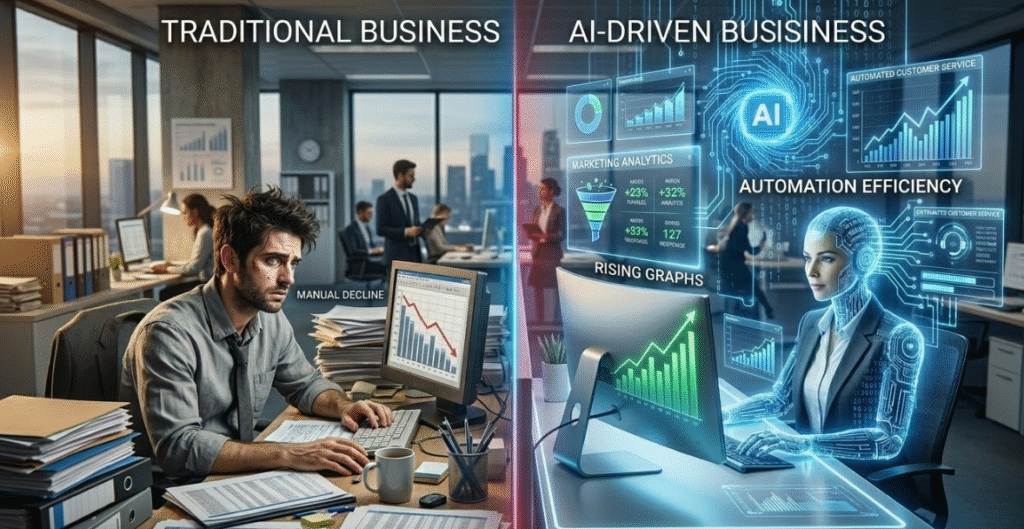
Key differences between traditional and AI-driven businesses include:
- Traditional marketing relies on manual campaign analysis, while AI systems optimize campaigns automatically.
- Traditional customer service depends on human response times, whereas AI chat systems provide instant support.
- Manual data analysis can take hours or days, but AI tools can analyze large datasets within minutes.
- Traditional forecasting often relies on historical data, while AI systems provide predictive insights based on patterns and trends.
These differences highlight why AI-enabled businesses are often able to operate faster, reduce operational costs, and deliver more personalized experiences for their customers.
AI Tools Businesses Are Already Using
Many organizations have already started integrating artificial intelligence into their operations through practical tools that support marketing, analytics, and customer engagement.
These tools allow businesses to automate routine tasks while gaining deeper insights into customer behavior and operational performance.
Some common AI-powered tools used by businesses include:
- AI marketing automation platforms that analyze customer behavior and optimize email campaigns or advertising strategies.
- AI customer support chatbots that provide instant responses to frequently asked questions.
- AI analytics tools that analyze website activity, sales patterns, and user engagement data.
- AI content generation tools that assist with writing marketing content, product descriptions, and creative ideas.
These technologies demonstrate how AI is already integrated into everyday business operations. Instead of replacing human employees, many of these tools simply enhance productivity and allow teams to focus on strategic tasks.
How AI Is Already Transforming Businesses
Artificial intelligence is already reshaping the way companies operate across multiple industries.
AI in Marketing
Marketing teams increasingly use AI to analyze customer behavior and predict purchasing patterns. AI systems can determine the best time to send emails, recommend products, and personalize advertisements.
Research shows that around 74% of companies use AI specifically to improve productivity, particularly in marketing and customer analytics.
AI in Customer Service
AI-powered chat assistants can answer frequently asked questions, guide customers through processes, and provide support at any time of day.
Some companies now automate a large portion of their customer interactions using AI systems.
AI in Business Operations
Automation tools powered by AI can process invoices, manage scheduling, analyze reports, and monitor performance metrics. This reduces manual workload and allows employees to focus on strategic tasks.
In fact, studies suggest that AI automation can reduce operational costs by up to 30% in certain industries.
Read Also:- Best WhatsApp Marketing Tools for Online Stores in India (2026 Advanced Guide)
Real Examples of Businesses Using AI
AI adoption is not theoretical—it is already producing measurable results in real companies.
Example 1: Automation in Financial Software
A leading tax software provider implemented AI systems to automate repetitive processes in financial analysis. Reports suggest that automation now handles a large percentage of routine tasks, allowing employees to focus on more complex financial guidance.
Example 2: AI-Driven Marketing Teams
Many marketing teams now follow an operational model where AI performs the majority of execution tasks—such as campaign optimization and data analysis—while human marketers focus on strategy and creative direction.
Example 3: High AI Adoption in Large Organizations
Some large enterprises report AI adoption rates exceeding 90% across internal workflows, demonstrating how deeply the technology is becoming embedded in business operations.
These examples show that AI is no longer experimental technology. It has become an operational advantage for companies willing to adopt it.
Industries That Will Change the Most
While AI will influence nearly every sector, some industries are likely to experience especially rapid transformation.
E-commerce
AI recommendation engines analyze customer browsing behavior and suggest products based on individual preferences. This significantly increases conversion rates.
Financial Services
Banks and financial institutions use AI for fraud detection, risk assessment, and personalized financial recommendations.
Healthcare
AI systems assist medical professionals in analyzing diagnostic images and predicting patient risks.
Marketing and Advertising
AI tools automate ad optimization, audience targeting, and campaign analytics, making marketing campaigns more efficient.
These industries illustrate how AI can reshape both operations and customer experiences.
The Future Economic Impact of AI
The global economic influence of artificial intelligence is expected to grow dramatically in the coming years. Industry projections suggest that the global AI market could exceed $1.7 trillion by 2030, reflecting rapid expansion across industries. Additionally, surveys indicate that around 80% of executives believe AI will be a major driver of future business growth. These projections highlight why organizations are investing heavily in AI technologies today.
Why Experts Believe AI Is a Competitive Necessity
Many technology leaders and business experts believe that artificial intelligence is no longer just a technological innovation. Instead, it is rapidly becoming a core driver of modern business growth and competitiveness.
Several influential figures in the technology industry have emphasized how AI will reshape the future of businesses across the world.
For example, Sundar Pichai, CEO of Google, has repeatedly described artificial intelligence as one of the most transformative technologies in human history. According to him, AI will impact businesses and industries in ways comparable to the invention of electricity or the internet.
Similarly, Satya Nadella, CEO of Microsoft, has stated that artificial intelligence will redefine productivity and business processes. Microsoft has heavily invested in AI technologies and integrated them across products like cloud services and productivity platforms.
Another strong supporter of AI-driven innovation is Elon Musk, CEO of Tesla. Tesla uses artificial intelligence extensively in areas such as autonomous driving, data processing, and intelligent vehicle systems. AI has played a major role in helping Tesla become one of the most innovative companies in the automotive industry.
Several global companies have already demonstrated how AI can significantly improve business performance.
Read Also:- 6 Best Content Research Tools for Bloggers in 2026 (Free & Paid)
Examples of companies successfully using AI include:
- Amazon uses advanced AI algorithms to power its product recommendation engine, helping customers discover relevant products and increasing online sales.
- Netflix relies heavily on AI-based recommendation systems to suggest personalized content to users, which improves user engagement and retention.
- Spotify uses AI to analyze listening behavior and recommend music tailored to individual preferences.
These companies illustrate how AI can transform customer experience, improve operational efficiency, and create powerful competitive advantages.
As industries become increasingly data-driven, experts widely agree that businesses that delay AI adoption may struggle to compete with organizations that leverage intelligent technologies to move faster and innovate more effectively.
What Businesses Should Start Doing Today
For companies that have not yet adopted AI, the transition does not need to happen overnight.
Instead, businesses can begin with small, practical steps.
Identify Repetitive Processes
Tasks that consume time but require minimal creativity are ideal candidates for automation.
Experiment With AI Tools
Businesses can start with AI solutions for marketing automation, analytics, or customer service.
Train Employees
Successful AI adoption requires collaboration between humans and technology. Training employees helps organizations integrate AI smoothly into workflows.
Focus on Data Quality
AI systems rely heavily on data. Businesses should ensure their data collection processes are accurate and organized.
Conclusion
Artificial intelligence is rapidly transforming how companies operate, compete, and serve customers.
Organizations that adopt AI gain powerful advantages in efficiency, decision-making, and customer engagement. Meanwhile, businesses that ignore these technologies risk falling behind in an increasingly competitive digital economy.
The next five years will likely redefine the relationship between technology and business success.
Companies that begin exploring AI today are not simply adopting a new tool—they are preparing for the future of modern business.