Best WhatsApp Marketing Tools for Online Stores in India:- India’s e-commerce ecosystem is expanding rapidly. Platforms like Flipkart and Amazon India have educated customers to shop online, but they’ve also raised expectations around speed, communication, and trust.
At the same time:
- Facebook and Instagram ads are getting expensive
- Email open rates are declining
- Customer attention spans are shrinking
- Trust deficit in new online brands is increasing
In this environment, WhatsApp has emerged as the most powerful direct response channel for Indian online stores.
But here’s the truth:
Sending random broadcasts is not WhatsApp marketing.
Real growth comes when you implement:
- Automation
- Segmentation
- Behavioral triggers
- Revenue-focused flows
- CRM integration
- Performance tracking
This guide is not just about listing tools.
It’s about helping you build a sales engine using WhatsApp.
Major Problems Faced by Online Stores in India
Before choosing any tool, you must understand the real operational challenges.
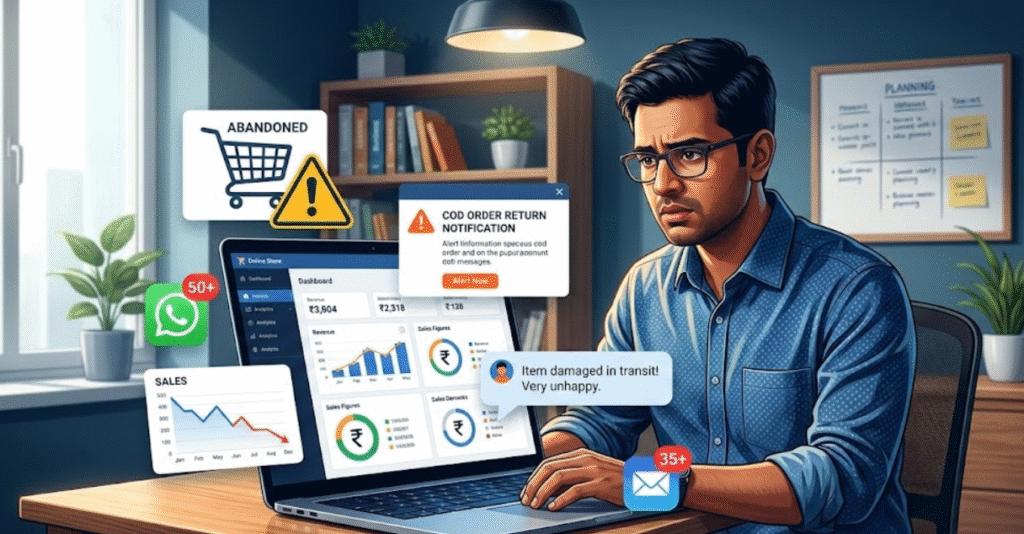
1. High Abandoned Cart Rate
Most Indian stores lose 60–80% of carts before checkout.
Why?
- COD hesitation
- Distraction
- Payment trust issues
- “Just browsing” behavior
Without automation, these users disappear forever.
2. High COD Returns
India still runs heavily on Cash on Delivery.
Problems:
- Fake orders
- Customers not picking up calls
- Wrong addresses
- Intent-less purchases
Every RTO (Return to Origin) eats into your margin.
3. Low Repeat Purchase Rate
Many stores focus only on first sale.
But profit is in:
- Second purchase
- Upsell
- Cross-sell
- Replenishment cycle
Without a retention system, CAC keeps increasing.
4. Manual WhatsApp Handling
Small teams manually reply to:
- Order queries
- Tracking requests
- Product questions
- COD confirmation
This causes:
- Delays
- Missed leads
- Team burnout
- Lost conversions
5. Generic Broadcasting
Sending the same message to everyone leads to:
- Low CTR
- Spam complaints
- Account bans
- Poor engagement
Personalization is no longer optional. It’s mandatory.
What a Proper WhatsApp Marketing System Should Do
Before jumping into tools, your system must support:
- Official WhatsApp Business API
- Automation workflows
- Abandoned cart triggers
- COD verification flow
- Segmented broadcasting
- CRM integration
- Shopify / WooCommerce sync
- Analytics & revenue tracking
Now let’s explore the best tools for Indian online stores.
Best WhatsApp Marketing Tools for Online Stores in India
Choosing a WhatsApp marketing platform is not about picking the most popular name. It’s about selecting a system that aligns with your store size, automation maturity, revenue goals, and team structure.
Below is a strategic breakdown of India’s leading WhatsApp platforms — not just what they offer, but how to use them correctly to increase sales and avoid common mistakes.
WATI – Enterprise-Level WhatsApp Automation
WATI
Best For: Scaling D2C brands and performance-driven e-commerce stores
Positioning: Revenue infrastructure, not just messaging software
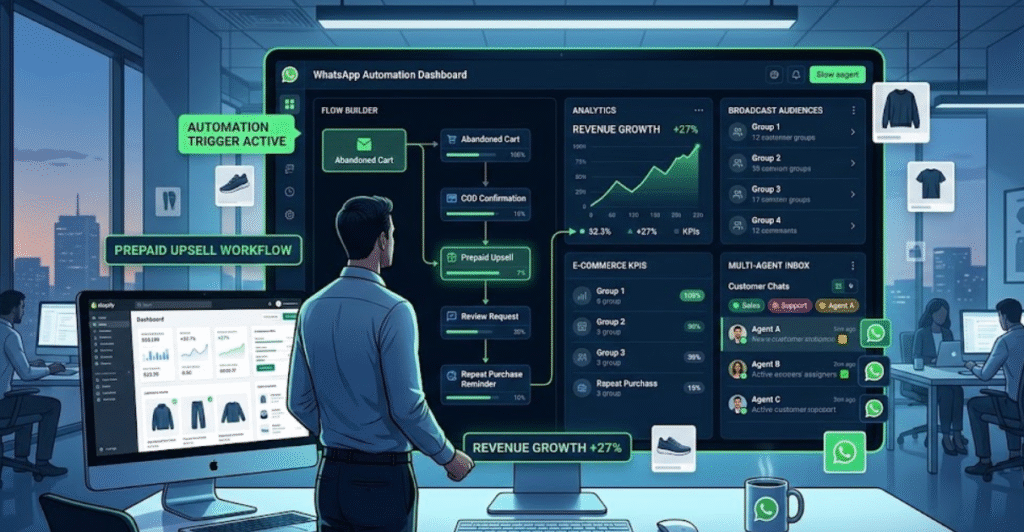
WATI is built for brands that treat WhatsApp as a core revenue channel, not a support extension.
What Makes It Powerful
- Visual automation flow builder
- Multi-agent inbox with access control
- Deep API customization
- Shopify & WooCommerce integrations
- Broadcast with segmentation
But the real value comes from how you structure it.
How to Use WATI to Increase Sales
Instead of using it only for broadcasts, implement these 5 revenue layers:
Read Also:- Top 10 AI Tools for Students in 2026: Complete Guide with Features, Benefits & Use Cases
- Abandoned cart recovery (trigger-based, not bulk)
- COD confirmation workflow with one-click confirmation
- Prepaid upsell flow (“Get 5% extra off on prepaid”)
- Post-delivery review automation
- 30-day repeat purchase reminder
If your store generates consistent traffic from ads, WATI allows you to build a full-funnel automation engine.
Where to Access
Always sign up via the official website to ensure verified WhatsApp API onboarding. Avoid unofficial resellers who may not provide Meta-compliant setups.
Interakt – Budget-Friendly Indian Solution
Interakt
Best For: Small to mid-size online stores in India
Positioning: Simple automation + Indian seller focus
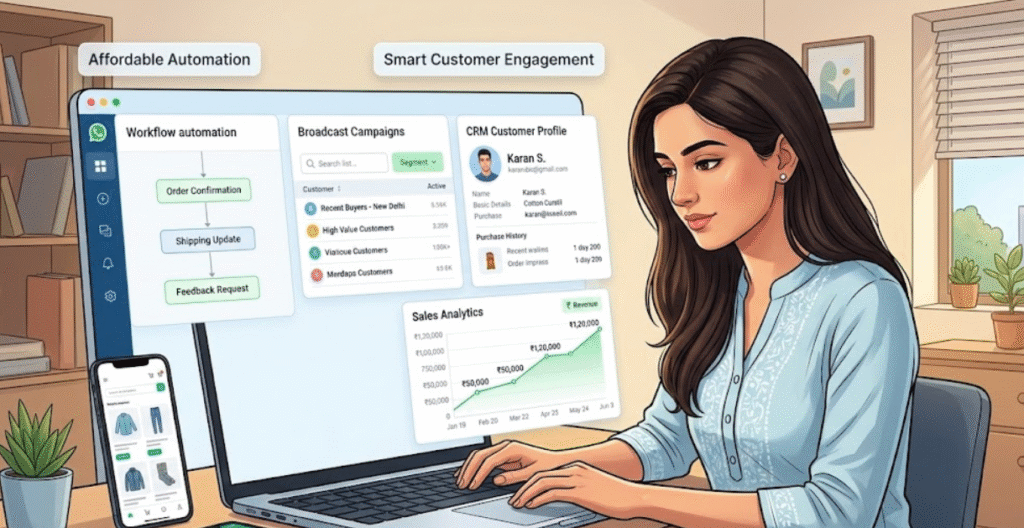
Interakt is designed keeping Indian e-commerce behavior in mind — especially COD-heavy markets.
Why It Works for Indian Sellers
- Simple Shopify integration
- COD verification flow
- Easy automation setup
- Affordable entry pricing
This makes it ideal for founders who don’t have a technical team.
How to Use It Strategically
Most beginners use it for sending offers. That’s a mistake.
Instead:
Step 1: Activate abandoned cart automation
Step 2: Add COD confirmation button (Confirm / Cancel)
Step 3: Set up order tracking automation
Step 4: Create segmented broadcast lists (buyers vs non-buyers)
When implemented correctly, Interakt can:
- Reduce fake COD orders
- Recover 10–20% abandoned carts
- Improve customer trust with instant tracking replies
It’s a practical starting point for structured WhatsApp growth.
Zoko – Automation-Heavy Conversion Tool
Zoko
Best For: High-automation, performance marketing-driven stores
Positioning: Conversion-focused conversational commerce
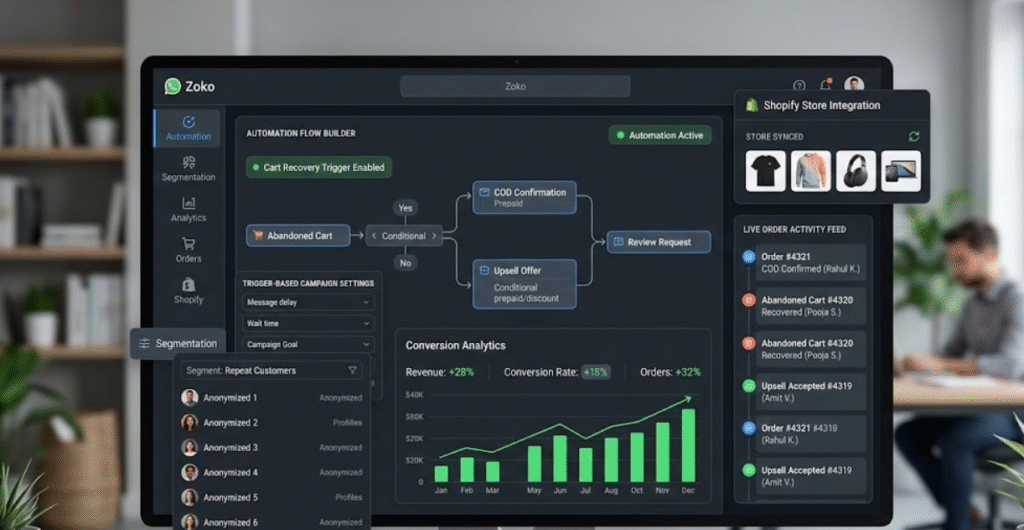
Zoko is built for brands that want behavioral automation instead of simple reminders.
Key Strengths
- Multi-step automated sequences
- Conversion-driven templates
- Team inbox management
- Shopify-native commerce sync
Advanced Revenue Use Case
Instead of sending:
“Complete your order.”
Build a multi-step psychology-based sequence:
Day 0: “You left something special behind.”
Day 1: Product benefit reminder
Day 2: Limited stock alert
Day 3: Social proof message
This layered approach increases conversion probability without looking spammy.
Zoko is ideal if:
- You run high ad spend
- You want personalized buyer journeys
- You need team collaboration
It supports serious automation maturity.
AiSensy – Entry-Level WhatsApp Marketing Platform
AiSensy
Best For: Small businesses and early-stage sellers
Positioning: Cost-effective broadcasting + starter automation
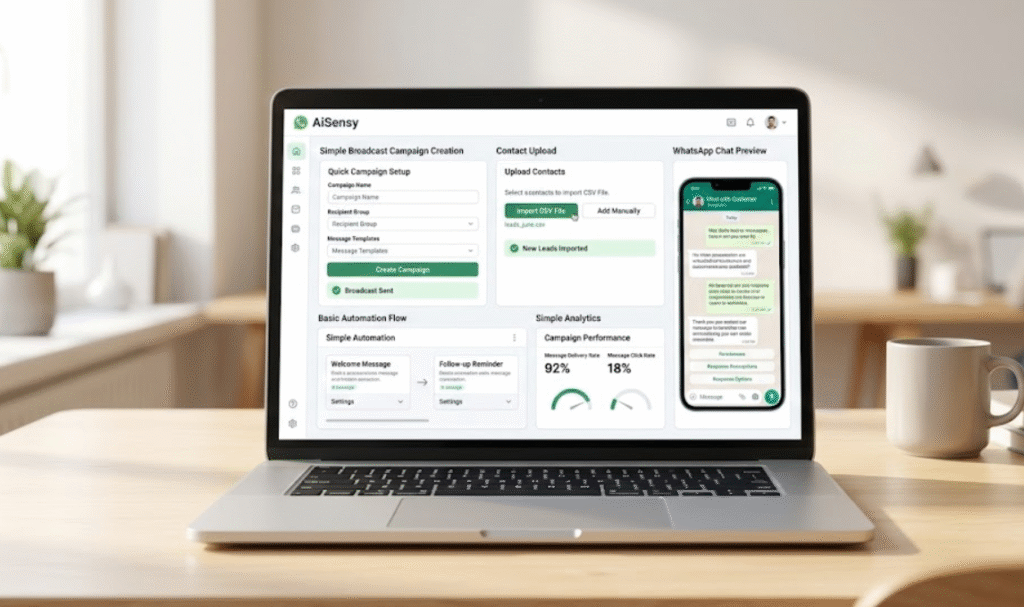
AiSensy is often the first step for businesses entering WhatsApp marketing.
What It Does Well
- Broadcast campaigns
- Basic automation flows
- Indian pricing model
- Easy onboarding
Read Also:- Best Free SEO Tools in the USA 2026: Keyword Research, Site Audit & Website Ranking
But here’s the strategic advice:
Do not rely only on bulk messaging.
Instead:
Segment customers into:
- Viewed but not purchased
- Purchased once
- High-value repeat customers
- COD-only buyers
Then send tailored campaigns.
Even with a basic tool, segmentation can double response rates compared to generic broadcasts.
AiSensy works best when used with discipline and structure.
Gallabox – CRM-Oriented WhatsApp Management
Gallabox
Best For: Brands with support teams and large customer volume
Positioning: CRM-style WhatsApp management system
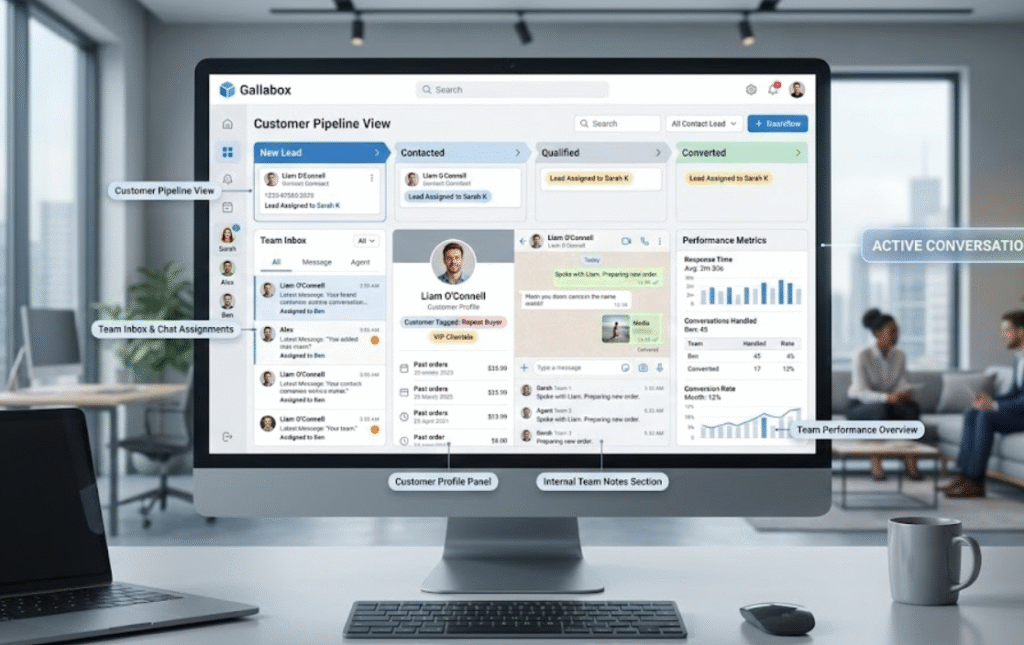
Gallabox focuses heavily on conversation management and structured customer tracking.
Core Strengths
- CRM-style inbox
- Multi-agent assignment
- Conversation tagging
- Lead tracking
- Workflow automation
If your problem is not just sales but also:
- Delayed replies
- Missed leads
- Poor support tracking
- No follow-up system
Then Gallabox helps create process discipline.
How to Use It for Revenue Growth
- Tag leads based on interest
- Assign hot leads to senior sales agents
- Automate follow-up reminders
- Track conversation-to-sale ratio
This turns WhatsApp from casual chat into a measurable sales pipeline.
Final Strategic Advice
There is no “best” tool universally.
The right platform depends on:
- Your monthly order volume
- Automation complexity required
- Team size
- Budget
- Revenue goals
If you are just starting → Choose simplicity
If you are scaling aggressively → Choose automation depth
If you handle large support volume → Choose CRM-focused solution
Most importantly:
Tool selection is 20%.
Implementation strategy is 80%.
WhatsApp Business vs WhatsApp API – Which Is Better for Online Stores?
Many small sellers in India start with the regular WhatsApp Business App because it’s free and easy. And honestly, for a home-based seller handling 20–30 conversations a day, that’s perfectly fine.
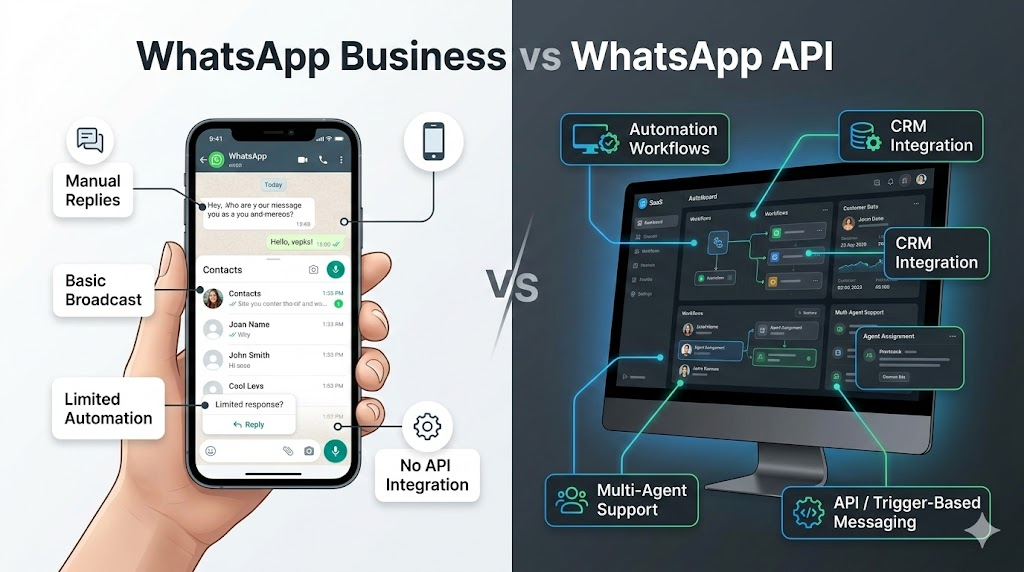
But the moment you want to scale revenue, automation becomes non-negotiable.
WhatsApp Business App – Where It Falls Short
The WhatsApp Business App is built for small operations. Its limitations include:
- Limited automation (only basic quick replies)
- No deep CRM integration
- No proper abandoned cart triggers
- Manual conversation handling
- No scalable broadcast system
- High dependency on one device or person
If your store is running ads and generating consistent daily traffic, the manual model will eventually slow you down.
WhatsApp API – Built for Growth
The WhatsApp API (officially provided via Meta-authorized partners) is designed for automation and business workflows.
Key advantages include:
- Advanced automation flows
- CRM integration
- Shopify and WooCommerce integration
- Bulk template messaging (compliant)
- Multi-agent access
- Campaign tracking
- Blue tick verification (after eligibility review)
The API connects to your Meta Business ecosystem under Meta Platforms and allows structured communication at scale.
If WhatsApp is going to be a revenue channel, not just a support inbox, API is the right choice.
Serious online stores should always move toward API-based infrastructure once they cross basic sales volume.
Advanced WhatsApp Marketing Strategy for Online Stores
Buying a tool does not increase revenue.
Strategy implementation does.
Below is a structured framework that high-performing Indian D2C brands use in 2026.
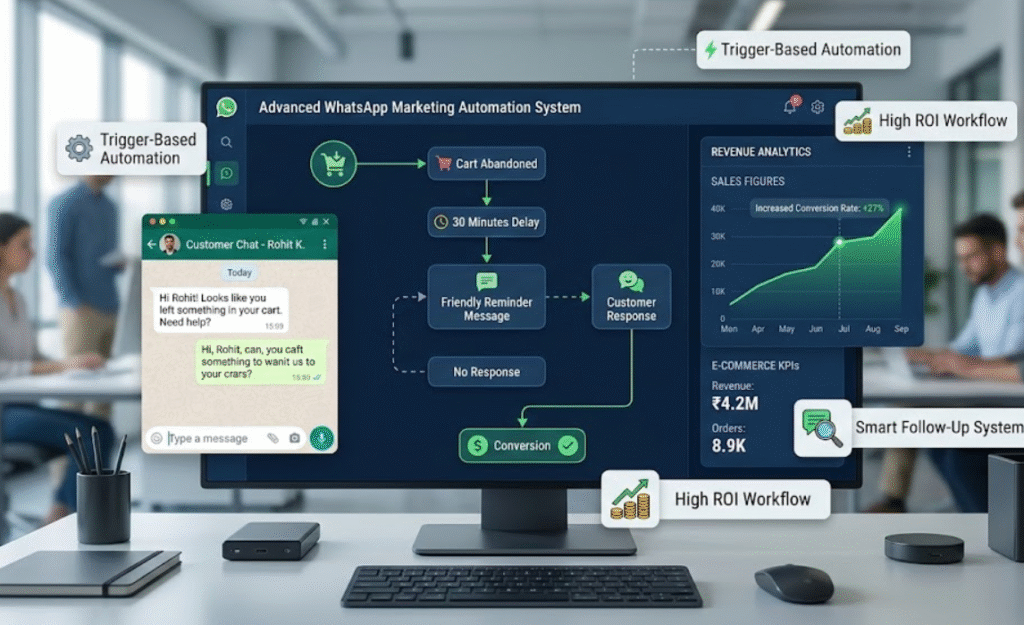
1. Abandoned Cart Recovery Automation
This is the highest ROI automation for e-commerce.
Recommended Flow Structure
30 minutes after cart abandon
Friendly reminder:
“Looks like you left something in your cart. Need help?”
6 hours later
Urgency message:
“Your selected item is getting limited in stock.”
Next day
Small incentive or trust message:
“Complete your order today and enjoy priority shipping.”
When implemented properly, this system can recover 10–20% of otherwise lost revenue.
Key Tip:
Do not always start with a discount. First trigger emotion, then urgency, then incentive.
2. COD Confirmation Automation
India has one of the highest Cash on Delivery ratios globally.
Without verification, fake orders eat margins.
Smart COD Flow
Immediately after order:
Step 1: Confirmation message
“Please confirm your order by clicking below.”
Step 2: No reply → Reminder after 2–3 hours
Step 3: Still no reply → Auto-cancel after 24 hours
This simple structure can significantly reduce RTO losses.
You can also:
- Offer 5% prepaid discount inside the confirmation message
- Ask customers to confirm address details
This increases prepaid conversion rate.
3. Lifecycle Marketing Automation
Most stores focus only on first sale. That’s a mistake.
Real profit comes from retention.
Lifecycle Messaging Stages
Post-delivery:
- Thank you message
- Usage tips
- Review request
7–14 days later:
- Cross-sell suggestion
- Complementary product recommendation
60–90 days later:
- Reactivation message
- Limited loyalty offer
This long-term system increases customer lifetime value (CLV) instead of chasing new customers every month.
4. Behavioral Trigger Messaging (Advanced Technique)
This is where serious brands win.
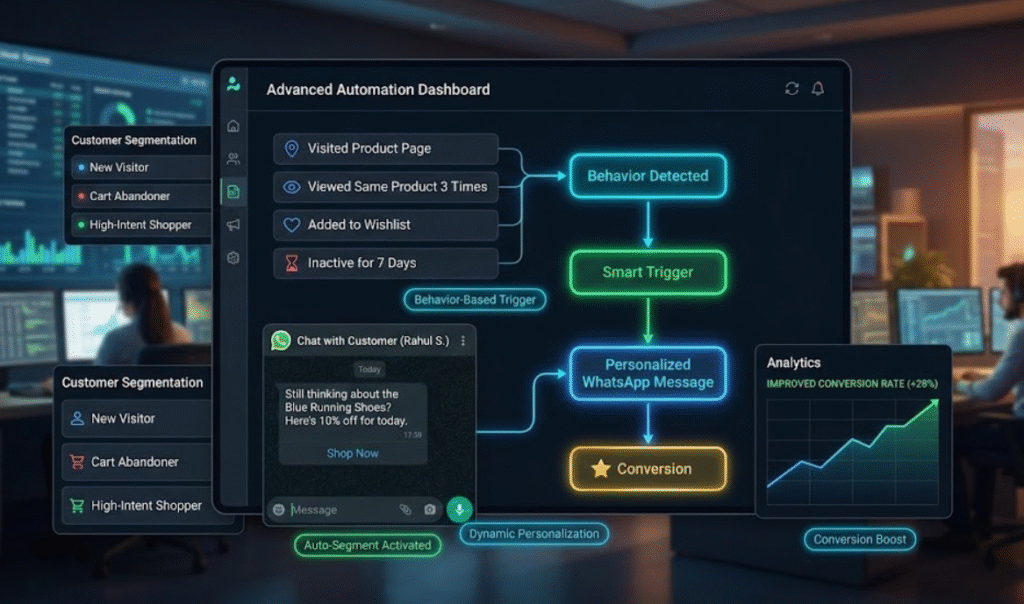
Example:
If a user views the same product 3 times but doesn’t purchase, trigger:
“Still thinking about this? Want help choosing the right size?”
Behavior-based messaging feels personal, not promotional.
You can trigger messages based on:
- Product views
- Category browsing
- Cart value
- High intent sessions
These micro-intent signals produce significantly higher conversion compared to generic campaigns.
5. Micro-Segmentation Strategy
Sending the same broadcast to everyone is lazy marketing.
Segment your audience by:
- Purchase value (low vs high spenders)
- Product category interest
- City or delivery region
- Engagement history
- COD vs prepaid behavior
- Last purchase date
Targeted campaigns often double conversion rates compared to mass broadcasting.
Personalization = higher trust + higher revenue.
Common Mistakes Online Stores Make in WhatsApp Marketing
- Sending only festival offers
- Ignoring opt-in compliance
- Relying completely on manual replies
- Not using segmentation
- Avoiding CRM integration
- No post-purchase follow-up
- Treating WhatsApp like casual chat instead of revenue channel
The biggest mistake?
Using WhatsApp only as a messaging tool.
It is a customer lifecycle system.
Implementation Blueprint for Indian Online Stores
If you want structured execution, follow this roadmap:
Step 1: Complete Meta Business verification
Step 2: Apply for WhatsApp API approval
Step 3: Select tool based on revenue goal
Step 4: Integrate with Shopify or WooCommerce
Step 5: Design automation flows (cart, COD, lifecycle)
Step 6: Define segmentation rules
Step 7: Track performance weekly and optimize
Skipping any step reduces effectiveness.
Metrics You Must Track
If you don’t track numbers, you can’t scale.
Monitor:
- Delivery rate
- Open rate
- Click-through rate
- Conversion rate
- Revenue per broadcast
- Revenue per automation flow
- Repeat purchase percentage
- COD confirmation rate
Advanced brands treat WhatsApp like an ROI channel, not a communication app.
Conclusion
There is no universal “best” WhatsApp marketing tool.
The right choice depends on:
- Your order volume
- Automation maturity
- Team size
- Budget
- Growth ambition
But one thing is clear:
WhatsApp can become a high-conversion revenue engine for Indian online stores — if implemented with structured automation, segmentation, and lifecycle marketing.
Tool selection matters.
Execution matters more.