Why Instagram Accounts Are Getting Restricted in 2026:- If you have opened Instagram recently and found your account locked, restricted, or silently suppressed, you are not alone. In 2026, a wave of restrictions has swept across the platform at a scale many creators and businesses have never seen before. Some accounts are being banned outright. Others are hit with action blocks. And a growing number are experiencing what Instagram quietly calls “reduced visibility” but what the internet calls a shadowban.
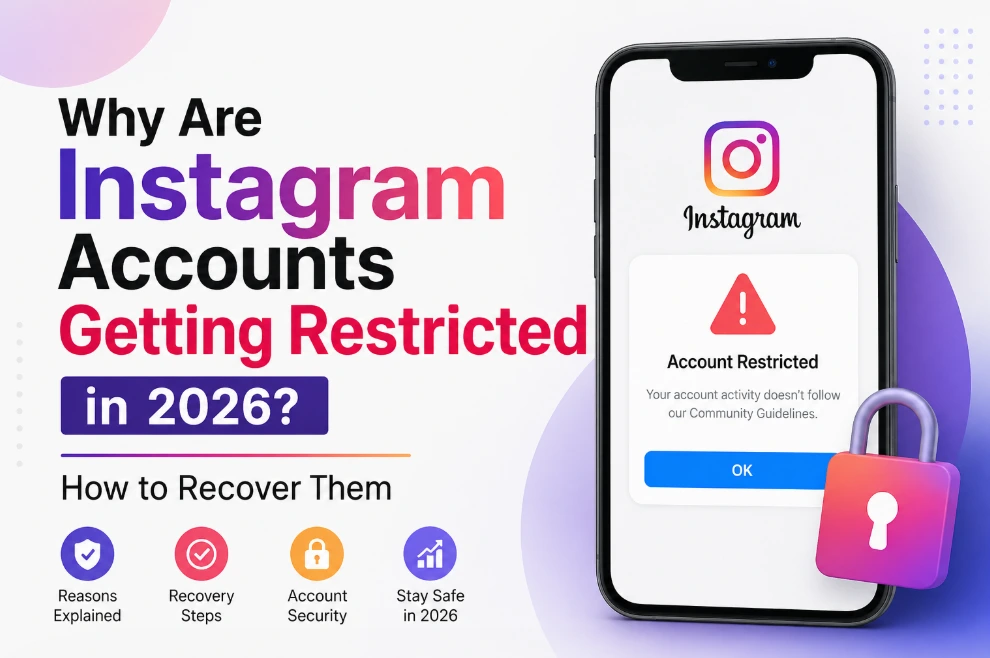
The frustrating part is that many of these restrictions are landing on people who believe they did nothing wrong. The rules have not changed dramatically, but the enforcement systems have. Instagram’s AI-driven moderation has become faster, broader, and far less forgiving of gray areas. To understand how to protect yourself, or recover if you have already been hit, you first need to understand why this is happening.
Why Instagram has become far stricter in 2026
Two major forces are behind the crackdown. First, Meta upgraded its detection systems with what security researchers are calling its most significant AI overhaul in years. The new behavioral analysis layer no longer just looks at what you post. It looks at how you behave, the rhythm of your actions, where you log in from, what devices you use, and how all of those signals compare to millions of other accounts over time.
Second, regulatory pressure from governments around the world has forced Meta’s hand. New frameworks similar to GDPR and emerging digital accountability laws have imposed heavy financial penalties on platforms that fail to police fake engagement and unverified advertising accounts. The result is a platform that would rather restrict too many accounts than face a regulatory fine for allowing too few to be caught.
Instagram’s algorithm in 2026 has moved away from simple keyword matching for violations. It now uses multimodal AI that scrutinizes behavioral patterns, posting rhythms, login geography, and content fingerprints simultaneously.
The most common reasons accounts are getting restricted
Understanding why accounts are flagged is the most useful thing you can do before attempting any recovery. The reasons fall into several distinct categories.
Bot-like behavioral patterns
Instagram’s AI compares your activity rhythm against known bot patterns. If you like 60 posts within a single minute, follow 50 accounts consecutively without pausing, or comment identically across dozens of posts, the system flags your account as possibly automated. The problem is that real users caught in an enthusiastic scroll session can trigger the same signals. Normal human actions are naturally random. Scripted or rushed actions appear linear, and that linearity is what the algorithm catches.
Third-party automation tools
Using any tool that automatically follows, unfollows, likes, or comments on your behalf is among the fastest ways to get restricted. Instagram’s current detection systems identify the API signatures of unauthorized apps and cross-reference them against account activity. Even tools that were working without issue six months ago may now be detectable. Buying followers or engagement from external services falls into the same category and carries the same risk.
Chain bans and connected account flags
One of the most widely reported phenomena in 2026 is the chain ban. When one account gets banned, Instagram may begin detecting other accounts connected to it through shared devices, phone numbers, email address patterns, or overlapping login IP addresses. If the system identifies a connection, those linked accounts may receive restrictions even if they have no individual violations on record. This is particularly damaging for creators or businesses that manage multiple accounts from the same device or network.
Recycled or watermarked content
Instagram’s content detection now operates at a pixel level. It extracts keyframes from videos and generates what can be described as a visual fingerprint. If your material has already been posted elsewhere, including on TikTok or other platforms with visible watermarks, Instagram’s system identifies it as low-quality or duplicated and dramatically reduces its reach. Old techniques like mirroring clips or adding filters are no longer sufficient to avoid detection.
Mass user reports
Receiving a large volume of reports from other users can trigger automated reviews regardless of whether the underlying content actually violates any guidelines. Coordinated reporting campaigns, whether from competitors or hostile communities, can flag an account faster than a human reviewer would ever assess it. Instagram’s automated systems treat a sudden spike in reports as a risk signal and respond accordingly.
Suspicious login activity
Read Also:- WhatsApp Account Ban or Restriction: Reasons, Fix & Recovery Guide
Logging into your account from multiple countries within a short time window, switching between devices frequently, or accessing your account from an IP address flagged as high-risk can all trigger security restrictions. Instagram interprets rapid geographic shifts as a potential account compromise and may temporarily lock access while it reviews the activity.
Community guideline violations and borderline content
Instagram’s AI now flags what it calls borderline content, which includes material that does not clearly violate guidelines but sits close to the line. This includes subtle misinformation, content that could be interpreted as promoting eating disorders, graphic material that stops short of being explicitly prohibited, and anything the system classifies as potentially misleading. This category has produced a high number of what researchers are calling false positives, particularly for non-English-language accounts and family-oriented business accounts.
Banned hashtags and spammy posting behavior
Using hashtags that Instagram has flagged as associated with spam or inappropriate content can restrict your reach or trigger an account review. Some banned hashtags are obvious, but many are not. Equally, posting too frequently in a short window, stacking dozens of hashtags into every post, or repeating the same caption templates across multiple posts signals spam behavior to the algorithm.
Understanding the shadowban in 2026
Instagram’s leadership continues to deny that a shadowban exists in name. However, Instagram’s own head acknowledged in a February 2026 session that the platform does reduce visibility for content it considers problematic. Internally, this is described as reduced reach or recommendation ineligibility, not a shadowban. But the effect on creators is identical.
A shadowbanned account can still post. Friends and existing followers can still see the content. But the account’s posts will not appear in hashtag searches, the Explore page, or in recommended content for non-followers. Reach collapses without any notification or warning. The account appears healthy from the inside while quietly being invisible to anyone who does not already follow it.
How to check your recommendation status
Go to Settings, then Account Status. Instagram now surfaces whether your content is eligible to be recommended to non-followers. If the status shows any restrictions, that is your clearest official signal that a shadowban-like reduction is active on your account. If everything shows as clear there but your reach has still dropped, the issue is likely algorithmic content suppression rather than a policy restriction.
How to recover a restricted or disabled account
Recovery depends on what type of restriction has been applied to your account. The approaches differ significantly between a temporary action block, a shadowban, and an outright account disabling.
Identify the type of restriction
Before doing anything else, check what kind of restriction you are dealing with. Is your account fully disabled and unable to log in? Are specific actions blocked, such as following or commenting? Or is your content just not being seen? Each situation has a different path forward.
Stop all automation and third-party tools immediately
If you have any apps connected to your account that are not officially approved by Meta, disconnect them right now. Change your Instagram password to force a logout from all connected apps. Do not resume normal posting until you have confirmed all automation has been removed.
Review your recent content
Go through your posts from the past 30 days and delete or archive anything that might have triggered a flag. Check not just for obvious violations but also for borderline content, recycled videos with visible watermarks, repetitive captions, and hashtag stacks that might have been interpreted as spam.
Submit an appeal if your account is disabled
If Instagram has disabled your account and shows an Appeal button in the app or on the login screen, use it. This is currently the only official channel for requesting account restoration. Write your appeal clearly and calmly. Explain that you believe the restriction was a mistake, confirm that you have not violated guidelines, and avoid any emotional or accusatory language. Do not submit multiple appeals in quick succession, as this can work against you.
Wait before resuming activity
Read Also:- Facebook Account Suspended in 2026? How to Recover It Fast
For temporary action blocks, do not attempt to resume the blocked activity right after the restriction lifts. Give your account a quiet period of at least 24 to 48 hours before returning to normal engagement. Acting too quickly after a block triggers the same detection system again and risks a longer or permanent restriction.
For shadowbans, apply a reset protocol
If your reach has collapsed but your account is still active, stop posting for 48 to 72 hours. During that time, engage manually and authentically with content in your niche. When you return to posting, prioritize original content, avoid recycled material, and remove any hashtags that might be flagged. Focus your first new posts on content that invites genuine engagement, particularly saves and shares, which signal quality to the algorithm.
Creating a new account on the same device after being banned may not help. Instagram analyzes device fingerprints, and a new account created on a previously flagged device may be automatically reviewed or restricted before you post a single piece of content. If you need a new account, use a clean device or ensure all previous app data has been fully cleared.
How to write an effective appeal
The tone and content of your appeal message matter. Instagram reviewers, or more accurately the automated systems that first assess appeals, are looking for clear, cooperative responses rather than emotional or aggressive ones.
A strong appeal message states the account username, the approximate date the restriction occurred, a calm declaration that you believe the restriction is a mistake, a specific statement that you do not use automation tools, and a polite request for review. It does not blame Instagram, make demands, speculate about algorithm errors, or include unnecessary emotional language. Keeping the message under 150 words tends to perform better than long, exhaustive explanations.
After submitting, expect to wait anywhere from a few hours to several days. Instagram does not guarantee restoration, and some appeals are rejected even for accounts with genuinely no policy violations. If your first appeal is rejected, you may be able to submit one follow-up, but repeated appeal submissions are unlikely to help and may signal uncooperative behavior to the review system.
Long-term protection for your account
Recovering from a restriction is one problem. Preventing future ones is a longer conversation. The accounts that remain stable in 2026 tend to share a consistent set of habits.
Post at a human pace
Spread your activity throughout the day. Avoid posting multiple times in very short windows or engaging in rapid, unbroken bursts of liking and following.
Use only approved tools
Stick to scheduling and analytics tools that are officially authorized Meta partners. Free growth tools and follower-boosting services are the fastest route to a ban.
Keep content original
Avoid reposting content from other platforms, especially with watermarks. Instagram’s pixel-level detection will flag recycled material as low-quality and reduce its reach.
Monitor hashtag health
Before using a hashtag, check that it shows recent posts. Banned or flagged hashtags have stalled feeds. Vary your hashtag sets rather than repeating the same combinations.
Read Also:- Facebook Account Disabled 2026: Ultimate Guide to Reasons, Hidden Causes & Instant Recovery Tricks
Separate your accounts
If you manage multiple accounts, avoid logging into them all from the same device and network. Instagram’s chain ban logic means one flagged account can pull others into review.
Enable two-factor authentication
Securing your account reduces the risk of suspicious login flags and protects against takeovers that can result in a ban from someone else’s activity on your profile.
Closing
The bigger picture
Instagram’s 2026 enforcement landscape is genuinely more aggressive than it has been in previous years. The platform is caught between pressure from regulators, competition from other short-form platforms, and the difficulty of using AI to make judgment calls that are inherently complex and context-dependent. The result is a system that catches real violations and also produces real false positives at a scale the appeal process was not designed to handle.
If your account has been restricted unfairly, the most honest advice is to appeal once, clean up anything that could be misread, and then demonstrate genuinely authentic behavior over the following weeks. The algorithm is watching not just what triggered the flag, but what happens after. Accounts that return quietly and post original, engaging content tend to recover visibility over time. Accounts that return and resume aggressive engagement tactics usually do not.
The fundamentals have not changed, even as the enforcement has sharpened. Post content that people genuinely want to see. Engage like a real person, because you are one. And give Instagram’s systems enough consistent signal that they have no reason to look twice at your account.
Here is a complete, in-depth breakdown of the Instagram restriction situation in 2026, covering everything from the root causes to step-by-step recovery.
The article draws on current research and covers these key areas:
Why it’s happening now: Meta’s AI detection has become behavior-based rather than just content-based, and new global regulations have forced the platform to crack down harder and faster than before.
The 8 core reasons accounts get restricted in 2026 — from bot-like scrolling patterns and third-party automation tools, to chain bans that pull connected accounts into review, to recycled content with watermarks being flagged at the pixel level.
The shadowban reality: Instagram’s head Adam Mosseri acknowledged in a February 2026 session that the platform does reduce visibility for problematic content Aitechtonic, even while officially denying the term “shadowban” exists.
A 6-step recovery process covering action blocks, disabled accounts, and shadowbans separately, since each requires a different approach.
Long-term protection habits that keep accounts stable as enforcement continues to tighten.