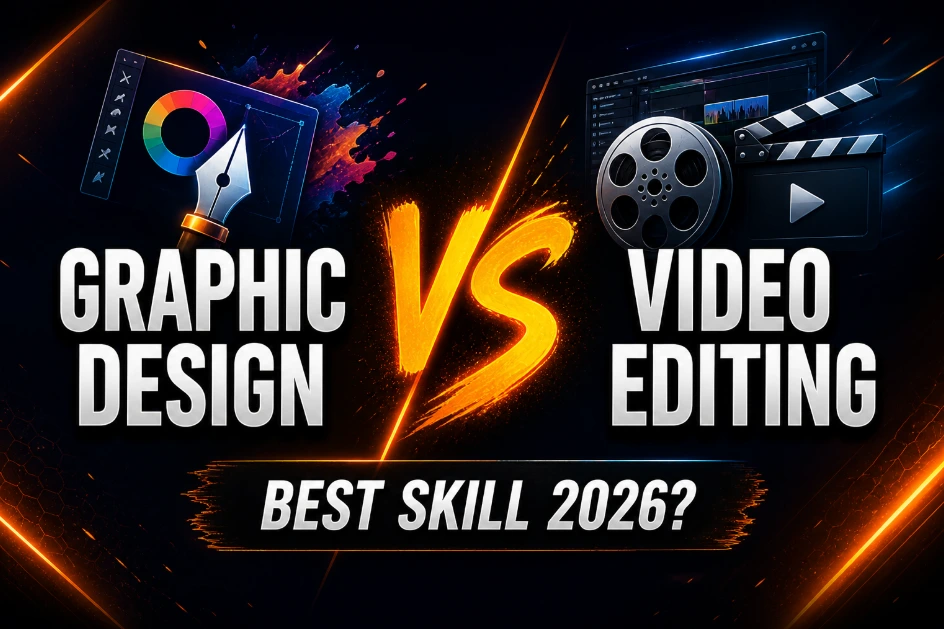
Graphic Design vs Video Editing:- Let’s be honest — you’ve probably been staring at your screen for the past hour, switching between YouTube tutorials on Photoshop and Premiere Pro, completely unsure which one to actually commit to.
You’re not alone. Every single day, thousands of people ask the exact same question: Should I learn graphic design or video editing in 2026? Both look exciting. Both seem to have great career potential. Both are in demand. And both require real time, effort, and money to learn properly. So making the wrong choice feels like a genuinely big deal.
Here’s the truth — there is no universally “right” answer. But there IS a right answer for YOU. And by the end of this article, you’ll know exactly which path makes sense for your skills, your personality, and your career goals in 2026.
We’re going deep on this one — salary data, learning curves, job market trends, AI impact, freelancing potential, and a structured comparison that will actually help you decide. Let’s get into it.
What is Graphic Design? (Purpose, Tasks, Tools & Skills)
Graphic design is the art and practice of visual communication. It is the process of combining images, typography, colors, shapes, and layout to convey a specific message to a specific audience — whether that message lives on a brand logo, a website, a social media post, a product package, a billboard, or an app interface.
But here’s what most beginners miss: graphic design is not just about making things look beautiful. It is fundamentally about solving communication problems visually. A great graphic designer doesn’t just ask “does this look good?” — they ask “does this communicate the right thing to the right person in the right way?”
Purpose of Graphic Design: Communicating ideas through static or animated visuals, building brand identities, guiding user behavior through design, and creating visual systems that make information clear and memorable.
Core Tasks of a Graphic Designer:
- Logo design and complete brand identity development
- Print design — brochures, posters, banners, packaging, business cards
- Digital marketing graphics — social media posts, display ads, email templates
- UI/UX design — app screens, website layouts, user flows
- Typography and layout for editorial and publishing projects
- Motion graphics and animated visual content
- Presentation design and infographic creation
Key Software Used in Graphic Design:
- Adobe Photoshop — Image editing, photo manipulation, digital art
- Adobe Illustrator — Vector graphics, logo design, illustration
- Adobe InDesign — Layout design for print and digital publications
- Figma — UI/UX design, prototyping, collaborative design
- Canva — Quick social media graphics (entry-level)
- Adobe After Effects — Motion graphics and animation
Key Skills Required:
- Color theory — understanding how colors interact and create emotion
- Typography — choosing and pairing fonts to enhance readability and tone
- Layout and composition — arranging elements for visual hierarchy
- Branding and visual identity — building consistent brand systems
- Understanding of user behavior and design psychology
- Communication and client management
Who Hires Graphic Designers in 2026? Marketing agencies, tech startups, e-commerce companies, FMCG brands, media houses, publishing companies, government bodies, NGOs, educational institutions, and honestly — every business that has a visual presence, which in 2026 means every business that exists.
What is Video Editing? (Purpose, Tasks, Tools & Skills)
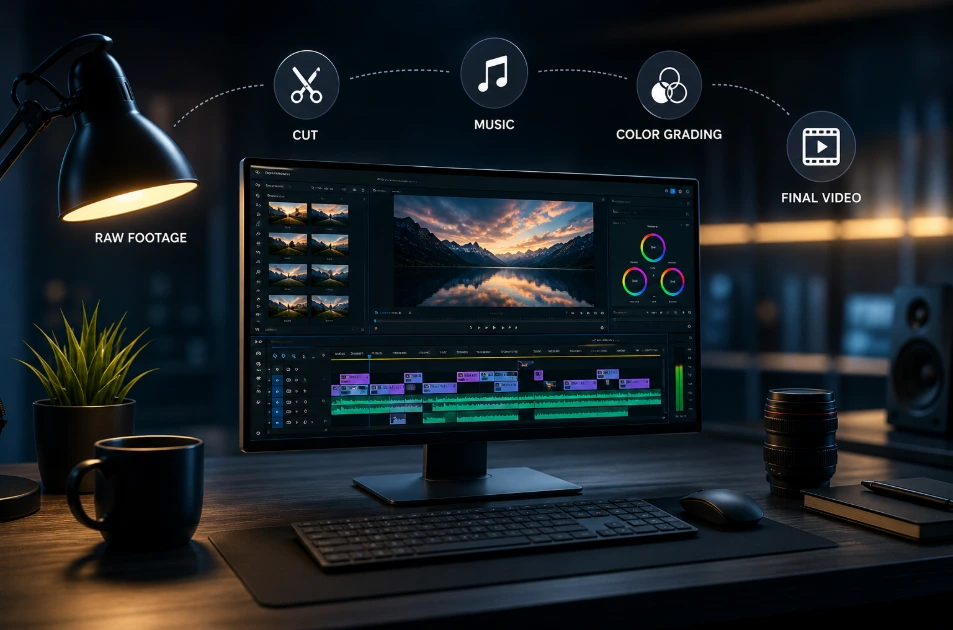
Video editing is the process of taking raw video footage — captured by cameras, phones, screen recorders, drones, or pulled from stock libraries — and transforming it into a polished, purposeful, emotionally compelling final product. It involves selecting the best takes, cutting and arranging clips, syncing dialogue and music, adjusting color, adding graphics and transitions, and crafting the overall pacing and narrative flow of a video.
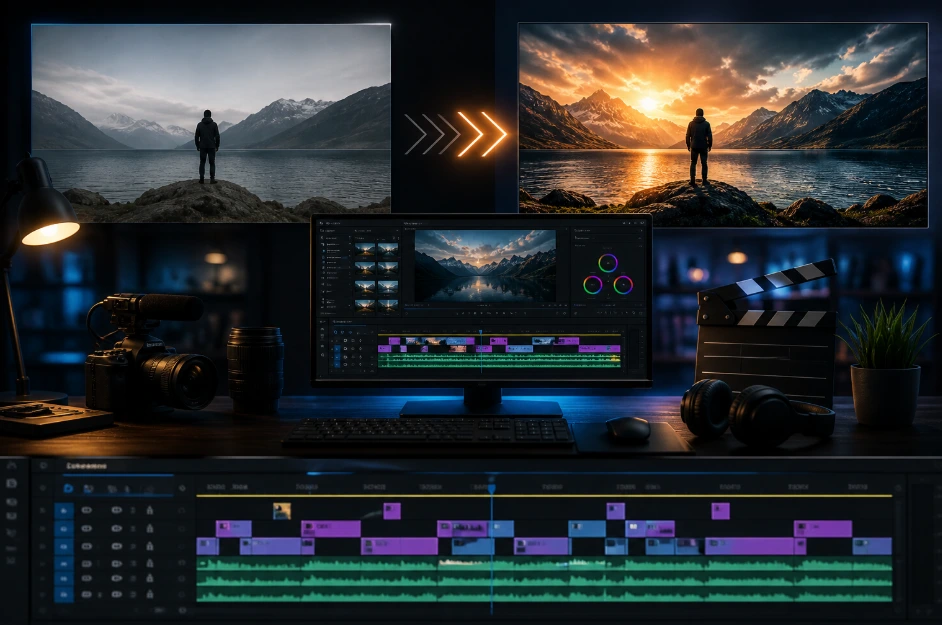
But just like graphic design, video editing goes far beyond the technical. The best video editors are not just software operators — they are storytellers. They instinctively understand pacing, emotion, tension, and release. They know that the difference between a video that moves people and one that bores them often comes down to a single cut — a half-second decision about when to switch from one shot to the next.
Purpose of Video Editing: Storytelling through the sequencing of video, audio, and motion. Creating emotional experiences, communicating brand messages, entertaining audiences, and producing content that holds attention from the first frame to the last.
Core Tasks of a Video Editor:
- Cutting and trimming raw footage into a coherent, engaging sequence
- Color correction — fixing exposure, white balance, and consistency across shots
- Color grading — creating a specific visual mood or cinematic look
- Audio editing — cleaning dialogue, syncing sound effects, mixing music
- Motion graphics — adding text animations, lower thirds, titles, and overlays
- Sound design — building the audio landscape of a video
- Visual effects (VFX) — green screen compositing, particle effects, CGI integration
- Exporting optimized files for different platforms — YouTube, Instagram, broadcast
Key Software Used in Video Editing:
- Adobe Premiere Pro — Industry standard for film, TV, and digital content
- Adobe After Effects — Motion graphics, visual effects, and compositing
- DaVinci Resolve — Professional color grading and editing (free version available)
- Final Cut Pro — Apple’s professional editing software for Mac users
- CapCut — Mobile and desktop editing for short-form social content
Key Skills Required:
- Storytelling and narrative structure — the most important skill, often overlooked
- Pacing and rhythm — knowing how fast or slow a video should breathe
- Storyboarding and shot sequencing
- Audio synchronization and sound design
- Color science — understanding how color affects mood and perception
- Motion graphics and basic animation
- Technical understanding of codecs, frame rates, and export settings
Who Hires Video Editors in 2026? Film and TV production houses, OTT platforms (Netflix, Amazon, Hotstar), YouTube channels and content creators, digital marketing agencies, corporate communications teams, wedding and event production companies, news channels, advertising agencies, and educational content producers.
Read Also:- Top 5 Skills to Build a Career After 12th – Best for 2026
Key Differences: Graphic Design vs Video Editing
This is the structured comparison that most articles skip — and it’s exactly what Google’s AI Overview looks for. Here is how the two fields differ across every dimension that actually matters.
Dimension — Output Format: Graphic design focuses primarily on 2D static visuals — images, layouts, logos, and print or digital assets that don’t move. Video editing focuses on temporal, motion-based content — video files that unfold over time and combine visuals, audio, and movement.
Dimension — Workflow: Graphic designers create assets from scratch, building visual elements layer by layer using design software. Video editors assemble and shape pre-existing assets — raw footage, music, sound effects — into a final narrative sequence.
Dimension — Creative Focus: Graphic design creativity is visual and spatial — it’s about how things look, how elements relate to each other in space, and how the eye moves through a composition. Video editing creativity is temporal and emotional — it’s about how things feel, how the story unfolds over time, and how audio and visuals work together to create an experience.
Dimension — Key Metric for Success: Graphic designers are judged primarily on visual impact — does this design communicate clearly and look professional? Video editors are judged on audience engagement and flow — does this video hold attention, build emotion, and deliver its message effectively?
Dimension — Hardware Requirements: Graphic design can be done comfortably on a mid-range laptop with 8-16GB RAM and a decent GPU. Video editing, especially with 4K footage or complex effects, demands significantly more — 16-32GB RAM, a powerful dedicated GPU, fast SSD storage (often 1TB+), and high-speed internet for file transfers.
Dimension — File Management: Graphic design project files are relatively compact. A complex brand identity project might be a few hundred MB. Video editing projects are massive — a single day of raw 4K footage can easily exceed 100GB, making storage management a critical part of the workflow.
Dimension — Client Feedback Cycles: Graphic design projects often involve multiple rounds of visual revisions — clients can quickly point to specific elements and request changes. Video editing revisions are more complex and time-consuming — changing a sequence can require re-cutting, re-rendering, and re-exporting entire sections.
Dimension — Collaboration Style: Graphic designers collaborate closely with marketing teams, brand managers, and clients. Video editors work alongside directors, producers, cinematographers, and sound engineers in a more production-focused team environment.
Graphic Design vs Video Editing — Salary in India 2026
Let’s talk money. This is the section most people scroll straight to, so let’s give it the depth it deserves.
Graphic Design Salary in India (2026)
Fresher (0–1 year experience): ₹2.5 to ₹3.5 LPA at agencies and companies. Many freshers start even lower at ₹1.8 to ₹2.5 LPA at smaller studios.
Mid-level (2–4 years experience): ₹4 to ₹8 LPA. At this stage, specialization begins to matter enormously. A general graphic designer earns less than one who has built expertise in a specific area.
Senior level (5+ years experience): ₹8 to ₹20 LPA for experienced designers at good companies. UI/UX specialists and motion graphics designers can command ₹15 to ₹30 LPA at product companies and MNCs.
Specialization matters more than anything: A general “I do everything” graphic designer faces commoditization and lower rates. Specialists who focus on UI/UX design, brand identity, motion graphics, or packaging design earn significantly more. UI/UX designers in particular are among the highest-paid creative professionals in India right now — senior UX designers at top product companies earn ₹25 to ₹50 LPA.
Industry average across all experience levels: Approximately ₹3.9 LPA — but this number is heavily skewed by the large number of junior roles. The median for experienced designers is considerably higher.
Video Editing Salary in India (2026)
Fresher (0–1 year experience): ₹2.5 to ₹4 LPA. Entry-level editors at digital agencies or YouTube channels often start in this range.
Mid-level (2–4 years experience): ₹5 to ₹10 LPA. Editors working on branded content, OTT projects, or ad films see faster salary growth than those stuck in generic social media editing roles.
Senior level (5+ years experience): ₹10 to ₹25 LPA. Editors with expertise in VFX, color grading (DaVinci Resolve), or post-production supervision for OTT content can command premium rates.
High-demand specializations: Color grading specialists, VFX compositors, and post-production supervisors are among the highest-paid video professionals in India. Senior colorists working with OTT platforms or ad film houses earn ₹20 to ₹40 LPA.
Read Also:- How to Create Nano Banana Images: Google Gemini 2.5 Flash Explained
Industry average: Approximately ₹4.7 LPA across all levels — slightly higher than graphic design at the average level.
Freelancing Income — Where Both Fields Get Really Interesting
Salaried numbers only tell part of the story. In 2026, freelancing is a legitimate and often more lucrative path in both fields.
Freelance Graphic Design Income: A freelance graphic designer typically charges ₹3,000 to ₹15,000 for a logo design, ₹15,000 to ₹80,000 for a complete brand identity package, and ₹1,000 to ₹5,000 per social media graphic. Established freelancers with a strong portfolio and client network comfortably earn ₹60,000 to ₹2 lakh per month. UI/UX freelancers working with startups often charge ₹50,000 to ₹3 lakh per project.
Freelance Video Editing Income: A freelance video editor typically charges ₹3,000 to ₹15,000 for a YouTube video edit, ₹20,000 to ₹80,000 for a wedding film, and ₹30,000 to ₹2 lakh for a branded content or ad film edit. Experienced freelancers specializing in wedding films, corporate videos, or branded content earn ₹80,000 to ₹2.5 lakh per month.
Global freelancing on Fiverr and Upwork: Both graphic designers and video editors can earn in USD by working with international clients. A mid-level graphic designer charging $50 to $150 per hour, or a video editor charging $500 to $3,000 per project, can earn 5 to 10 times more than equivalent Indian market rates.
Salary Verdict: Video editing has a slight edge at the average level. But at the senior and specialization level — especially UI/UX for design and OTT/VFX for editing — both fields offer exceptional earning potential. Freelancing income in both depends far more on your niche, portfolio, and client relationships than on which field you chose.
Graphic Design or Video Editing — Which is Easier to Learn?
This is one of the most searched questions on Google about these two fields, and the honest answer requires more nuance than most articles provide.
The Learning Journey in Graphic Design
Graphic design has the gentler entry point of the two. You can start learning with free tools like Canva, get comfortable with basic design principles, and produce presentable work within a few weeks. Moving to Photoshop and Illustrator adds complexity, but the learning curve is manageable with consistent practice.
The fundamentals of graphic design — understanding color, typography, layout, and composition — can be grasped conceptually in a few months. Executing them well in real projects is where the real learning happens and where most people stay stuck for years.
What makes graphic design genuinely hard to master is the subjective nature of creative judgment. Knowing the rules of design is different from knowing when to break them. Developing a personal aesthetic, building the confidence to push back on bad client feedback, and learning to create work that is both beautiful and strategically effective — these things take years of real-world experience.
In 2026, there’s an added layer of difficulty: AI tools like Adobe Firefly and Midjourney can generate decent-looking graphics in seconds. This has raised the bar significantly. To be competitive as a graphic designer today, your work needs to be genuinely better than what AI can produce automatically — which means deeper creative thinking, stronger conceptual work, and more sophisticated execution.
Realistic timeline for graphic design:
- Weeks 1–4: Learn the software basics, understand fundamental design principles
- Months 2–4: Start creating real projects — social media graphics, simple logos, posters
- Months 5–9: Build a portfolio, take on first freelance clients
- Year 1–2: Develop genuine expertise, specialize in a niche, command professional rates
The Learning Journey in Video Editing
Video editing has a steeper initial learning curve than graphic design. The software is more complex, the workflow has more stages, the file sizes are enormous, and you need a more powerful computer to run it all smoothly. The sheer number of panels, tools, and settings in Premiere Pro or DaVinci Resolve can feel overwhelming at first.
But here’s what’s interesting: once you push through the initial technical learning phase, video editing often feels more intuitive than graphic design. Why? Because storytelling is something humans instinctively understand. We have all watched thousands of hours of video content. We know what feels right — even if we can’t always articulate why. This intuitive understanding gives video editing learners an advantage once they get past the technical basics.
The mechanical parts of video editing — cutting clips, syncing audio, adding transitions — can be learned in a few months. The real skill, which is developing strong storytelling instincts and a sophisticated eye for color grading, takes considerably longer and requires exposure to a wide range of content — films, documentaries, ads, music videos — to internalize what great editing actually looks like.
Read Also:- Sell Canva Designs 2025 Online & Earn from Home
Realistic timeline for video editing:
- Weeks 1–6: Learn the software, understand basic editing workflow
- Months 2–5: Edit real projects — YouTube videos, short films, event coverage
- Months 5–8: Develop color grading skills, learn motion graphics basics
- Year 1–2: Build a portfolio, develop storytelling instincts, specialize in a content type
Which is Easier — The Verdict: Graphic design is easier to start. You can produce something presentable much faster. Video editing has a steeper beginning but often feels more natural once the technical foundation is built. Neither field is “easy” to master — both require years of genuine practice and real-world experience to reach a professional level.
Who Should Choose Graphic Design?
You’re probably a natural fit for graphic design if these things resonate with you:
You notice good and bad design everywhere — in logos, packaging, websites, and signage — and it genuinely bothers you when something is poorly designed. You love working with color, fonts, and visual composition.
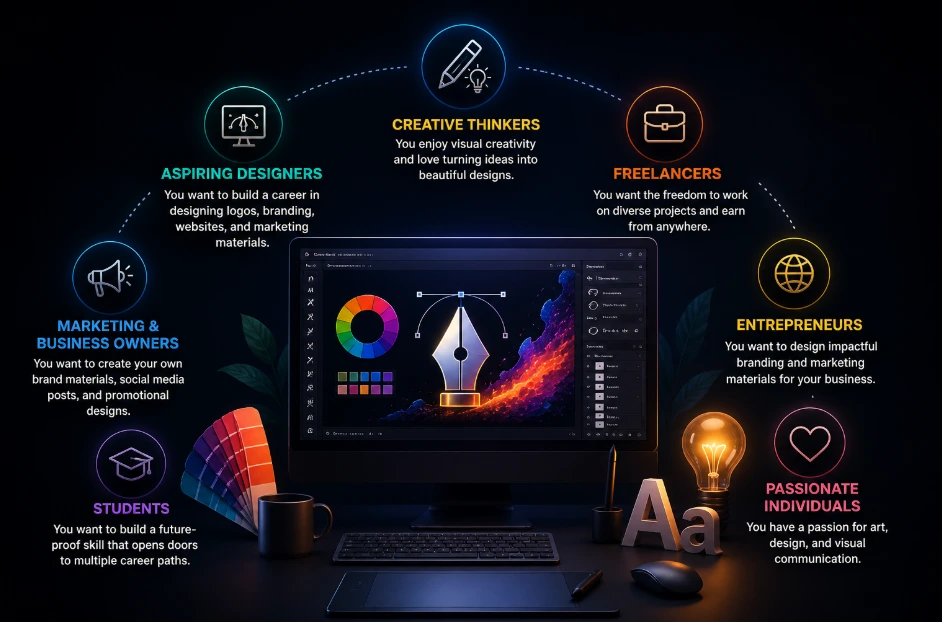
You enjoy the challenge of communicating a complex idea through a single powerful image. You prefer working on multiple projects simultaneously rather than being deeply immersed in one thing for a long time. You like the idea of building visual identities for businesses — creating the colors, fonts, logo, and design language that define how a company presents itself to the world.
Graphic design is also the smarter choice if your long-term goal is to move into UI/UX design — which is currently one of the highest-paying creative careers globally. The transition from graphic design to UI/UX is natural and well-documented. Many of India’s best-paid UX designers started as graphic designers and gradually shifted toward product design.
If you are drawn to precision, systems thinking, and the satisfaction of creating something that is both beautiful and strategically effective — graphic design is your field.
Who Should Choose Video Editing?
Video editing is probably your path if these things describe you:
You watch films and instinctively notice how scenes are cut — you feel the pacing, you notice when a transition doesn’t land, and you get genuinely excited when a sequence of shots creates an emotional impact. You enjoy the process of building something slowly and seeing it come together over time. You are drawn to storytelling — not just how things look, but how they make people feel. You want to work in the content creation economy, in film or OTT production, in advertising, or in the rapidly growing world of branded video content.
Video editing is particularly strong for anyone who wants to tap into India’s exploding YouTube and Instagram content creator market. Thousands of Indian creators are looking for skilled editors who can handle their content consistently and creatively. This is one of the fastest-growing freelance segments in the country right now, and quality editors who can work reliably are genuinely hard to find.
If you get a rush from watching a rough collection of clips transform into something that actually moves people — video editing is your field.
Graphic Design and Video Editing Jobs — What the Market Looks Like in 2026
Understanding the job market is critical before investing months of your life into learning a skill. Here’s an honest look at both fields.
Graphic Design Job Market: The overall job growth projection for graphic designers is approximately 3% over the next decade — modest but stable. However, this headline number obscures a massive divergence within the field. Traditional print design roles — newspaper layout, magazine design, physical advertising — are declining sharply. Digital-first roles — UI/UX design, motion graphics, digital marketing design, product design — are growing at 35 to 40% over the same period. The message is clear: graphic designers who specialize in digital and interactive work are in high demand. Those who stay in print-only work face increasing challenges.
Video Editing Job Market: Video editing is projected to grow at approximately 7% over the next decade — more than double the rate of graphic design at the overall level. This reflects the fundamental shift in how the world consumes content. Video has become the dominant format across every platform and industry. The emergence of OTT platforms, the explosion of short-form video content, the growth of e-learning and corporate video, and the increasing use of video in digital marketing have all contributed to a strong and growing job market for skilled video editors.
Freelance and Gig Economy: Both fields have strong freelancing markets. Platforms like Fiverr, Upwork, Toptal, and 99designs serve graphic designers. Video editors find clients through the same platforms as well as through direct outreach to content creators, agencies, and production houses. In India specifically, the creator economy has made video editing one of the most in-demand freelance skills — the supply of truly skilled editors has not kept pace with the explosion of demand.
Can You Learn Both Graphic Design and Video Editing?
The short answer is yes — and in 2026, doing so is one of the smartest career moves a creative professional can make.
These two skills are not competitors. They are complements. And the market in 2026 is actively rewarding people who can work across both disciplines.
Think about what a combined skill set looks like in practice. A video editor who understands graphic design creates better motion graphics, more visually polished thumbnails, and more cohesive brand-consistent content. A graphic designer who knows video editing can offer animated logos, social media reels, brand intro sequences, and promotional videos — dramatically increasing their value to clients and their earning potential as a freelancer.
Content creators, marketing agencies, and brands increasingly want creative professionals who can handle the full visual workflow without requiring multiple specialists. They want someone who can design the thumbnail and edit the video. Someone who can create the brand assets and animate them. Someone who speaks both languages fluently.
The key is to avoid trying to learn both simultaneously from scratch — that is a recipe for overwhelm and slow progress in both. Instead, build genuine competence in one field first, reach a level where you can earn from it, and then expand into the second skill as a natural extension of your existing work. The overlap between the two fields means the second skill will come faster than the first.
Read Also:- Top 10 Must-Use Canva Apps Features in 2025 Complete …
How AI is Changing Graphic Design and Video Editing in 2026
Artificial intelligence has changed both fields significantly — and understanding those changes is essential for anyone making a career decision right now.
AI’s Impact on Graphic Design:
AI tools — Adobe Firefly, Midjourney, Stable Diffusion, Canva’s AI features — can now generate logos, social media graphics, illustrations, and even basic brand identities in seconds. This has genuinely disrupted the low end of the graphic design market. Clients who previously paid ₹5,000 for a basic social media graphic can now get something usable from Canva AI for free. This is a real challenge for designers who positioned themselves around producing standard, template-like work.
But AI has simultaneously created new opportunities for designers who think at a higher level. The ability to use AI tools strategically — to generate rapid concept variations, create mood boards, produce initial drafts that can be refined — has made skilled designers dramatically more productive. The demand for designers who can direct AI, refine its output, and apply genuine creative judgment to what the AI produces is growing, not shrinking.
The bottom line for graphic design: AI is replacing the mechanical, low-creativity parts of the job. It is not replacing strategic brand thinking, conceptual design, or the ability to solve complex communication problems visually. Designers who move up the value chain — toward branding strategy, UI/UX, and creative direction — are more valuable than ever.
AI’s Impact on Video Editing:
AI video tools — Runway ML, Adobe’s Sensei AI, Descript, CapCut’s AI features — can now auto-cut footage, generate subtitles, remove backgrounds, create AI voiceovers, and even generate short video clips from text prompts. The mechanical, repetitive parts of video editing — syncing audio, removing filler words from talking-head videos, basic color matching — can now be done by AI in minutes.
This has reduced the barrier to entry for basic video editing and cut the earning potential for editors who only do simple cuts. But it has increased demand for editors who can do what AI cannot: make complex emotional storytelling decisions, develop sophisticated color grades that create genuine cinematic moods, design custom motion graphics, and produce the kind of high-quality content that brands need for OTT, advertising, and premium digital platforms.
The takeaway for both fields: AI is a tool, not a replacement. The creative professionals who will thrive in 2026 and beyond are those who use AI to work faster and more efficiently, while bringing genuine creative thinking and strategic judgment that AI cannot replicate.
Free and Paid Courses to Learn Graphic Design and Video Editing in 2026
If you’ve made your decision, here’s where to actually start learning.
For Graphic Design:
Free resources — YouTube channels like Satori Graphics, The Futur, and Flux Academy offer excellent foundational content. Adobe’s own free tutorials on their website are surprisingly thorough. Canva Design School is useful for absolute beginners.
Paid courses — Coursera’s Google UX Design Certificate is excellent for those interested in UI/UX. Skillshare has strong courses on typography, brand identity, and Illustrator. Adobe’s own learning platform offers structured courses on all their tools.
For those in India — platforms like Udemy regularly offer comprehensive graphic design courses for under ₹500. NIFD, Arch Academy, and Arena Animation offer offline diploma courses for those who prefer classroom learning.
For Video Editing:
Free resources — YouTube channels like Justin Odisho, Premiere Gal, and Casey Faris offer excellent Premiere Pro and After Effects tutorials. DaVinci Resolve’s official YouTube channel has a complete free course for beginners.
Paid courses — Udemy’s complete video editing courses are comprehensive and affordable. MasterClass has courses from professional film editors that are excellent for understanding the craft beyond just the software.
For those in India — Frameboxx, Maya Academy of Advanced Cinematics (MAAC), and Whistling Woods offer professional video editing programs with industry connections.
Which is Right for You? — The Final Decision Guide
After covering salary, learning curves, job markets, AI impact, and everything in between, here is a clear framework to make your final decision.
Choose Graphic Design if: You enjoy visual aesthetics and are drawn to color, typography, and layout. You want the option to transition into UI/UX design, which is one of the highest-paying creative careers globally. You prefer working on multiple projects simultaneously. You like the idea of building brand identities and visual systems. You want a skill that applies across both digital and physical media.
Choose Video Editing if: You are drawn to storytelling and emotional impact. You want to tap into the rapidly growing content creation, OTT, and branded video market. You enjoy the immersive experience of working deeply on a single project. You want slightly higher average starting salaries and strong freelancing demand in India’s creator economy. You are excited about the future of film, digital content, and video-first marketing.
Choose Both if: You are serious about building a long-term creative career and want to maximize your earning potential, client value, and career flexibility. Start with one, build real competence, start earning, then add the other.
The only wrong decision is paralysis — spending months researching instead of learning. Both graphic design and video editing are exceptional skills with strong futures. Both will make you more valuable in the job market. Both can build you a genuinely rewarding career.
Pick the one that excites you most. Start learning today. Build your portfolio with real projects as quickly as possible. And remember — in a world where AI is handling the basic work, the creative professionals who invest in genuine skill development are the ones who will always be in demand.
Frequently Asked Questions
Q: Which has a better future — graphic design or video editing? Both fields have strong futures in 2026. Video editing is projected to grow faster overall (7% vs 3% for graphic design). However, within graphic design, digital-first specializations like UI/UX and motion graphics are growing at 35–40%. Both fields are being transformed by AI — but neither is being replaced by it.
Q: Can a graphic designer do video editing? Yes — and this combination is increasingly valuable. Graphic designers already understand color theory, composition, typography, and visual hierarchy, all of which directly apply to video editing. Learning the technical workflow of video editing software is the main additional step.
Q: Which is better for freelancing — graphic design or video editing? Both have strong freelancing markets. Video editing has strong freelancing demand in India specifically, driven by the creator economy. Graphic design has strong international freelancing potential on platforms like Fiverr and Upwork. Your earning potential in either field as a freelancer depends more on your niche, portfolio, and client relationships than on which skill you chose.
Q: Is video editing harder than graphic design? Video editing has a steeper initial learning curve. Graphic design is easier to start but harder to master at a high level in the age of AI. Both fields require years of practice and real-world project experience to reach a genuinely professional level.
Q: What software should I learn for graphic design in 2026? Start with Adobe Photoshop and Illustrator for the fundamentals. Add Figma if you’re interested in UI/UX. Learn Adobe After Effects if you want to add motion graphics to your skill set.
Q: What software should I learn for video editing in 2026? Start with either Adobe Premiere Pro (industry standard) or DaVinci Resolve (free and increasingly industry-standard for color grading). Add Adobe After Effects for motion graphics once you have the editing basics down.
Final Thoughts
The debate between graphic design and video editing ultimately comes down to one question: what kind of creative work genuinely excites you?
Both fields are in demand. Both pay well for skilled practitioners. Both are being transformed by AI in ways that reward creative thinking over mechanical execution. And both can build you a career that is creatively fulfilling and financially rewarding.
The person who picks graphic design and commits fully to it will build a better career than the person who picks video editing but keeps second-guessing themselves. Commitment to learning, building real projects, and developing genuine expertise is the only thing that actually predicts success in either field.
So make your choice. Start today. And go deeper than everyone else.
Found this article helpful? Share it with someone who’s been going back and forth on this decision. And if you’ve already chosen your path — drop a comment and tell us which one you picked, what made you decide, and how it’s going. We read every comment.